CBD Cut Cue-Triggered Heroin Craving in a Controlled Trial, and Later Studies Still Refuse to Call It a Cure

The sentence that cannabis cures opioid addiction was always a headline in search of a mechanism. What researchers have measured is narrower. Cannabidiol can blunt the craving and anxiety that heroin cues set off in people who are already abstinent. It has not, in the controlled work published since, shown a clear advantage over placebo when it is added to buprenorphine. The overdose crisis has been moving for other reasons. Provisional figures from the CDC’s National Center for Health Statistics, released May 13, 2026, put drug overdose deaths at an estimated 69,973 in 2025, down almost 14 percent from 81,313 in 2024, a third straight yearly drop. Deaths involving opioids fell from an estimated 55,296 to 44,564. That is not a cannabis result. It is the background the cannabis claim has to survive.
The claim got its political scar in 2016. While Congress wrote the Comprehensive Addiction and Recovery Act, proposals to study medical cannabis were dropped before the bill became law. Other evidence was already awkward for a prohibition line. The National Academies of Sciences, Engineering, and Medicine, in the January 2017 report The Health Effects of Cannabis and Cannabinoids, found substantial evidence that cannabis is an effective treatment for chronic pain in adults, the condition that still feeds a large share of long-term opioid prescribing. Pain relief that lets someone take fewer opioids is a substitution story. Craving, withdrawal, and relapse are a different experiment.
What the Mount Sinai trial actually measured
The experiment that changed the tone of the debate came out of the lab of Yasmin Hurd, director of the Addiction Institute at the Icahn School of Medicine at Mount Sinai. Animal work had already suggested that CBD reduced heroin-seeking. Hurd’s group then ran a double-blind, placebo-controlled trial in people with heroin use disorder who were abstinent, most of them for less than a month. The paper, “Cannabidiol for the Reduction of Cue-Induced Craving and Anxiety in Drug-Abstinent Individuals With Heroin Use Disorder,” appeared in the American Journal of Psychiatry in 2019.
Forty-two people were randomized: 14 received 400 milligrams of CBD, 13 received 800 milligrams, and 15 received placebo, once a day for three days. The CBD was Epidiolex, the purified formulation the FDA had approved for certain seizure disorders. Participants watched neutral videos and videos built from drug cues. Compared with placebo, both CBD doses cut cue-induced craving and cue-induced anxiety. Heart rate and salivary cortisol, the physiological half of that stress response, came down as well. The effect was still measurable seven days after the last dose. Cognition tests did not move in a meaningful way. There were no serious adverse effects. CBD did not intoxicate anyone. Hurd’s group did not call it a cure. They called it a reason to run the next trial.
That precision matters because CBD is easy to oversell. It does not intoxicate, it can be taken from hemp, and after the FDA’s 2018 approval of Epidiolex it had a legal identity that whole-plant cannabis did not. The trial’s design is the antidote. Three days of dosing, a cue test, a one-week follow-up, a small sample, and people who were not being stabilized on methadone or buprenorphine in that study. The result is real. The FDA has not approved CBD for opioid use disorder.
The studies that came after the headline
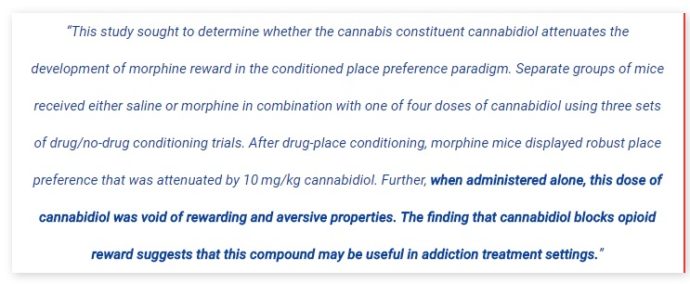
Hurd kept going, with NIH HEAL money behind a harder question: does CBD help people who are already on medication for opioid use disorder, the treatment that actually cuts death. One completed Phase 2 trial, NCT06206291, randomized people maintained on methadone or buprenorphine to 200 milligrams of CBD, 400 milligrams, or placebo, twice a day. The primary readout was cue-induced craving and anxiety at four weeks, plus the share of participants with a urine test positive for illicit opioids. The record lists a target of 76 participants and shows the trial completed, with an update dated June 18, 2026. Results have not been posted on that public record. Until they are, the four-week adjunct study is a finished experiment the rest of us have not been allowed to read.
A different trial has been read, and it is the one that should slow the victory lap. A pilot randomized study of adjunctive CBD during inpatient buprenorphine treatment, published in late December 2025 and indexed as PubMed 41467610, enrolled adults who met criteria for opioid use disorder between May 2022 and March 2024. Of 35 people enrolled, 30 received at least one dose, 18 on CBD and 12 on placebo. CBD was tolerated. Nobody died. Nobody had a serious adverse event. The common complaints were gastrointestinal, in both groups. Blood levels did not show a meaningful pharmacokinetic clash between CBD and buprenorphine, which matters because a drug that interferes with buprenorphine would be disqualified on safety before efficacy ever came up. Craving and negative mood fell in both arms. The group-by-time pattern mostly favored placebo. Cue-induced craving leaned the other way, toward CBD, without becoming a clear win. The authors’ conclusion was the sentence the marketing never prints: safe to combine, no demonstrated advantage, larger trials required.
Two more Mount Sinai efforts show how unfinished the program is. NCT04567784, an imaging study of CBD versus placebo in people on methadone, completed June 18, 2025. It planned about 200 participants and enrolled 66. No publications were attached to the record. The longer bet is NCT06940674, the Adjunctive Cannabidiol for Recovery From Opioid Study, sponsored by Mount Sinai with Hurd as the responsible investigator and backed by NIH grant UH3DA050323. People on methadone or buprenorphine are randomized to 200 milligrams of CBD, 400 milligrams, or placebo, twice daily for 24 weeks. The primary outcome is the share whose urine toxicology stays negative for illicit opioids. Dosing began June 13, 2025. Primary completion is estimated for July 15, 2027. A 2025 systematic review put the human evidence in one place: craving and abstinence-related anxiety can move, short trials look tolerable, and none of it is a stand-alone treatment.
Why the state-by-state overdose charts misled people
Population studies made the cure story sound statistical. A 2014 analysis led by Marcus Bachhuber, in JAMA Internal Medicine, found that from 1999 through 2010, states with medical cannabis laws had lower opioid-analgesic overdose mortality, on the order of a 25 percent difference. Chelsea Shover and colleagues extended that method through 2017 and published the reversal in PNAS in 2019. The association flipped, to roughly a 23 percent increase in overdose deaths in medical-cannabis states, and it stayed positive after they accounted for recreational laws. Their conclusion is the one worth keeping: it is unlikely that medical cannabis, used by a small share of the population, produced large effects in opposite directions depending on the years an analyst chose. Legalization changes pain practice and the drug supply. It does not hand a state a lower death rate on a timer.
The legal status of the plant shifted under the research anyway. On April 23, 2026, the Justice Department announced that FDA-approved marijuana products, and marijuana covered by a qualifying state medical license, were being placed in Schedule III. The order, from Acting Attorney General Todd Blanche and effective April 28 as AG Order 6754-2026, did not reschedule the rest. Adult-use product stayed in Schedule I. A separate DEA hearing on that broader move ran across June and July 2026. By late September the administrative law judge’s recommendation was still unposted. FDA testimony supported a currently accepted medical use for pain, certain forms of anorexia, and nausea from chemotherapy. Opioid use disorder was not on that list. Schedule III for state medical programs lowers a barrier for researchers. It does not create an indication.
A person swapping an unmeasured edible for a prescribed opioid is not enrolled in NCT06940674. At the level of a cue in a lab, CBD has looked like it can turn down craving and anxiety, including for a week after a very short course. Added to buprenorphine, the first published randomized pilot did not beat placebo. At the level of state death rates, the famous protective effect did not survive a longer timeline. The 24-week urine-toxicology trial is the study that could move any of those sentences. It will not finish on the schedule of a headline.
The government’s own patent on cannabinoids, filed while the plant sat in Schedule I, is documented in our reporting on U.S. Patent 6,630,507. The industrial crop that got pulled into the same argument is covered in nine uses for hemp, and the degree built to train the chemists is at Northern Michigan University. Related files include Ohio’s adult-use market and the health and U.S. news desks at The AEGIS Alliance.



Got a close friend who successfully got off crack with it. Clean for a couple decades now.
Wow ! At this point it’s going to be easier to name the things cannabis can’t do , such an amazing plant 🌱