
The receipt is still the cleanest way to tell this story. Adult-use cannabis sales opened in Ohio on August 6, 2024. By August 10, the Division of Cannabis Control had counted $11,530,708 in recreational product sales, the figure the Ohio Capital Journal published from department data and the one that rounded, in every headline, to $11.5 million. In those first days retailers moved more than 173,000 products and about 1,285 pounds of flower. Combined taxes from the opening stretch topped $1.8 million. Ohioans 21 and older had voted the market into existence through Issue 2 in November 2023, with about 57 percent support, on top of a medical program that began in January 2019. The first-week number was never the peak. It was the proof that the pipes already existed.
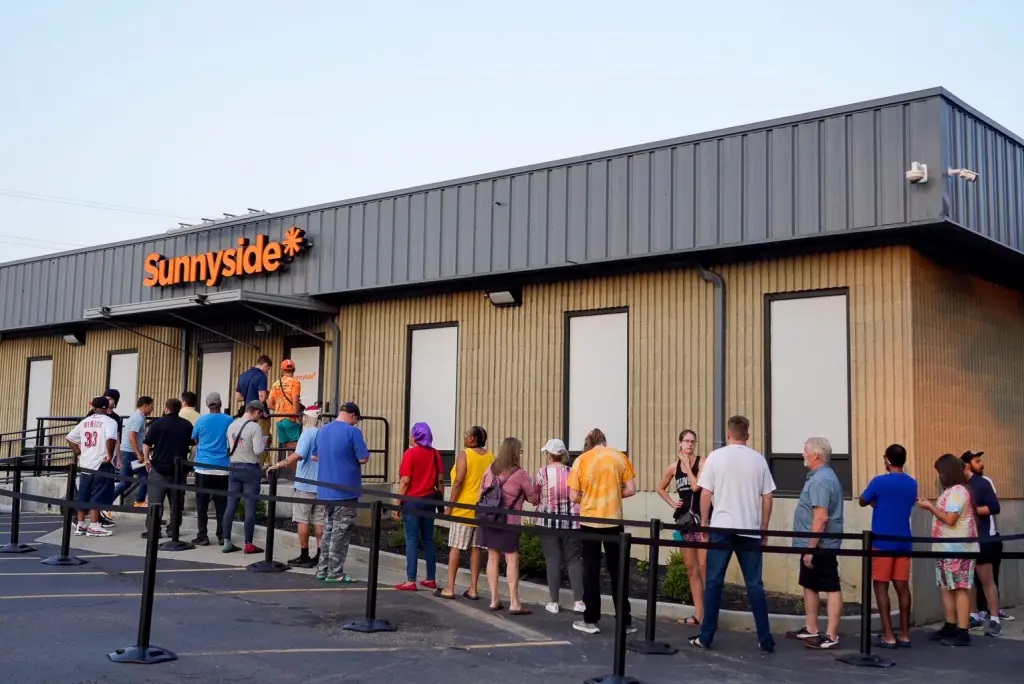
State Representative Jamie Callender bought the first legal recreational flower and called opening day “a piece of history.” Lines outside shops such as Sunnyside made the demand visible in a way a spreadsheet does not. People were not reading statute. They were waiting on a sidewalk. The AEGIS Alliance has covered the plant as more than a headline for years, from industrial hemp uses that rarely make television to a study on cannabis and opioid addiction. Ohio’s opening week was the moment a Midwest industrial state stopped treating the plant as a medical exception only.
From a five-day receipt to $1.87 billion
The curve after that week is the part opening-day coverage could not see. Recreational sales reached about $242 million by the end of 2024. The one-year mark, in August 2025, sat near $702.5 million. Calendar-year 2025, the first full year, brought in about $836 million in adult-use product. Cumulative non-medical sales stood at $1,091,250,807 on January 3, 2026, and at about $1.58 billion in the Division’s July 2026 program update, when 223 dispensaries held certificates of operation. The September 17, 2026 reading, drawn from Division figures through September 5, put non-medical sales at $1,868,032,447 and medical sales at $2,421,461,131. Together, legal cannabis product sales in Ohio had reached $4,289,495,488. An analysis of those running totals put 2026 year-to-date, through September 5, near $914 million, with adult-use accounting for roughly $785 million of that slice and about 86 percent of the year’s combined market.
Volume, not panic pricing, is what those billions are made of. Through early September 2026 the programs together had logged nearly 50 million transactions, more than 661,000 pounds of plant material, and about 71.5 million units of manufactured product. The state listed 228 dual-use dispensaries with certificates of operation, 50 more with provisional licenses, 39 operating cultivators, 46 processors, and seven testing labs. Flower that had averaged about $9.40 a gram just after recreational sales began was down near $6.54 a gram in the week of June 7 through June 13, 2026, about a 30 percent drop, with manufactured products averaging $24.64 that same week. Prices then ticked up in the summer of 2026, the first sustained monthly increases since the doors opened. That is a mature-market wobble. Cultivators overbuilt, stores discounted, and shoppers stopped paying novelty prices. The $11.5 million week was scarcity plus a line. The billion-dollar years are repetition.

Voters funded a program. Lawmakers funded a general fund.
Issue 2 sketched social equity and addiction treatment as the moral purpose of the tax. The General Assembly wrote a cash-management story instead. Host cities waited more than a year for their share of the 10 percent adult-use excise tax because lawmakers had not approved a way to send the checks. In early January 2026 the Department of Taxation began releasing the backlog. Columbus alone received about $4.2 million covering late 2024 through 2025. Communities that host dispensaries have since taken in more than $55 million. In June 2025 legislators directed 36 percent of adult-use excise revenue to those host municipalities and the other 64 percent to the state general fund, rather than to the social-equity and addiction programs the ballot language had described. More than 130 Ohio cities and townships still ban adult-use shops. Local control survived. The original spending map did not.
That split is the political core of the Ohio file. Voters legalized a plant. The legislature legalized a revenue stream and then argued about who keeps it. Towns that hosted stores wanted the checks. Towns that banned stores wanted none of the traffic and none of the blame. Columbus wanted the general fund. Senate Bill 56, which Governor Mike DeWine signed on December 19, 2025, and which took effect on March 20, 2026, finished the rewrite. The law folds adult-use cannabis into the same Revised Code chapter as the medical program, under the Division of Cannabis Control. It makes marijuana bought in another state illegal to bring into Ohio. It caps THC at 35 percent in adult-use flower and 70 percent in extracts. It bans intoxicating hemp products outside licensed dispensaries. It caps the statewide store count at 400. A conference draft had opened a temporary lane for THC beverages. DeWine line-item vetoed that piece, keeping drinkable cannabinoids inside the dispensary regime. A referendum drive by Ohioans for Cannabis Choice tried to put the bill before voters in November 2026 and failed to qualify. The cap, the hemp ban, and the out-of-state rule therefore stand.
Home-grow limits from Issue 2 remain on paper: six plants per adult, twelve per household. Possession limits remain 2.5 ounces of plant material and 15 grams of extract. What changed is provenance. Cannabis that did not come from an Ohio dispensary or a lawful Ohio grow is contraband, even if it was legal in Michigan that morning. The store cap of 400 has not bitten yet — 228 operating dual-use shops is well under the ceiling — but it is the number cultivators now plan against. Patients who already held medical cards shop next to adults who never applied for one. Adult-use, which did not exist before August 2024, had grown by September 2026 to about 44 percent of all marijuana sales recorded in Ohio since the medical market launched in 2019.
A federal court put the hemp fight back in the license office
The hemp ban did not go quietly. Hemp-drink and hemp-product companies sued, arguing Senate Bill 56’s new definition — hemp may not carry an intoxicating THC above the federal 0.3 percent line — shut a lawful interstate business. A federal judge in the Northern District of Ohio issued temporary relief in the summer of 2026. On September 25, 2026, the U.S. Court of Appeals for the Sixth Circuit limited that relief. Bloomberg Law reported that companies behind hemp-derived drinks and similar products can no longer sell in Ohio without a license from the state’s marijuana authorities. The same order said the state’s geographic limits on who may sell intoxicating hemp run into the dormant commerce clause, which bars a state from preferring in-state sellers over out-of-state ones. The state, the court said, cannot deny approvals based on geography. Licensing itself was put back in force. A gas-station soda with hemp THC is, again, a regulated marijuana product unless a licensed channel sells it.
Shoppers on opening week were not reading the Sixth Circuit. They were standing in a line that produced an $11.5 million receipt. Everything after that receipt — the billion-dollar years, the delayed city checks, the THC caps, the failed referendum, the hemp licensing fight — is the state deciding what kind of market those lines were allowed to become. The AEGIS Alliance will keep the receipt and the statute in the same file. One without the other is a press release. For the policy fights around the plant, see The AEGIS Alliance U.S. news and health coverage, and the older record of how a public university treated cannabis as a course of study long before Ohio put it on a ballot. Two years after Sunnyside opened its doors, Ohio has a legal market past $1.8 billion in adult-use receipts, a tax formula that feeds cities and the general fund, a store cap that will eventually bind, and a federal appeals court that sent intoxicating hemp back to the license window. The five-day figure still works because it was the first honest count. Columbus has been editing the ending ever since.