FBI Closed the Project Chanology File After Scientology Called Anonymous Terrorists Over Guy Fawkes Faxes and Starch Letters


Thanks to journalist Emma Best (@NatSecGeek), a trove of FBI documents tied to the Church of Scientology’s complaints about Anonymous’ Project Chanology has been released to the public. Tony Ortega reported:
“We have two FBI files for you to pore through now, at 268 and 180 pages they’re additional releases that we’re getting thanks to journalist Emma Best, who is suing the FBI over a number of document requests she has made.”
Best is one of the most prolific FOIA requesters in the country — the FBI has described them as sitting at or near the top of its list of “vexsome” requesters, even weighing prosecution over their use of public-records law — and in 2017 Best also helped put the CIA’s roughly 13-million-page CREST archive of declassified documents online. The Scientology files came out of a FOIA lawsuit Best filed against the bureau that same year.
To understand why the FBI had a file at all, it helps to revisit how Project Chanology began. On January 14, 2008, a Church of Scientology promotional video featuring an intensely earnest Tom Cruise was posted to YouTube and quickly went viral. The church moved to scrub it from the internet, issuing a copyright claim against YouTube on January 16, and the clip was pulled — but the site Gawker refused to take its copy down, with editor Nick Denton calling it newsworthy. That attempt at suppression is exactly what drew the attention of Anonymous, who framed it as internet censorship. Ortega has laid out the backstory of the incident here.
On January 21, 2008, Anonymous launched the campaign publicly with a now-iconic YouTube video, “Message to Scientology” — a two-minute production of time-lapsed clouds and robotic text-to-speech narration that branded the church a “dangerously insane cult” and ended with the words that became the movement’s signature: “We are Anonymous. We are Legion. We do not forgive. We do not forget. Expect us.” Created by activist Gregg Housh, the clip racked up hundreds of thousands of views within days and helped make the video manifesto a permanent fixture of Anonymous communications. A second video, “Call to Action,” followed on January 27, calling for protests outside Scientology centers, and on February 10, 2008, an estimated 6,000 to 8,300 masked demonstrators turned out in cities across the U.S. and Europe — the moment Project Chanology pushed Anonymous out of imageboard culture and into real-world activism, and cemented the Guy Fawkes mask from V for Vendetta as the collective’s public face.
Although the church initially dismissed Anonymous as a “pathetic” collection of “computer geeks,” it complained to the FBI that it was under attack by a “terrorist” organization. That framing was tied in part to a series of letters containing a mysterious white powder that were mailed to church facilities. The powder turned out to be harmless starch, and Anonymous denied sending the letters.
The newly released documents show the FBI took the church’s complaints seriously. The bureau opened its investigation in San Diego, where church offices had been receiving harassing emails, phone calls, and faxes.
“The San Diego church offices have also received black facsimiles. The church has received 20 to 30 of these facsimiles. They incorporated photos of Guy Fawkes (17th-century Englishman notorious for plotting to blow up Parliament as part of an extremist Catholic campaign against Protestant rule), numerous cartoons, etc., all of which had the effect of consuming a substantial quantity of ink.”
What would America do without the FBI here to guard against domestic threats — and protect our ink supplies?
Ortega’s report walks through additional incidents the bureau looked into, all of which led to dead ends. Taken together, the files offer a fascinating — and frequently comical — glimpse into how the FBI approached the Anonymous movement in its early days, and into the Church of Scientology’s “inner snowflake.”
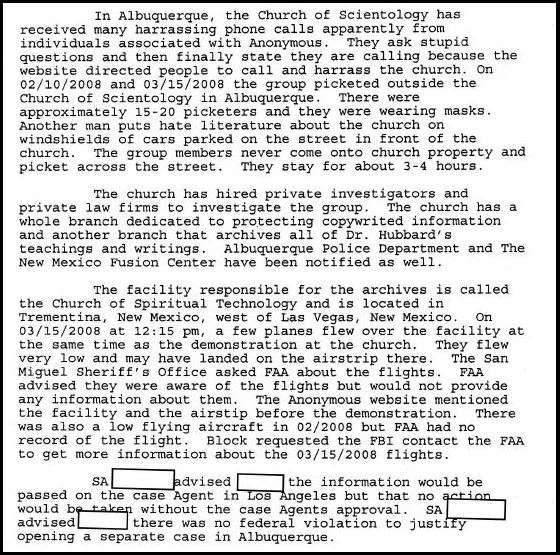
The bureau poured considerable time, funding, and energy into investigating Anonymous, even as it struggled to get the church to produce any witnesses to interview. In the end, the case fizzled:
“After approximately two years, no investigative leads of worth have been developed. Based upon the age of the case, lack of an articulated threat, and the lack of any additional investigative leads, writer requests that this matter be closed.”
That quiet closure is its own kind of footnote to history. Project Chanology eventually wound down by around 2010, but it had already done something lasting — it transformed Anonymous from a loose troll collective into a recognizable force in digital activism, and the tactics, imagery, and “Expect us” ethos forged in the fight with Scientology would echo through nearly every Anonymous operation that followed.
For more, see Ortega’s full report, which presents the documents in an easy-to-read format with sources.
Emma Best kept filing. The same FOIA practice that produced these Scientology files later helped force other U.S. intelligence dumps into public view, and the Church of Scientology never did get the “terrorist” case it wanted. The files remain the best official snapshot of how the bureau treated a Guy Fawkes fax campaign as a two-year investigation and then quietly closed it.
Related from The AEGIS Alliance: Attempting to Clear up Misconceptions about Anonymous, Anonymous Official Exposed, and Anonymous News.
A Street in Clearwater, and a File Germany Finally Closed
The bureau’s closing memo is still the cleanest official description of Project Chanology: two years, no witness the church would produce, no articulated threat, case closed. That paperwork has a cousin. In 2026 Germany’s federal Office for the Protection of the Constitution ended a surveillance practice aimed at Scientology that had run for nearly thirty years. Human Rights Without Frontiers, drawing on Bitter Winter, reported in May that the Bundesamt für Verfassungsschutz quietly dropped the monitoring so agents could spend time on violent extremism, Russian espionage, cyberattacks, and terrorism. Several states, including Baden-Württemberg, Lower Saxony, and North Rhine-Westphalia, had already stepped back. On June 22, 2026, the Church of Scientology International issued its own statement calling the end of the program proof that no extremist network had been found. Those are not the same claim. One is a church declaring vindication. The other is an intelligence office admitting, without a parade, that the file had outlived the threat it was written to catch. The San Diego faxes that ate the toner fit the second reading.
Emma Best did not stop at the 2017 lawsuit. On May 14, 2019, Best filed a separate MuckRock request for FBI records mentioning Project Chanology, including the January 21, 2008 video, the early denial-of-service actions, the black faxes, and the later push to have the Internal Revenue Service examine the church’s tax exemption. That request has sat on the public docket as awaiting a response. The 268-page and 180-page releases Ortega published remain the readable core of what the bureau put on paper about a Guy Fawkes mask and a starch letter.
The original “Message to Scientology” is still on YouTube. A copy on the Church0fScientology channel, posted the day the campaign went public, has drawn on the order of 5.5 million views. What changed is the church’s footprint, not the slogan. Tony Ortega reported on September 22, 2026, that Clearwater’s city council had voted 3-2 in June to vacate South Garden Avenue. Scientology’s plan folds that short downtown street into a 3,100-seat L. Ron Hubbard Hall and an L. Ron Hubbard Park beside the Flag Land Base, the Fort Harrison Hotel, and the Flag Building. A petition effort, Save the Garden, was having signatures examined when he published. The FBI never got its San Diego witnesses. A city council handed over a street anyway.
Ortega’s docket, published with that Clearwater story, still carries the criminal case that grew up after Chanology’s street phase. Actor Danny Masterson was sentenced on September 7, 2023, to 30 years to life after a Los Angeles jury convicted him of raping two women. As of September 22, 2026, Ortega wrote that the appeal was fully briefed. Separate civil fights, including labor-trafficking claims and suits naming the church beside Masterson, were still caught in religious-arbitration arguments. None of that is in the 2008 FBI file. The file is about ink, starch, and a movement the church wanted labeled terrorist.
The Guy Fawkes mask stuck. A high-school assignment built around V for Vendetta could still blow up years later, which is why The AEGIS Alliance’s account of the Muncie Central walkout belongs in this file, as does the later campaign against neo-Nazi websites. Both used the posture Chanology taught: no headquarters, a video instead of a press office, and a target picked for what it tried to hide. Germany’s intelligence service and the FBI both eventually wrote, in their own language, that the dramatic threat file was not the one worth staffing. Clearwater’s street vote is the reminder that a closed investigation is not a smaller church. More of that record is in Anonymous and The AEGIS Alliance News.




I would like to help people with TRUE FACTS.