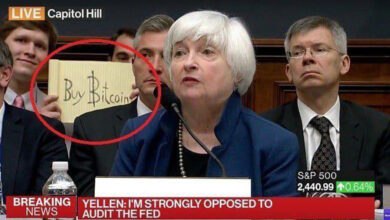


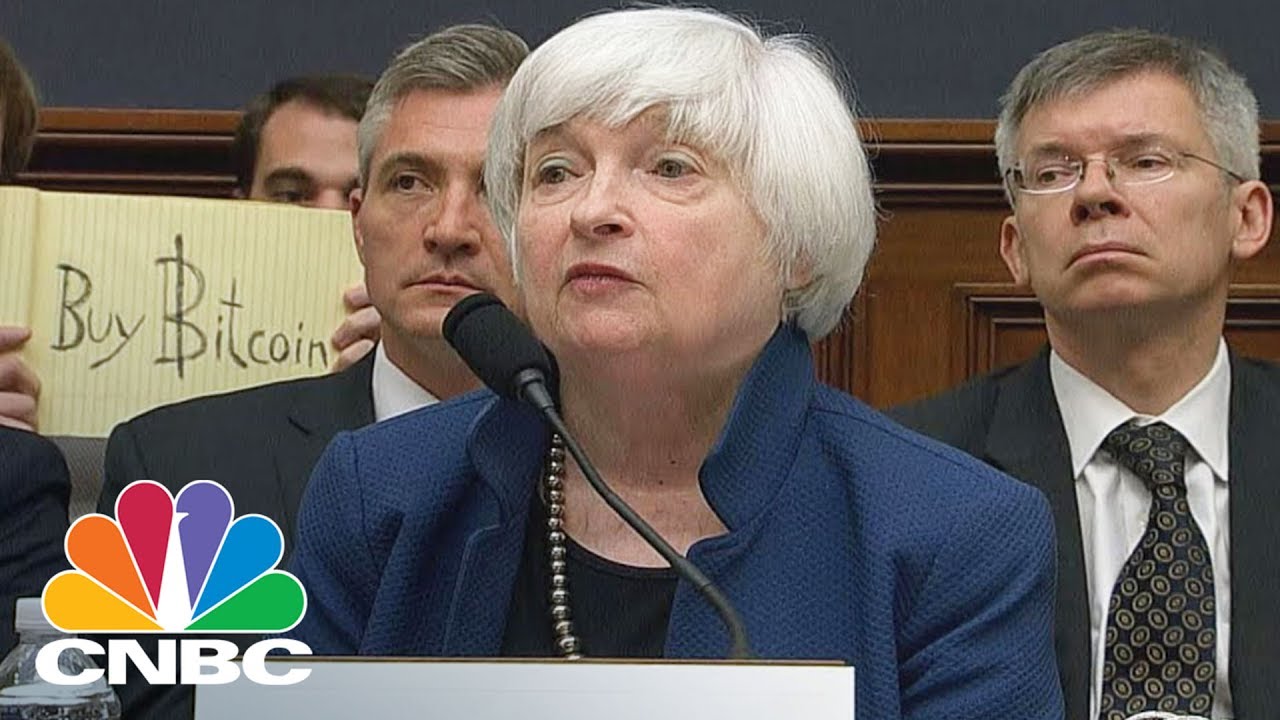
Washington, D.C. On July 12, 2017, Janet Yellen sat before the House Financial Services Committee for the Federal Reserve chair’s regular monetary-policy testimony. The cameras were there for interest rates. For a few seconds they caught something else. A young man in a seersucker suit lifted a yellow legal pad on which he had written two words: Buy Bitcoin. Security walked him out for breaking committee rules. CNBC’s lead that afternoon was almost embarrassed by how small the stunt looked: “An unidentified man held up a sign saying ‘buy bitcoin’ during Fed Chair Janet Yellen’s testimony Wednesday before the House Financial Services Committee.”
The man was Christian Langalis. He was 22 and interning at the Cato Institute. He has said since that he did not expect the room to care. His phone was dead before the hearing started, so he planned to pull a screenshot later as a private joke. He learned it had gone everywhere only after he was already outside. In later retellings he described the motive as fatigue with what he called Fed worship, a cypherpunk objection to money issued by a state. The pad went into a sock drawer. Bitcoin, that afternoon, did not.
The Price That Afternoon, and the Forecasts That Were Supposed to Sound Crazy
CoinDesk clocked the coin at $2,418.46 at 2:27 p.m. Eastern, up 3.7 percent on the day. Anniversary graphics have used $2,329 as the reference print. Either figure makes the same point. A legal pad on Capitol Hill was advertising an asset that still traded like a speculative toy.
Tom Lee, then freshly out of JPMorgan Chase and building Fundstrat, had gone on CNBC five days earlier with a model that sounded like a dare. “We believe one of the drivers [of bitcoin] is crypto-currencies are cannibalizing demand for gold,” he said. “Based on this premise, we take a stab at establishing a valuation framework for Bitcoin. Based on our model, we estimate that bitcoin’s value per unit could be $20,000 to $55,000 by 2022.” The scarcity claim under the model was the one that has aged: the protocol caps supply at 21 million coins. Lee added that once the market value passed $500 billion, central banks would have a reason to buy, and that those purchases would be “a game changer, enhancing the legitimacy of the currency and likely accelerating the substitution for gold (by investors).” Sheba Jafari, Goldman’s technical strategist, was circulating a much nearer target in the same weeks, a move toward roughly $4,000. Both numbers were treated as promotional. Both were too low.

CNBC’s write-up of the hearing wondered whether Bitcoin even needed the free advertising. Lee’s gold-substitution note is still the cleanest contemporary statement of the bet. The image of Langalis himself spread from a Facebook post that, for a while, was the only public proof the man in the suit existed.
The Pad Left the Sock Drawer Worth More Than the Coin Had Been
Langalis stayed “Bitcoin Sign Guy” online for years because he did not rush to monetize the face. In April 2024 he auctioned the original legal pad. CoinDesk reported the sale through the Bitcoin marketplace Scarce City: a pseudonymous bidder paid 16 BTC, about $1.027 million at the time, and Langalis said the money would fund a software venture. Later anniversary posts have placed the gavel at PubKey in New York. The venue details differ by retelling. The price does not. A piece of yellow paper that had been contraband in a House hearing cleared seven figures in the asset it had advertised, and the 16 coins paid for it were worth more, by themselves, than a stack of the 2017 price.
That is folklore. The monetary record around it is not. Lee’s 2022 band of $20,000 to $55,000 was left behind. Bitcoin pushed through six figures and printed an all-time high near $128,000 in October 2025. Then it did what it has always done after a blow-off. By late June 2026 it was back around $58,000. Fidelity’s Jurrien Timmer has described the washout as a double bottom, with lows near $60,033 and $57,742. From those summer lows the coin rallied hard. A September 30, 2026 market note put the session settlement at $83,016, down 1.17 percent on the day, after a failed attempt to hold an eight-month high in the $86,000 to $87,000 range. From the July trough near $58,500, that was a gain of about 43 percent in a single quarter.
The buyers, this time, were not only the people who would sneak a sign into a hearing. Spot Bitcoin funds took in $2.39 billion in one week, a weekly record since October 2025, and about $3 billion across ten trading days. Cumulative net inflows since the funds launched in January 2024 were put near $57.58 billion, with BlackRock’s and Fidelity’s products doing much of the lifting. Over ten weeks, wallets labeled as whales added more than 113,000 BTC. Strategy bought another 1,665 coins for $142.7 million at an average of $85,681. In the same week investors pulled 31,782 BTC, about $2.52 billion, off exchanges, including roughly 19,500 coins off Binance. Coins leaving exchanges are coins that are harder to sell in a panic. That is a supply story, not a slogan.
The Fed He Trolled Is Still the Weather
Langalis held his pad up because he thought the central bank was the show and Bitcoin was the interruption. Nine years later the interruption still trades against the show. On September 29, 2026, CoinDesk noted Bitcoin near $83,190 after a session that had dipped toward $82,500, and it noted something rarer: the coin was holding up better than gold on a day when longer-term yields hit levels last seen in 2007 and the dollar index had climbed about 2.7 percent, from 98.78 to nearly 101.50, since September 9. Gold fell almost 4 percent. Bitcoin fell about 1 percent and bounced. Timmer wrote that a break and hold above $80,000 would confirm the double bottom and open a path toward $100,000. Veteran chartist Peter Brandt, on Cointelegraph’s Trade Secrets the same week, raised his cycle target from the $250,000-to-$300,000 band he had used in July to a peak somewhere between $300,000 and $600,000 in late 2029. “The bull market cycle this time has a very good chance of reaching half a million,” he said. He also warned of a pullback toward $65,000 or $66,000 in early October that would shake out anyone who bought the rally late.
None of those targets is a promise. Brandt has been wrong on timing before, and he said so when he retired an October 4 date for the end of the bear phase because the June low may already have been it. Lee’s 2017 model was useful and still too timid. A coin that can fall by half after making a high near $128,000 can fall by half again. Nothing in this article is investment advice. It is a record of what the cameras caught, what the forecasts said, and where the ticker sat on the last day of September 2026.
The deeper argument Langalis was making, badly and briefly, is the one Washington still refuses to put on a televised chart. The Federal Reserve creates the reserves, sets the floor under short-term rates, and then tells the public the plumbing is too technical to audit in full. The AEGIS Alliance has kept the roll call of senators who voted against auditing the Federal Reserve, and the later fight over the renovation, the empty criminal file, and the chair who arrived after that probe collapsed. A bank that can mis-key a transfer is not a side note either. Citigroup’s $81 trillion internal transfer error was reversed, and it was still a window onto how casually the wholesale system moves numbers that dwarf the entire Bitcoin stock.
Yellen’s hearing was about the price of money. A legal pad in the background said the price was optional. The coin is no longer $2,418. The pad sold for 16 of them. The institution he interrupted is still the one that decides what a dollar costs to hold overnight. Both facts can be true, which is why the clip has outlived the hearing.