

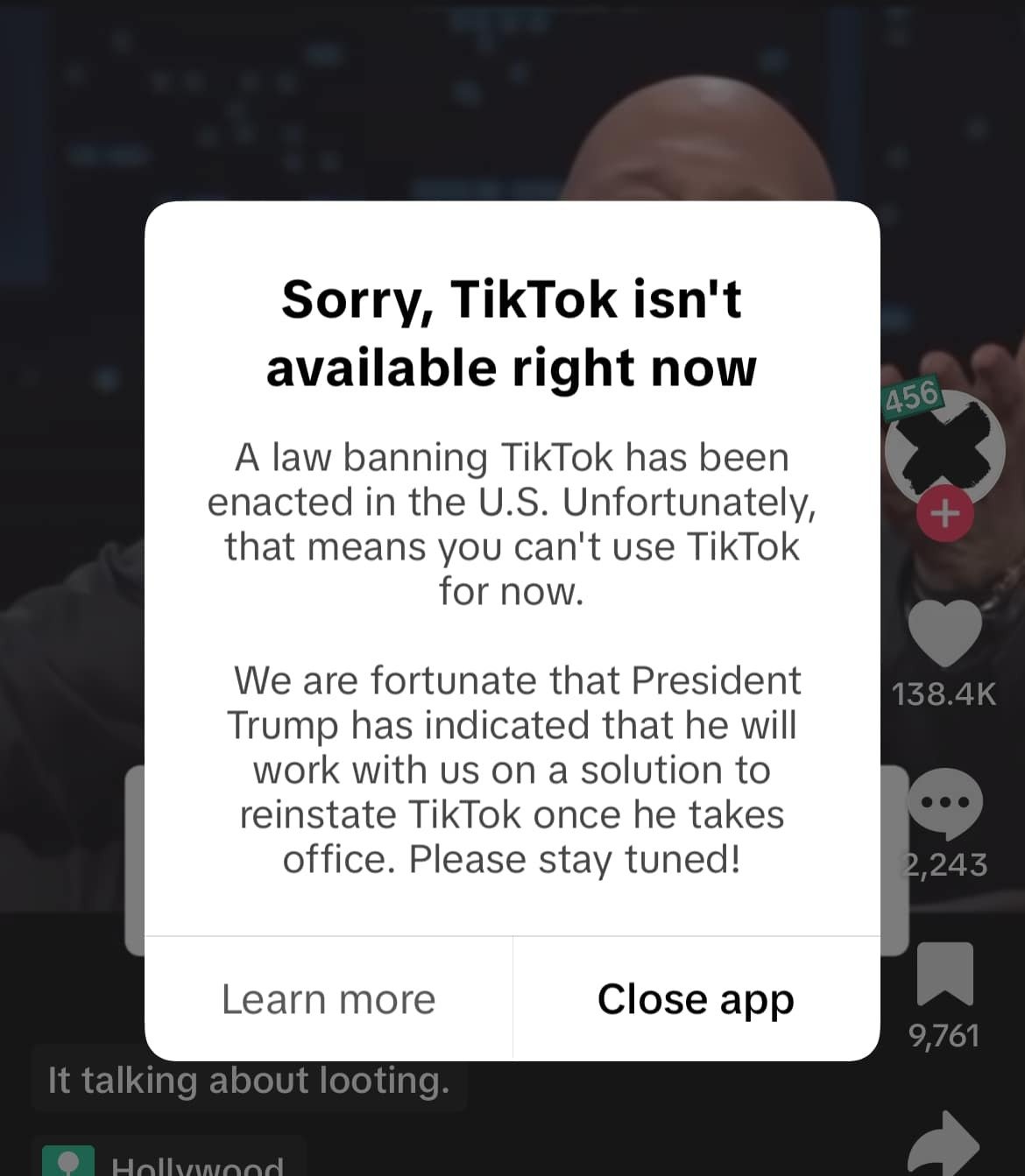
For part of a Saturday night and a Sunday morning in January 2025, the largest entertainment app in the United States was a message on a black screen. “Sorry, TikTok isn’t available right now.” A longer notice told users a law banning TikTok had been enacted, that they could not use the service for now, and that President-elect Donald Trump had indicated he would work on a solution. Please stay tuned. The outage was not a routing accident. It was the first hour in which the Protecting Americans from Foreign Adversary Controlled Applications Act became something a person could hold.
The AEGIS Alliance covered that weekend as a legal event wearing an app icon. A later joint venture rewrote the letterhead. The letterhead did not erase the demonstration. Congress had built a kill switch aimed at the companies that host and distribute a platform, and the platform’s owner chose to throw the switch early. Everything after that weekend, including the American ownership chart announced in January 2026, is a negotiation conducted in the shadow of a screen that had already gone blank.
The statute was a threat to the pipes, and the company turned off the tap
The 2024 law did not make it a crime for a teenager to open an app. It told app stores and hosting companies to stop distributing and maintaining TikTok unless ByteDance sold the U.S. operation on a deadline. The Supreme Court, on Friday, January 17, 2025, unanimously left that structure standing. The statutory deadline landed that Sunday. ByteDance did not wait for midnight. The New York Times reported that by Saturday evening users were already locked out, about ninety minutes before the law’s effective moment, after a pop-up earlier in the night warned that the end was close. Forbes put the logout near 10:30 p.m. Eastern, while people were still trying to save their own videos.
Apple removed TikTok and other ByteDance apps, including Lemon8, from its U.S. store. Google’s store did the same. CapCut, ByteDance’s editing app, went unavailable with them. A search on Apple’s store returned a line that treated the whole family of apps as absent from the country. The ban, in other words, was never only a dance-video service. It was a corporate family. Sister apps that most congressional hearings barely named went dark because they shared a parent. That is what an adversary-controlled-application statute looks like when it is written against a company rather than against a single icon.
President Joe Biden’s administration had already signaled it would not spend its last hours in office enforcing the law, and would leave the mess to the incoming White House. TikTok went dark anyway. Compliance, in that choice, was also leverage. A company that shuts itself off can say it obeyed. It can also show 170 million users, the figure everyone used that weekend, exactly who is capable of taking the For You page away. The companion account on this desk, how the service came back, follows the thank-you screen. This piece stays with the dark.
Fourteen hours is long enough to prove a point and short enough to bargain
The blackout lasted roughly twelve to fourteen hours by the counts news organizations later settled on, and about fifteen by CBS’s Sunday recap. That is not a technical failure window. It is a negotiated pause wearing the costume of a legal deadline. Creators who had built storefronts on short video lost a sales day and gained a political education. Small businesses that sell through shoppable clips learned that a statute can close a shop without a bankruptcy court. Teachers who had turned clips into classroom material learned that a lesson plan can depend on a hosting provider’s risk tolerance. Teenagers treated it like a power cut. Lawyers treated it like the first visible hour of a statute the Court had declined to block. All of them were describing the same object.
The migration that followed was frantic and mostly temporary. Some users piled into whatever clone was trending that night. Others opened RedNote, a Chinese video app that had picked up American refugees in the days before the deadline, and then discovered that a foreign substitute does not answer a statute written to reduce foreign control. Virtual private networks spiked because a location trick feels like a solution when the real barrier is a distributor’s legal duty. None of those workarounds restored the graph of followers, sounds, and shoppers that lived inside one app. A kill switch does not need to be permanent to work. It needs to be credible.
What the Court left standing, and what the White House declined to use
The constitutional argument did not vanish when the icon came back. Opponents said Congress had used national security as a way to smash a communications platform it would not have treated the same way if the parent company sat in Menlo Park. Supporters said a parent company exposed to Chinese intelligence law cannot be the steward of a behavioral graph that large. The Supreme Court treated the sale-or-ban structure as a permissible regulation of foreign-controlled ownership, not as a rescue of the For You page. This newsroom’s account of that holding is the legal spine. The blackout was the demonstration that the spine had a body.
After the inauguration, Trump signed a series of orders telling the Justice Department not to enforce the statute while a sale was negotiated. Critics on the Senate Intelligence Committee, including Sen. Mark Warner, argued that the text Congress passed did not hand the president a renewable calendar. The White House used one anyway. Five extensions turned a hard stop into a year of permission. In September 2025 the administration described a framework valuing the U.S. assets at about $14 billion. On December 18, chief executive Shou Zi Chew told staff that ByteDance had signed with Oracle, Silver Lake, and Abu Dhabi’s MGX. The transaction closed on January 22, 2026, as TikTok USDS Joint Venture LLC, one day before the last enforcement date then on the books.
The Associated Press put American usership, by the time of the close, at more than 200 million, a larger number than the 170 million cited during the blackout. Oracle, Silver Lake, and MGX each took 15 percent as managing investors. Other investors, including Michael Dell’s family office and existing ByteDance backers such as affiliates of Susquehanna and General Atlantic, filled out an 80.1 percent non-ByteDance bloc. ByteDance kept 19.9 percent, a sliver under the statute’s 20 percent foreign-adversary cap. Adam Presser, who had run operations and trust and safety, became chief executive of the venture. Oracle executive Ken Glueck joined a majority-American board that also includes Chew. Oracle was named the trusted security partner. U.S. user data was to sit in Oracle’s domestic cloud. The recommendation algorithm was to be retrained, tested, and updated on U.S. data, under a license from ByteDance, which still owns the core intellectual property.
A percentage is not source code
The 19.9 percent line is the entire legal trick, and it is why the blackout still matters. Congress defined the problem as foreign-adversary control. The deal answers with a cap table. Percentages can be true and still leave a recommendation engine on a leash. The statute, as Reuters and the AP both noted in their readings of the law, is hostile to ongoing cooperation on a content-recommendation algorithm between ByteDance and a new American owner. The closing announcement said ByteDance would license the algorithm so the joint venture could retrain it. Georgetown law professor Anupam Chander’s point, quoted by the AP, is the one that survives the press release: who controls TikTok in the United States has a lot of sway over what Americans see.
Advertising, e-commerce, and other global business lines were reported to remain with ByteDance-side entities while the joint venture took data, moderation, and the U.S. app. That split is not a footnote. It is how the service makes money. In the weeks after the close, Sen. Ed Markey said the arrangement raised more questions than answers and asked Congress to test whether national security had actually been separated from the feed. A Culver City headquarters and a cloud region in the United States are political objects. So was the fourteen-hour outage. They are not the same object. One proves the government can make a platform go dark. The other proves a group of investors can make the icon reappear under a new name.
By February 2026 the talk of a mass exodus looked overstated. Usership steadied. Advertisers stayed. Stability is not independence. A feed can feel American because it is trained on American behavior and still be ranked by an engine whose intellectual property lives on the other side of a license. The same political season produced a different platform decision that belongs in the file. Meta dropped third-party fact-checking while Washington was busy deciding who may own a For You page. The through line is who sits between a person and the next video.
The AEGIS Alliance will treat the January 2026 close as a change in custody of the icon, not as a laboratory demonstration that the algorithm left Beijing. The blackout already answered a narrower question. A sale-or-ban law can empty a phone. Whether the joint venture answered the question the law was written to ask is a documents problem, and the documents are not the shutdown screen. For the rest of the technology desk, see tech news and how other software has hidden itself on the same devices.








Tiktok. An app for kids and nonces. Who gives a shit really
Now we’re unburdened from TikTok not a happy Trump supporter here. Tom Cotton and Marjorie Green need to go. Even if TikTok comes back and I’m sure President Trump can make it happen. We need to vote those two out and all the other others that supported the ban no matter how much they support President Trump and everything else they can be replaced with somebody else that will stand behind him. God bless President Trump and the USA. 🇺🇸
Plot twist…Elon wants TikTok….never saw that coming much.