Two Ships Named Defiant: DARPA’s Crewless USX-1 Still Has No Navy Handoff While a Battleship Proposal Wears the Same Name

America Is Building Two Warships Named Defiant, and Only One of Them Can Be Boarded
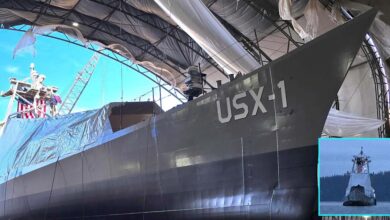
The hull that Reddit dragged into public view in March 2025 is still a research ship. The battleship that later borrowed its name is still a budget line. They do not share a dry dock, a mission, or a crew concept. They share a word the Navy likes when it wants a vessel to sound like it will not blink. USX-1 Defiant is 180 feet long, about 240 metric tons, and designed so that no sailor ever walks the deck. The proposed USS Defiant, lead ship of the Trump-class battleship, is a nuclear surface combatant the Congressional Budget Office priced, in an August 5, 2026 estimate, at $23.4 billion for the first hull alone. One of those Defiants has already crossed an ocean with nobody aboard. The other has not been laid down.
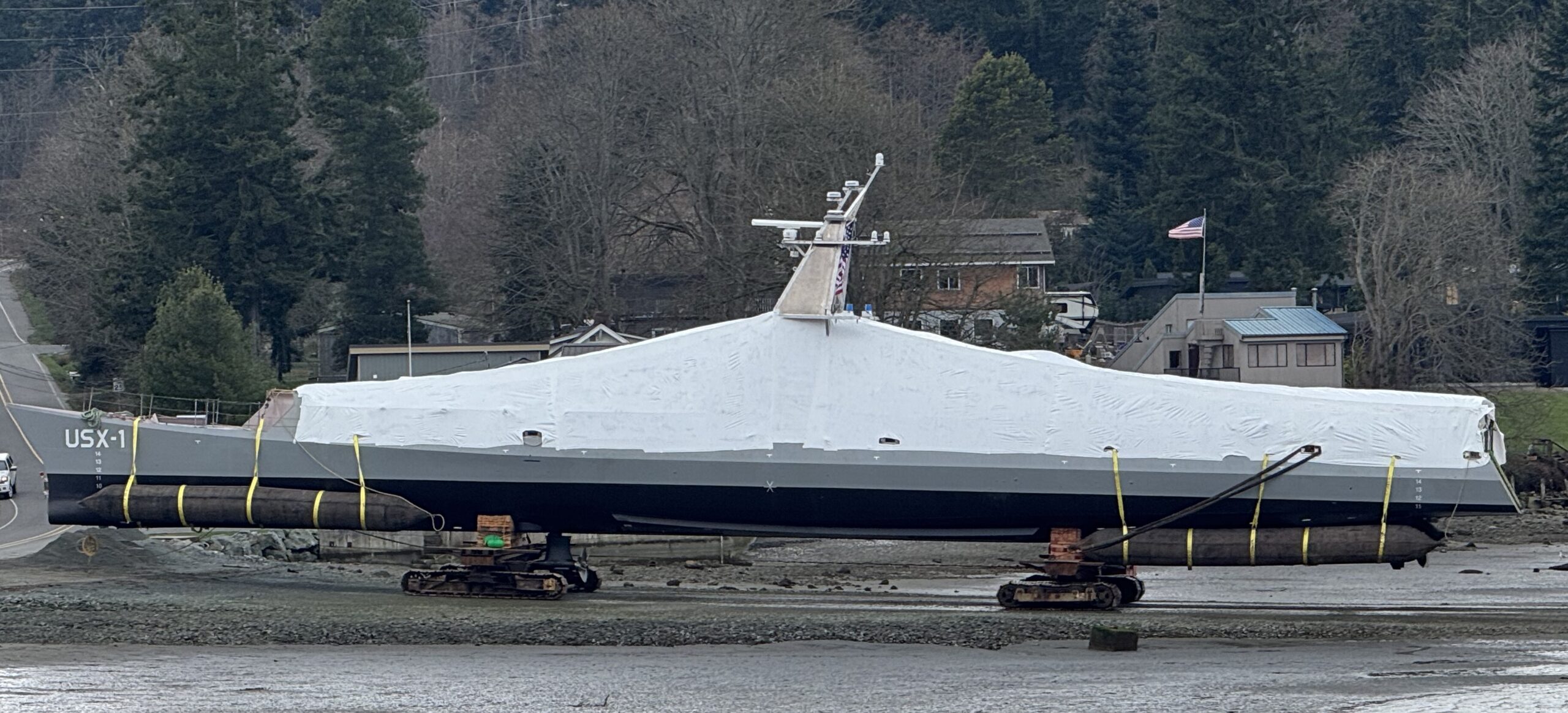
That split is the story the tarp photos only started. A Washington resident posted pictures to r/navy after watching a low, sheeted shape under tow in Saratoga Passage, a short ride from Naval Air Station Whidbey Island. Commenters guessed barge, then secret destroyer. Within days the Defense Advanced Research Projects Agency confirmed the United States owned the hull. The name painted on it was USX-1 Defiant. The AEGIS Alliance has watched this sequence before, when a machine the Pentagon preferred to introduce on its own clock met a camera first. The X-37B spaceplane spent 434 days up before the public got a clean account of the trip. A shoreline and a subreddit compressed the same kind of calendar for a ship.
A Seaframe That Never Budgeted for a Human
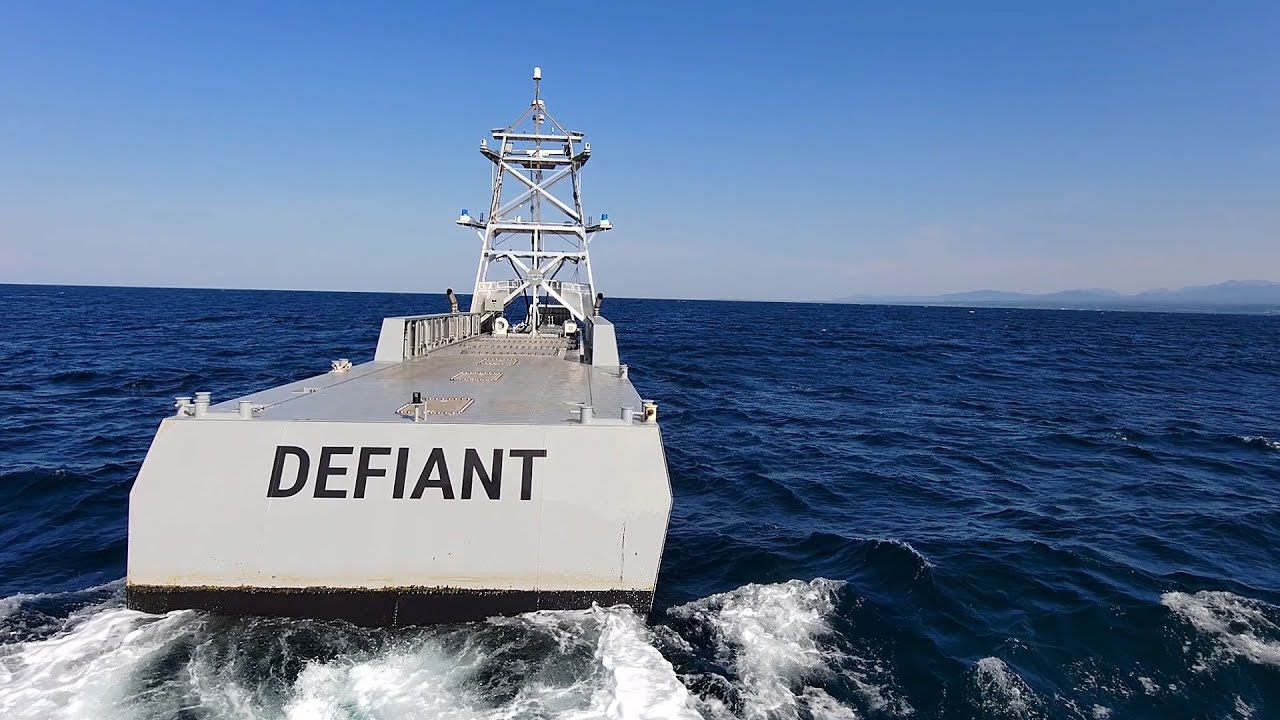
Defiant is the prototype from DARPA’s No Manning Required Ship program, NOMARS. The instruction to the designers was not to strip bunks out of a patrol craft. It was to draw a seaframe that never expected lungs, a galley, a ladder, or a bridge. Serco won the 2022 contract over a Leidos team paired with Gibbs and Cox. Nichols Brothers Boat Builders in Washington put the hull in the water in early 2025. Because no one has to squeeze past an engine, the beam is only as wide as the largest piece of machinery. DARPA’s pitch is that a hull like that can be built and repaired at ordinary Tier III yards that already turn out yachts, tugs, and workboats. A medium unmanned surface vessel, in that theory, does not need a destroyer dock to stay in the fight.
The number that matters more than the silhouette is availability. NOMARS talks about roughly 90 percent uptime across a year at sea. A ship with no crew cannot shout for a machinist’s mate when a pump seizes in a December gale. Program manager Greg Avicola, at the August 11, 2025 christening at Everett Ship Repair, called Defiant “a tough little ship” that “defies the idea that we cannot make a ship that can operate in the challenging environment of the open ocean without people to operate her.” He said the hull is meant to work in sea state 5 without a performance drop and to ride out worse weather, then pick the mission back up when the sea lies down. That is a reliability claim. It is not yet a fleet order.
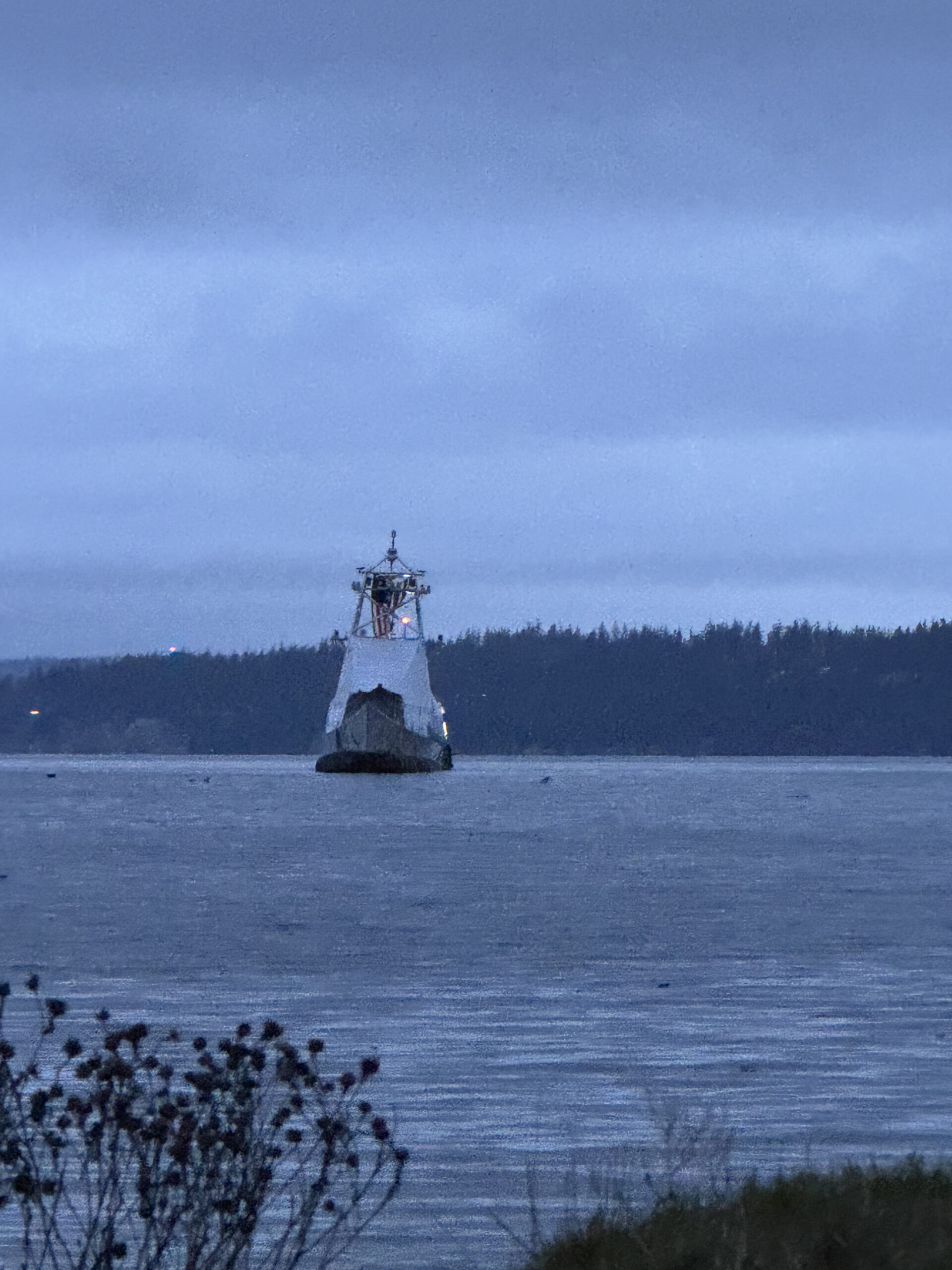
What the Water Has Already Accepted
The extended demonstration began September 4, 2025, near Port Angeles. Defiant ran the Strait of Juan de Fuca and finished more than 1,100 nautical miles of open-ocean transit in five days, tying up at Naval Base Ventura County Port Hueneme on September 8. Port Hueneme is where the Navy parks its unmanned surface work. Sailors from Unmanned Surface Vessel Squadron One were on the trials so the fleet, not only a contractor, would have time on the software. During the week of September 17 the team passed lines and connected a probe from a crewed support ship. Water stood in for fuel. Nobody stepped onto Defiant to make the connection. DARPA had rehearsed the idea in December 2024 with the experimental vessels Ranger and Mariner. Doing it on the NOMARS hull was the point of the California stop. The same window covered turns, runs near 20 knots, automated dockings, and harbor entries and exits.
After another autonomous stretch of about 1,000 nautical miles, Defiant was back in the Long Beach area by late September 2025. Winter was for engineering changes. The ship returned to the water in February 2026 and moved into final acceptance trials aimed at executive autonomy, meaning perception and navigation, plus machinery-control software. Hyliion said in May 2026 that the Office of Naval Research and DARPA had picked Defiant as a candidate for an 800-kilowatt KARNO plant, four 200-kilowatt cores in a keel-cooled package, with at-sea power trials aimed at 2027. A ship that cannot call a technician needs a power system that does not ask for one. That test has not happened yet. Neither has the handoff.
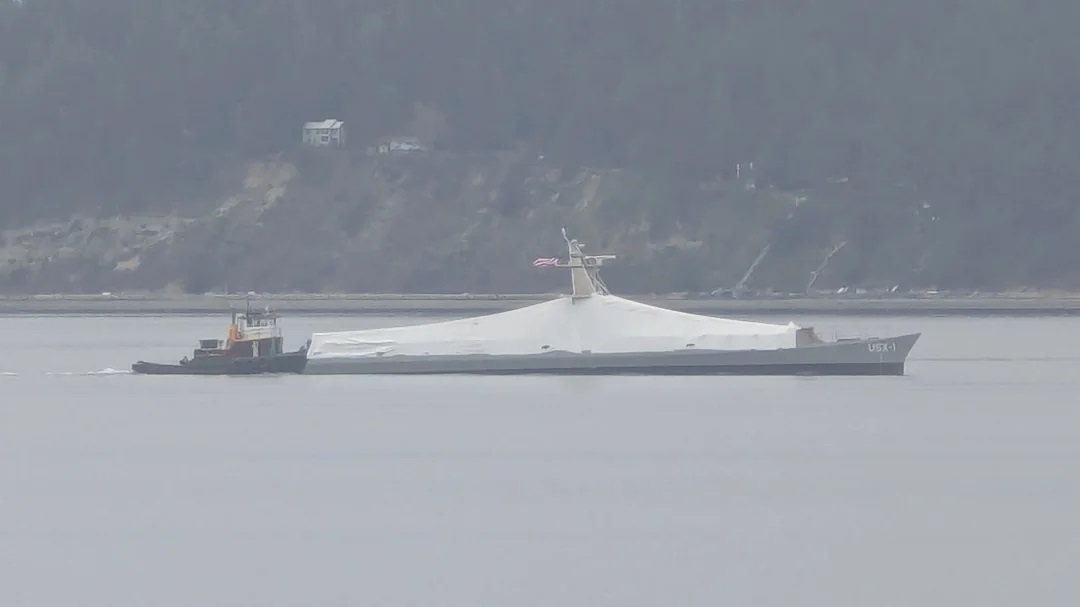
The Other Defiant Is a Battleship That Exists on Paper
On December 22, 2025, President Donald Trump announced a new guided-missile battleship class and said the first hull would be USS Defiant. U.S. Naval Institute News described a ship in the 30,000- to 40,000-ton range, the largest American surface combatant proposed since the Second World War, with a magazine built around hypersonic missiles, lasers, and, eventually, a railgun. Acting Navy Secretary Hung Cao said in May 2026 that three of the nuclear-powered hulls were lined up for fiscal years 2027 through 2031. Construction of the first has been discussed for 2028, with delivery talked about for 2036. The CBO’s August 2026 figure for 15 ships was $275 billion, with follow-on hulls averaging about $18 billion. House lawmakers have already argued about whether a ship wearing a president’s name should wait until the weapons on the brochure actually work.
Put the two Defiants on the same page and the procurement argument gets sharper. USX-1 is a demonstrator whose selling point is that a civilian yard can weld it and that losing one does not mean losing a crew. The Trump-class hull is the opposite bet: a capital ship so expensive that the reactor industrial base building it may crowd out an aircraft carrier, because both want the same scarce nuclear plant capacity. Distributed Maritime Operations, the doctrine behind unmanned surface vessels, says the fleet should spread sensors and weapons across many cheaper hulls so a single hit cannot blind a strike group. A $23 billion battleship says the opposite in steel. The Navy is trying to fund both sentences at once.
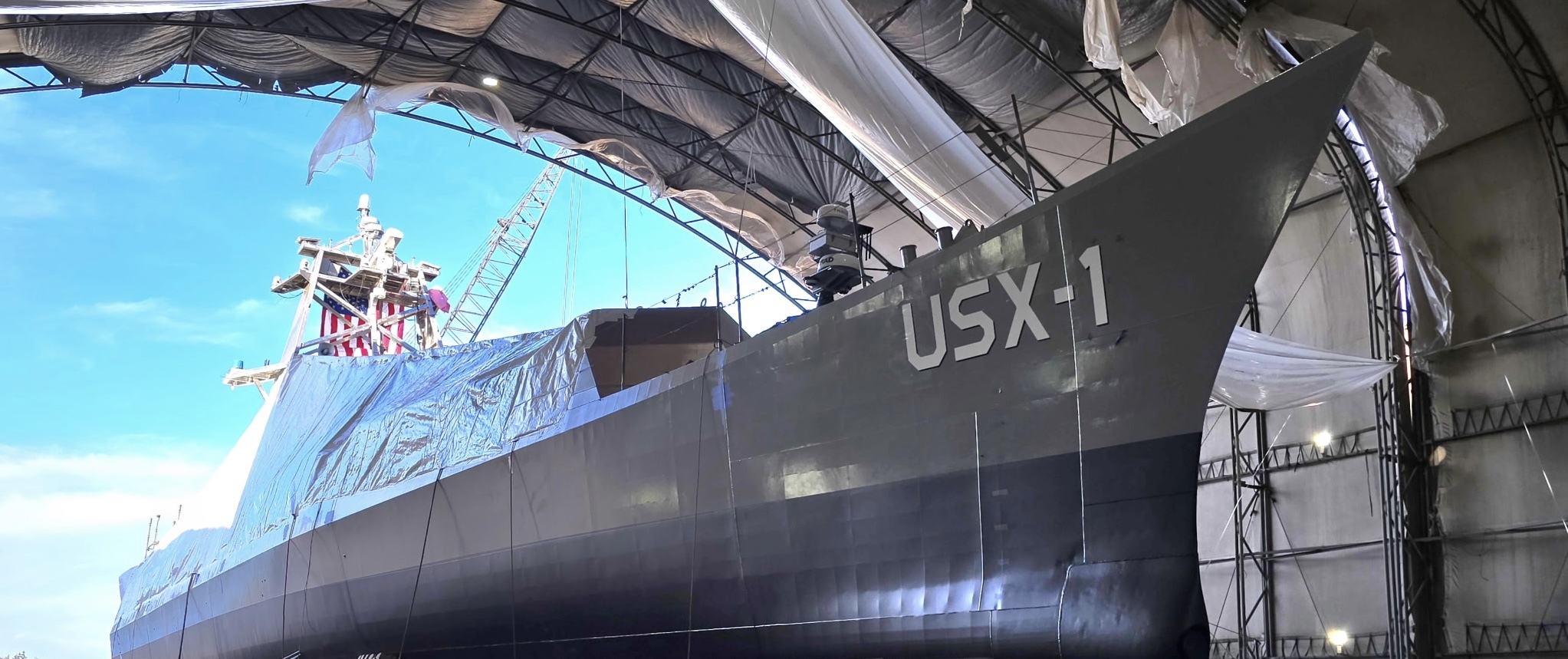
A Hull With No Keys Still Needs Someone to Answer For It
DARPA has said that after the demonstration, Defiant is meant to transfer to the Unmanned Maritime Systems Program Office, PMS 406, and become the Navy’s first medium unmanned surface vessel designed from the keel up with no provision for people. Earlier vessels such as Seahawk were hybrids. A sailor could still climb aboard and take the conn. Defiant has nothing to grab. There is no public date for that transfer. Final trials are not a commissioning. A production contract is not a christening.
The legal questions sit outside the shipyard. Who answers if the perception stack calls a fishing boat a threat. How a vessel with no crew renders aid, breaks off a track, or yields in a crowded strait. Those are not solved by a successful docking at Port Hueneme. They are the same family of problems that follow other Pentagon hardware once it outruns the language officials use to describe it. Payload talk, including the idea of a low-cost missile truck for a Taiwan Strait “hellscape,” remains a concept unless PMS 406 bolts a weapon on and writes rules for it. Certification near civilian traffic is a separate exam from open-ocean mileage.
Reddit did not design Defiant. It made the Pentagon say the name out loud before the press office was ready. The ending still belongs to a contracting shop. If a second hull is ordered from a yard that has never built a destroyer, NOMARS becomes a fleet idea. If the autonomy stack needs a barge of technicians shadowing it across the Pacific, the cost case dies even if the welds were cheap. Until a marshal of the budget signs that paper, the ship famous for having no one aboard is still a prototype that the internet introduced, and the battleship sharing its name is still a speech. Readers who track machines that surface before the briefing can follow Cold War hardware the Space Force would rather catalog quietly and the laser links NASA has already fired down to Earth alongside the unmanned file.
More coverage sits in technology, science, and U.S. news at The AEGIS Alliance. A ship built so nobody can take the keys should not need a bystander to introduce it. That is still how the public met this one.