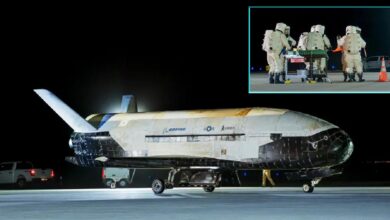

The X-37B does not announce itself when it comes home, and it does not announce itself when it refuses to. On the night of March 6, 2025, the second vehicle in the two-ship fleet touched Runway 12 at Vandenberg Space Force Base at 11:22 p.m. local time, ending Orbital Test Vehicle-7 after 434 days. On the East Coast that landing was already March 7. The U.S. Space Force waited to tell the public. That pause is the program’s house style. OTV-7, flown as USSF-52 on a SpaceX Falcon Heavy, was the first X-37B mission to work a highly elliptical path instead of the low orbits that defined the early flights. Amateur observers later placed that path between roughly 323 and 38,838 kilometers. Before re-entry the vehicle aerobraked, using atmospheric drag to change orbit, save fuel, and shed service-module hardware. Those two facts, the ellipse and the aerobrake, are still the clearest sentences the Pentagon has offered about what the little shuttle did for fourteen months.
Then the program changed its religion. Earlier flights kept trying to outlast one another. OTV-6 had held the record at 908 days. OTV-7 cut that streak on purpose. Less than six months later the sister airframe was back on a pad. Pace, not endurance, became the point.
A Pickup-Bed Payload Bay With a Runway
Boeing built two X-37Bs. Each is about 29 feet long with a 15-foot wingspan and a payload bay roughly the size of a pickup bed. They launch on a rocket, fly themselves, and land like an airplane. Before OTV-8 left Florida, the pair had already stacked 4,208 days in space across seven flights. That is the capability classified customers actually buy: a machine that can sit in orbit long enough to finish a test card and then come home so engineers can open it. Most national-security payloads never get that second look.
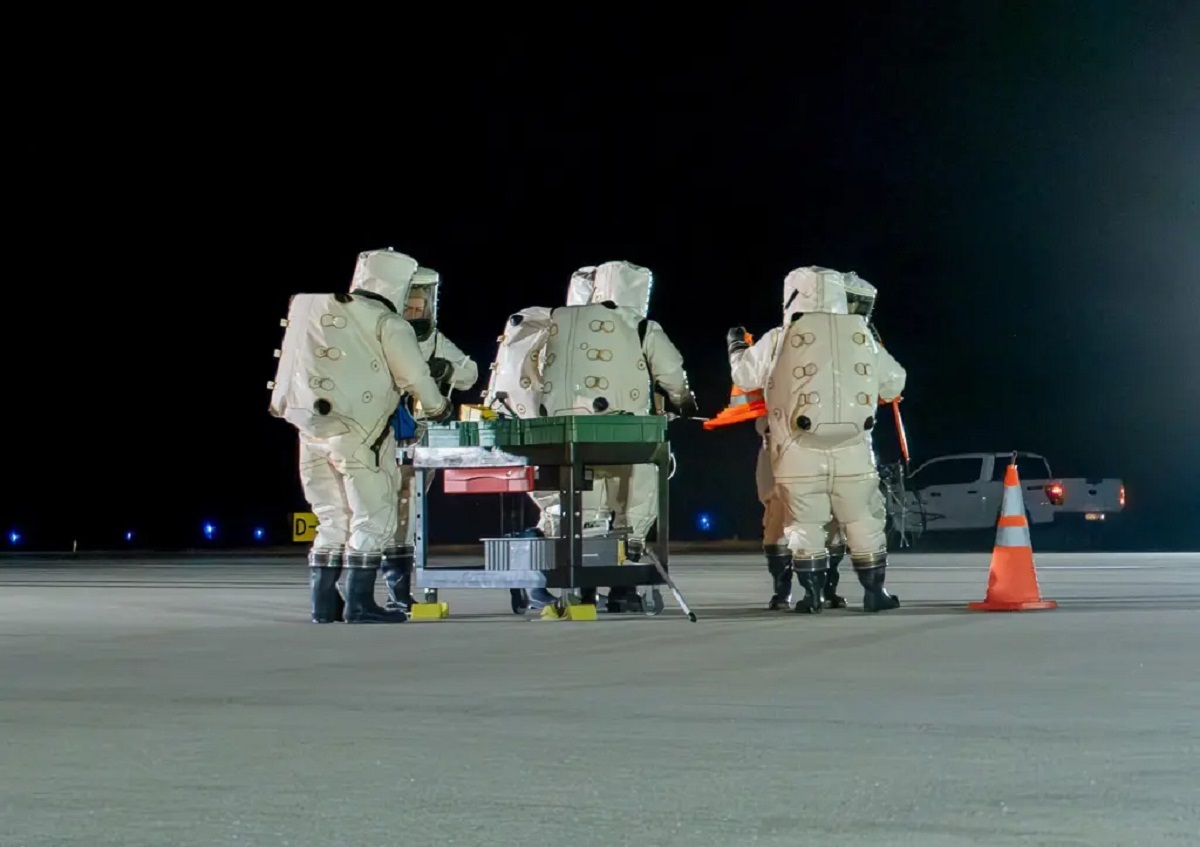
Ground photos from the Vandenberg recovery showed teams in hazmat suits around the vehicle. The Space Force has never said the payload was radioactive. The suits still did what rumor always does. Analysts have spent fifteen years listing the usual suspects: sensors, radiation-hardened electronics, rendezvous practice, materials that would look ugly in an open budget hearing. None of that list is confirmed for OTV-7. All of it is the kind of work a reusable bay is built to hide. The AEGIS Alliance has tracked the same official silence around other hardware, including the uncrewed vessel DARPA only claimed after photos hit Reddit.
OTV-8 Went Up Low, and It Stayed Up
OTV-8 is the fourth flight of the first airframe, cataloged as USA-555, NORAD 65271, COSPAR 2025-183A. It left Launch Complex 39A at NASA’s Kennedy Space Center at 11:50 p.m. Eastern on August 21, 2025, which was 03:50 UTC on August 22, on a Falcon 9 Block 5. The booster, B1092 on its sixth flight, landed at Cape Canaveral’s Landing Zone 2. Public orbital elements put the spaceplane in low Earth orbit, about 331 by 342 kilometers at 49.5 degrees inclination, a very different geometry from the ellipse OTV-7 had just finished. Day-to-day flying belongs to the 5th Space Operations Squadron inside Space Delta 9, with the Air Force Rapid Capabilities Office, the Air Force Research Laboratory, and the Defense Innovation Unit on the experiment list.
The Space Force chose, for once, to name part of the cargo. OTV-8 carries a service module, a high-bandwidth laser communications test meant to talk to proliferated commercial satellites in low Earth orbit, NASA materials work on the woven fabrics used in inflatable heat shields, and what officials call the highest-performing quantum inertial sensor ever flown. The sensor watches the rotation and acceleration of atoms so a vehicle can navigate when GPS is jammed, spoofed, or simply not there, including in cislunar space. It is not a quantum computer and it is not a replacement constellation. It is a compass that does not need a radio.
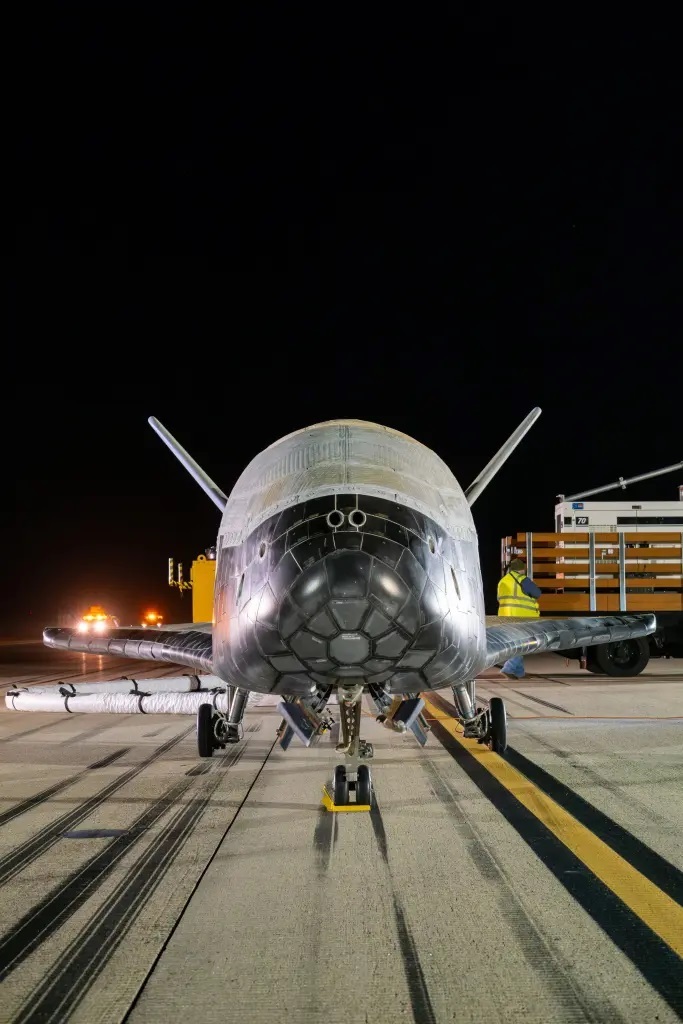
Chief of Space Operations Gen. Chance Saltzman called the laser demo a step toward using commercial networks as part of a redundant architecture. Col. Ramsey Horn, then commander of Space Delta 9, called the quantum sensor “a welcome step forward for operational resilience.” Space Launch Delta 45 commander Col. Brian Chatman, speaking after liftoff, said fast launches and the X-37B itself were how the service adapts when orbit is contested. Acting Air Force Rapid Capabilities Office director William Blauser had already described the vehicle as the premier test platform for technologies the service wants next. Boeing’s Michelle Parker has called it the most reliable testbed the company flies. On April 13, 2026, Boeing said the vehicle was healthy and still working the experiment list after more than 230 days. Public catalogs still listed USA-555 as active after the flight passed 400 days, with no landing date posted.
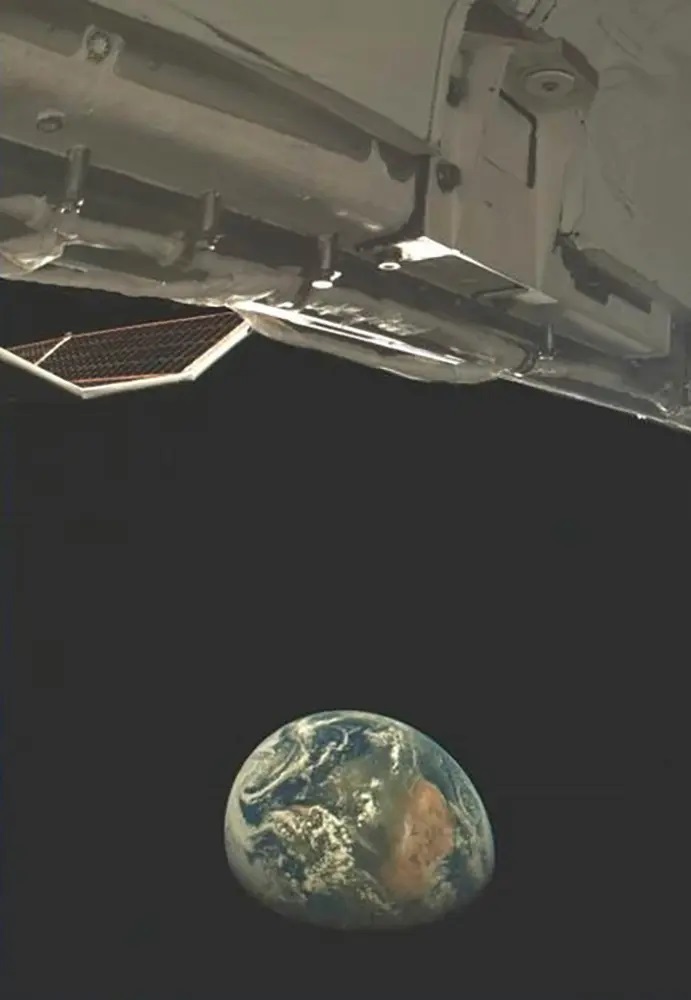
Satellite tracker Marco Langbroek, who teaches optical space situational awareness, photographed the USSF-36 objects from Leiden on August 24, 2025, and said he had imaged the X-37B and a companion he identified as Limasat. He has tracked earlier OTV missions and describes them as naked-eye targets in low Earth orbit when the geometry is right. The Space Force has not confirmed a deployed subsatellite by that name. The photographs still make a point the press office prefers to skip: secrecy is not the same thing as invisibility. A winged vehicle at 330 kilometers can be seen by a camera in the Netherlands three days after launch.
Moscow’s Bomber Story, and the Bay That Does Not Fit It
Russian and Chinese officials have spent a decade insisting the X-37B is a weapon with a cover story. The most specific charge comes from Yan Novikov, director general of the air-defense firm Almaz-Antey, who has claimed the spaceplane could carry nuclear warheads. That line produces the recurring “space bomber” headline. Analysts who have measured the vehicle keep giving the same rebuttal. The bay is small. A nuclear delivery role would be a poor use of a machine whose real advantage is that it comes home. Chinese researchers have warned of a space arms race anyway. Beijing built its own answer, the Shenlong spaceplane, which has flown multiple long missions and released unexplained objects, with a second concept, Tengyun, discussed behind it. In September 2026 Langbroek was still correcting people online who mixed OTV-7’s finished flight with OTV-8’s open one. The confusion is useful to anyone who would rather argue about a bomber than read a catalog.
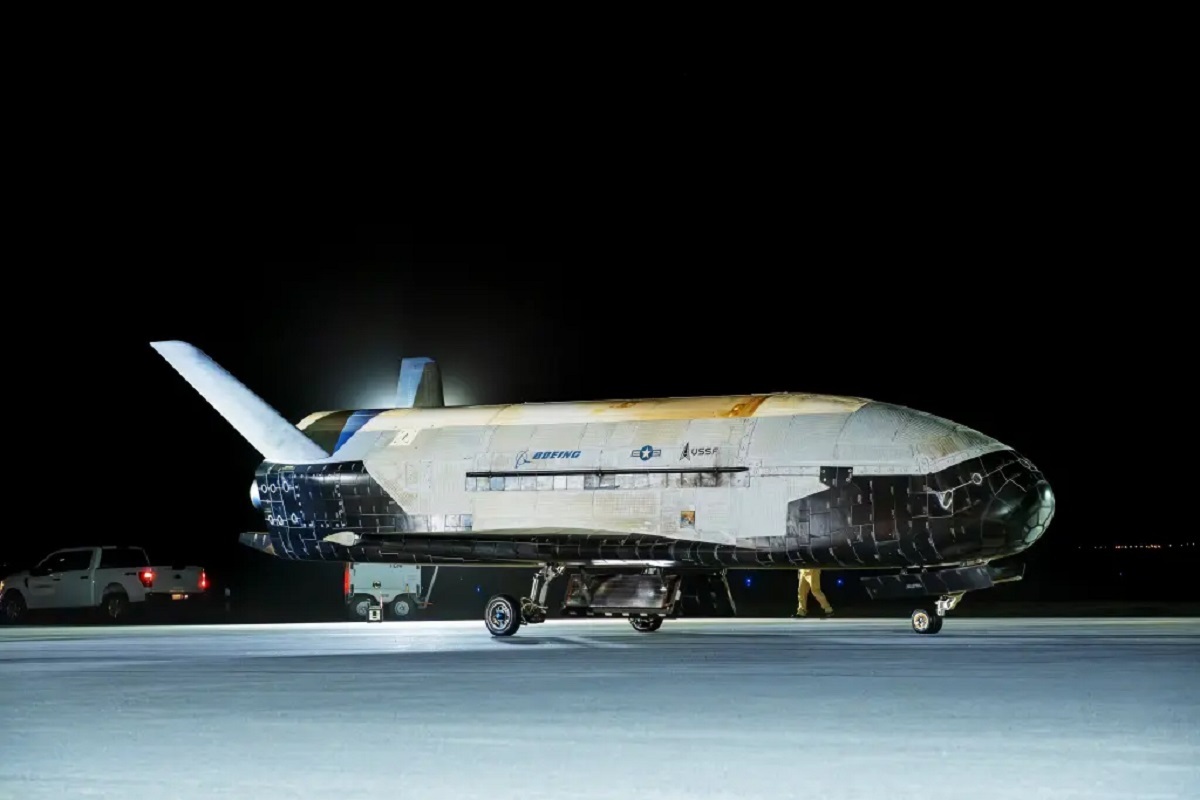
The honest description is less cinematic and more expensive. A reusable spaceplane that can change altitude, dump a service module, test a quantum compass, and shoot a laser at commercial satellites is a laboratory with landing gear. It is also a budget line that never produces an inventory. Adversaries have to price an object that lingers and will not explain itself. Domestic oversight has to price the same silence. Both problems look like features from the Pentagon’s side of the table.
The AEGIS Alliance has covered other machines that sit at the edge of plain language, from a dead Cold War satellite the Space Force had to go find to laser links that move data without a radio. OTV-7 proved the fleet could leave low Earth orbit, aerobrake, and still find a California runway. OTV-8 is proving the turnaround can be measured in months and that a GPS-denied compass can ride along without a press tour. Whether a third airframe is ever bought remains unanswered. The two that exist are not museum pieces. One came home in March 2025 with an elliptical pedigree. The other has been flying since August 2025 with a quantum sensor and a laser modem, past a full year, still without a landing notice.
Readers tracking the hardware can continue through technology, U.S. news, and other files on what is actually overhead. The classified remainder is still classified. The disclosed remainder is now large enough that the secrecy is about the results, not about whether the plane exists.