

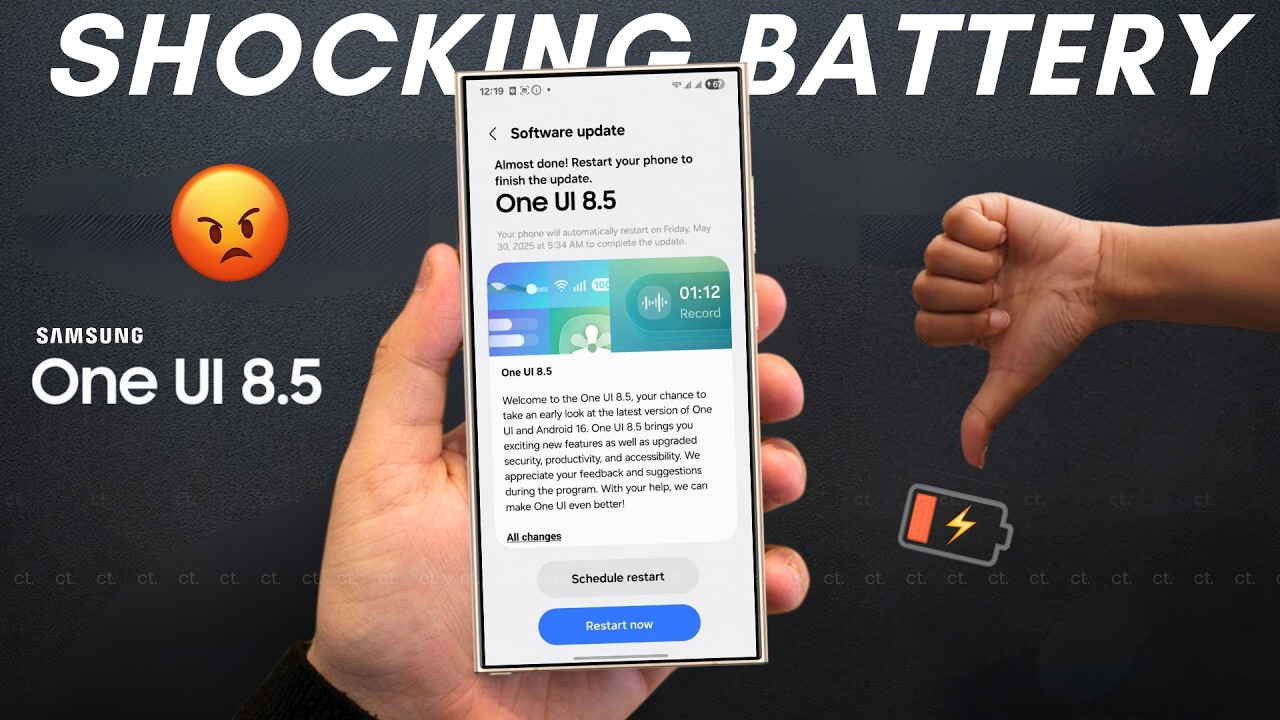
Samsung sold the Galaxy S24 as a seven-year phone. The promise was software, delivered on a schedule, long after the launch cameras left. Owners learned the less flattering version of that promise. The phone they paid for kept being revised by updates that made it hotter, thirstier, and slower to charge, and the company that shipped those updates answered with troubleshooting links instead of an admission. The AEGIS Alliance is not reprinting a spec sheet. The useful record of this flagship is the firmware year, and then the firmware year after that, when the same chassis was asked to survive One UI 7, One UI 8, and a July 2026 security patch that community boards treated as a regression.
Heat is a measurement, not a mood
A flagship gets warm. Four-K video, a bright screen, and a navigation app will spend the thermal budget Samsung’s engineers already modeled. The complaint that lasted is different. Owners described the chassis warming during ordinary scrolling, then warming while the screen was off. On Samsung’s own community boards, people who said the phone was tolerable on earlier One UI builds described a step change after the Android 15-based One UI 7 package and another after One UI 8. Background work that would not sleep, a radio that hunted bands it could not hold, and a battery curve that no longer matched the first year of ownership are not “intensive use.” They are a phone spending power the owner did not request.
In October 2025 Samsung pulled One UI 8 builds for the S24, S24+, and S24 Ultra off its servers after a troubled rollout, a pause Android Police documented at the time. Pulling a file is an admission that the file was not ready. It is also a warning that the next file may be shipped to the same people as the test. Stable One UI 8.5 began reaching Galaxy S25 phones in early May 2026 and then the S24 line. The first drain wave on that release was widely traced to the Samsung Keyboard and was patched through the Galaxy Store without a full operating-system flash. That was the manageable failure. The July failure was not.
Fifty-seven security fixes, and a processor that would not sit down
Samsung’s July 2026 maintenance release for the One UI 8.5 cycle was, on paper, a security update. It addressed 57 documented vulnerabilities, 41 of them from Google’s Android bulletin and 16 specific to Samsung, including critical flaws in components such as KnoxGuard and image codecs. Security patches are not optional in any serious sense. They are also not free. Within days, owners of the Galaxy S24 Ultra and S25 Ultra, and of other recent Galaxy phones, described sharp idle drain, heat during light use, and charging that had slowed to a crawl. PhoneArena’s roundup of those reports landed on July 30. A European S24 Ultra owner documented a full charge stretching from about 70 minutes toward three hours. On Samsung’s U.S. community, an unlocked S24 Ultra on build S928U1UES6DZG1, security patch level July 5, 2026, was written up with the same trio: idle drain, heat, throttled charging.
Technicians who read that pattern pointed at a partial wakelock, a software hold that keeps the processor awake after the screen is off. A stuck wakelock does not always appear as a guilty app in the battery menu. It looks like a phone that is doing nothing and getting warm anyway. Samsung’s public response, where moderators replied at all, sent people to a generic troubleshoot page and offered a private message. There was no press statement that the July patch had done this, and no committed repair date. Some individual cases were later pinned on a stuck WhatsApp encrypted backup, which is a reminder that not every hot phone is the same bug. A backup loop and a firmware wakelock can both be true in the same week, on different handsets, under the same update. Blaming the user for either one is how a company avoids a changelog.
By late August 2026, August security builds for the S24 family were being spotted on Samsung’s servers, including moves from DZH1 to DZH3 on international S24 and S24+ firmware and a DZH2 package on the Ultra. A build number on a test server is not a promise that the wakelock is gone. It is evidence that the monthly train kept moving while owners were still living with July. The honest instruction, if your S24 started this behavior on the July patch, is still the unglamorous one. Watch battery usage for a single app that never sleeps. Clear the system cache from recovery if the drain began the hour the update finished. Give a new patch forty-eight hours before judging it, because indexes rebuild. Then judge it. A security update that triples a charge time has not finished shipping, no matter how many vulnerabilities it claims to close.
The camera that argues, and the gallery that wakes up
The S24 camera hardware was never the scandal. The software layer that decides the photographer was wrong is the scandal. Scene optimizer, automatic night processing, and extra smoothing on daylight skin produce the plastic look owners have described since the first month. Power users know the toggle names. Everyone else knows that a dinner photo looks like a brochure. Computational photography is a bet that the company recognizes a good picture faster than the person who framed it. Sometimes the bet is right. Sometimes it turns a face into porcelain and calls the result a feature.
Heat and the camera app found each other again in 2026. On Samsung’s member forums in June, an S24 owner wrote that simply opening the camera warmed the phone, and that taking pictures made it worse, while other apps did not. Samsung’s moderator answered with the standard list: dim the screen, close background apps, do not game while charging, install the next update. That list describes a phone under load. It does not describe a phone that heats up because the camera process started. A separate, well-known S24 quirk, false moisture detection in the USB-C port, can disable charging and accessories even when the port is dry. A safety sensor that cries wolf is the same design habit as a camera that will not accept a manual exposure. Both assume the company’s guess should outrank the person holding the device.
Gallery behavior belongs in the same family. Owners have watched the gallery rebuild its index at odd hours and spend the battery while the phone sits on a nightstand. A flagship that wakes itself to re-read photographs is a flagship that does not respect the morning. The fixes that actually change the temperature are dull, and they should not be required of an eight-hundred-to-thirteen-hundred-dollar slab. Put idle social apps into deep sleep instead of trusting Adaptive Battery to notice them. Drop the highest refresh rate when the phone is already warm or on a charger. If a carrier cannot hold a 5G standalone band in your city, stop letting the modem hunt it. Clear the camera app’s cache after a major One UI drop. None of that is a review score. All of it is the unadvertised manual.
The next operating system started before the last patch was owned
In August 2026, firmware watchers spotted the first One UI 9 test build for the S24 series on Samsung’s servers, a sign that an Android 17 beta was being prepared while July’s heat reports were still open. A company can do two things at once. It can also use the same customers as the last laboratory for the old release and the first laboratory for the new one. The seven-year promise is only a gift if year three does not undo year one. Pausing One UI 8, shipping a keyboard bug, patching it quietly, then shipping a security update that lights up idle-drain threads is a pattern. Pixel owners lived a cousin of it while Google chased its own battery bugs. Shared misery is not a warranty.
The larger fight on the same piece of glass is about control of the software other companies put there. The winter the S24 was already in pockets, TikTok went dark in the United States and came back under a political stay that took another year to become a joint venture. That blackout and the hardware in your hand are the same kind of story at different scales. You do not fully operate the object. Samsung operates the thermal policy. A social network operates the feed. A security patch operates the processor while you sleep. Device-level failures tend to hide in layers users never open, which is why a hot phone and a leaked keystroke can belong in the same conversation about trust.
The AEGIS Alliance will treat the next maintenance release, not the launch event, as the review that counts. If August’s builds and the One UI 9 beta that followed them still leave an S24 warm in a pocket during idle use, the honest line on the box is the one Samsung will not print. This flagship runs hot after the update you were told to install, and the people who noticed were the owners, not the keynote. The rest of the technology desk is at tech news and U.S. news.