MIT Built Verticillin A After 50 Years, and the Natural Molecule Was Not the One That Hit Glioma Cells Hardest


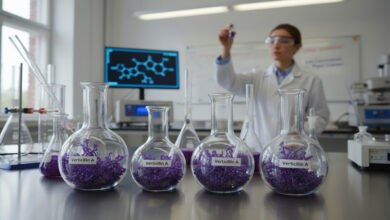
Verticillin A was isolated in 1970 and then spent half a century as a rumor with a structure. Fungi make the molecule in small amounts, as a defense chemical, and the defense is the problem. The same sulfur bridges that appear to matter in a cancer cell also fall apart on a bench. In December 2025 a group led by MIT chemistry professor Mohammad Movassaghi published the first total synthesis of (+)-verticillin A in the Journal of the American Chemical Society. Sixteen steps from a beta-hydroxytryptophan starting material. Ten rings. Eight stereogenic centers. Two extra oxygen atoms that a near-neighbor, made in the same lab in 2009, does not have. The paper is not a cure. It is the end of a supply excuse.
The medical surprise sits one step past the synthesis. The natural product was not the strongest killer in the dish. N-sulfonylated versions, of verticillin A and of the 2009 cousin (+)-11,11′-dideoxyverticillin A, were. Movassaghi said it plainly to MIT News: “The natural product itself is not the most potent, but it’s the natural product synthesis that brought us to a point where we can make these derivatives and study them.” Fifty years of scarcity had frozen the question at “can anyone make the fungus molecule.” The answer rearranged the question. The fungus molecule is a key. The drug, if there is ever a drug, is likely a variant a fungus never made.
Why two oxygen atoms stalled a laboratory for decades
In 2009 Movassaghi, then with graduate student Justin Kim and postdoctoral researcher James Ashenhurst, reported an 11-step synthesis of the dideoxy cousin in Science. That molecule already had 10 rings and eight stereocenters. Verticillin A differs by two oxygens. Those two atoms, Movassaghi said, “greatly limit the window of opportunity that you have in terms of doing chemical transformations.” They make the compound fragile. They make the order of bond-forming events nonnegotiable. Waiting to install the carbon-sulfur bonds at the end produced the wrong stereochemistry. The lab had to reverse the sequence it already knew.
The route that worked starts with beta-hydroxytryptophan and adds alcohols, ketones, and amides in an order that protects the correct shape. A pair of carbon-sulfur bonds and a disulfide go on early, then get masked as ordinary sulfides so the halves can survive an ambitious dimerization. The fragments being joined are crowded. Movassaghi called that dimerization out for the density of functional groups and stereochemistry being brought together. After the two halves lock, and after a photochemical step strips a protecting group, the disulfides are unveiled. The result is the first dimeric epidithiodiketopiperazine natural product with C12 oxygenation that anyone has built from scratch. Walker Knauss, PhD ’24, is lead author. The paper is JACS 2025, volume 147, pages 46430-46439, accepted in November and posted December 2.
That choreography is the news for chemists. For everyone else it is a supply story. Until a defined, clean sample existed, biologists were stuck with whatever a fermentation produced in a given season, at whatever purity the extract allowed. Taxol needed a bark and then a semi-synthesis. This molecule needed a 16-step answer to a disulfide that kept eating the route. Once the answer exists, analog chemists can change one piece at a time. Before it existed, “promising against cancer” was a sentence attached to a compound almost nobody could restock.
What the glioma cells actually did
Jun Qi, associate professor of medicine at Dana-Farber Cancer Institute, Boston Children’s, and Harvard Medical School, is co-senior author with Movassaghi. Xiuqi Wang, a medicinal chemist at Dana-Farber, and Mariella Filbin, research director in pediatric neurology-oncology at Dana-Farber/Boston Children’s, are on the paper. They asked a narrow question about diffuse midline glioma, the pediatric brain tumor still often called DIPG when it sits in the pons. Surgery usually cannot take it out. Radiation can slow it. Many of these tumors carry a histone mutation that strips a methylation mark, H3K27me3, and they lean on a protein called EZHIP that interferes with the cell’s methylation machinery.
In human cell lines, (+)-verticillin A and designed derivatives cut viability and raised H3K27me3, pushing cells toward apoptosis. The lines that fell hardest expressed high EZHIP. A thermal-shift assay on cell lysates found that an N-sulfonylated dideoxy derivative bound EZHIP, while a related natural product, chaetocin A, did not show that engagement. Reported potencies in the study put verticillin A itself at an IC50 of 58 nanomolar in one DIPG line, SU-DIPGXXV, 36 nanomolar in BT869, and a weaker 238 nanomolar in an EZHIP-expressing osteosarcoma line, U2OS. The sulfonylated analogs were tighter still, down to about 5 and 8 nanomolar in the DIPG line and the low teens in BT869. Nanomolar in a dish is a real signal. It is not a survival curve in a child.
Qi’s next sentence is the one that should travel farther than the headline. Identifying targets will “play a critical role in further understanding their mechanism of action, and more importantly, will help optimize the compounds from the Movassaghi lab to be more target specific for novel therapy development.” The Dana-Farber group said it had already profiled lead molecules across more than 800 cancer cell lines, and that animal models of pediatric brain cancers were the hoped-for next test. More tests, the MIT announcement said, are required before anyone talks about clinical use. No hospital is stocking verticillin A. No trial protocol has been posted off the back of this paper. As of the public record through September 2026, the story still stops at cells and a binding assay.
The headline that families have already survived
Diffuse midline glioma has a long file of chromatin drugs, delivery trials, and viral ideas that arrived as hope and left as a quieter methods paper. The AEGIS Alliance science desk and the health desk will not skip that history to flatter a 16-step route. The honest claim is smaller than a cure and larger than a curiosity. Chemists can now make the natural product and, more importantly, make variants that are more stable and more potent against the EZHIP-high lines. Anyone selling the fungus chemical as a treatment is running ahead of Filbin’s patients and ahead of the data.
There is a second risk that has nothing to do with families and everything to do with how a synthesis becomes a company. A total synthesis can seed a patent estate. Variants can become a slide called platform. None of that is misconduct. All of it can outrun the biology. Readers should watch whether the next paper still includes the pediatric oncology group or whether the molecule migrates into a deck about optionality. The first paper earned a second paper. It did not earn a ticker.
Natural-product medicine has always been a pharmacy with a logistics problem. The logistics problem here was solved in Cambridge, not in a fermenter. Movassaghi’s line about finally having the technology to make designed variants is the line to keep. The MIT announcement and the JACS abstract agree on the limit: interaction with EZHIP may be a way into pediatric cancers that live and die by H3K27 methylation. “May” is the correct verb. A gene-therapy result in sickle cell disease became news when a patient walked out with a measured change in his blood. Verticillin A has not had that day. If a derivative shrinks an orthotopic glioma model without wrecking the mouse, that will be a different article. If the next paper only adds adjectives, it will be a reprint. Until then the molecule is what the synthesis made it: available, for the first time in fifty years, and already less interesting than the variants it allowed someone to build.