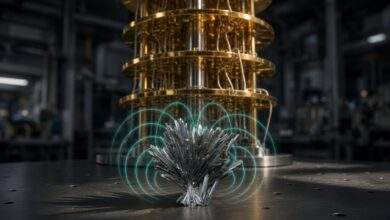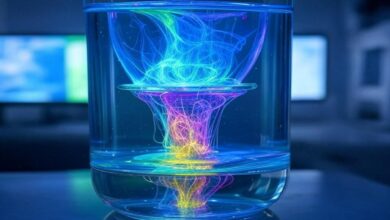
Perovskite Chips Now Hold a Room-Temperature Supersolid After Lecce Scientists First Forced Polariton Light Into a Crystal That Flows


Light is not supposed to keep a shape and flow at the same time. In March 2025 a laboratory in Lecce, Italy, showed that a certain kind of light, dressed as matter, can do both. A year later a second laboratory took the same strange phase out of the cryostat and ran it at room temperature. The object is called a supersolid. It is a quantum state that is crystalline and frictionless in the same sample. Textbooks used to reserve that sentence for helium arguments and for clouds of atoms held near absolute zero. The new sentence is about chips, lasers, and a pattern of stripes that chooses its own phase.
A supersolid breaks two symmetries at once. A repeating density pattern is what makes a solid a solid. Flow without viscosity is what makes a superfluid a superfluid. The pairing sounds like a pun until a lab measures both signatures and publishes the noise floor. That is what Dimitrios Trypogeorgos and colleagues at CNR Nanotec did, with partners in Austria, the United States, and other Italian labs, in a Nature paper published March 5, 2025, titled “Emerging supersolidity in photonic-crystal polariton condensates.”
They Did Not Freeze a Flashlight
The Lecce team fired a laser at a gallium arsenide semiconductor etched with microscopic ridges, a photonic-crystal waveguide. Photons in that lattice coupled so strongly to excitons, the bound electron-hole pairs in the semiconductor, that the two stopped behaving like separate things. The hybrids are exciton-polaritons. Those quasiparticles condensed into a topologically protected bound state in the continuum, a mode that leaks so little energy that the condensate lives long enough to be mapped. The ridges then forced a periodic, crystal-like density while the condensate kept a coherent phase. The group measured the density modulation, the fingerprint of broken translational symmetry, to a few parts in a thousand. Direct access to the phase of the wavefunction let them measure local coherence as well. That precision is the difference between a pretty interference picture and a claim Nature will print.
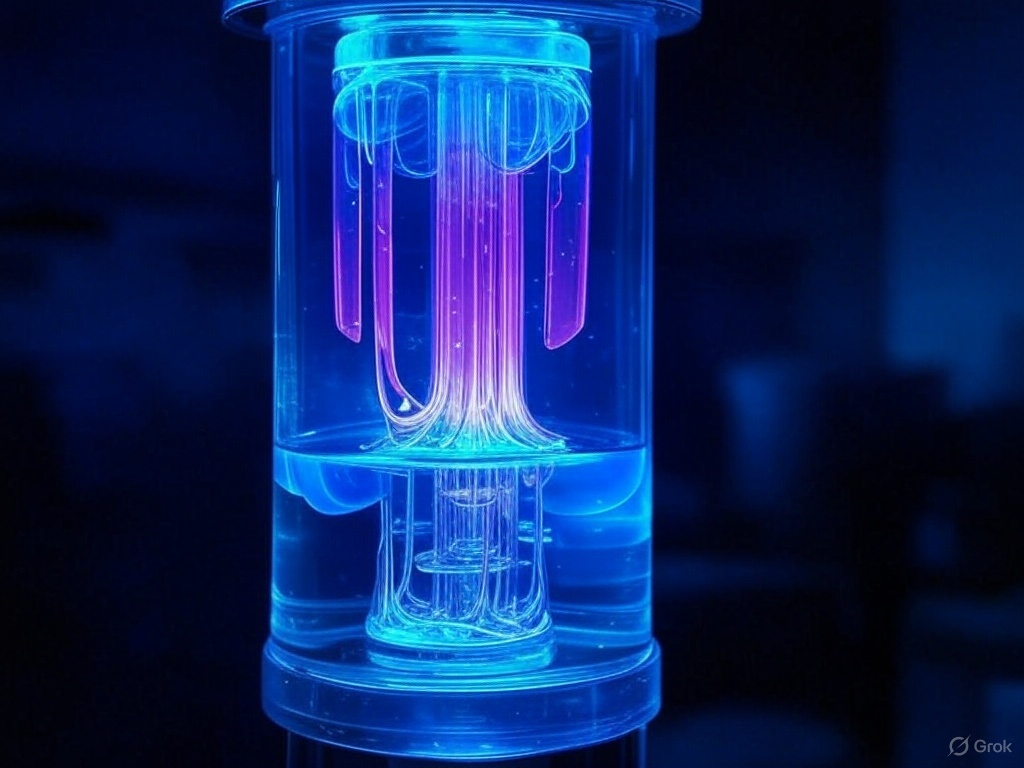
Trypogeorgos called the result “pretty awesome,” which is not a unit and still matches the mood in the lab. Dario Gerace at the University of Pavia said the group had only scratched the surface. Daniele Sanvitto, a senior author in Lecce, framed it as a demonstration of principle, not a product. Manuele Landini at the University of Innsbruck and Iacopo Carusotto in Trento were among the theorists and experimentalists who put the double symmetry breaking on a driven-dissipative system, the kind of condensate that only exists while you keep pumping it. Related theory in Physical Review Letters that same season mapped how a polariton fluid can show the order helium made famous, without being helium.
Headline writers preferred “scientists turned light into a solid.” That sentence is useful and slightly wrong. Take the lattice away and the supersolid goes with it. The thing in the chip is a polariton condensate, part photon and part semiconductor excitation. Honesty does not shrink the result. Matter-light hybrids are already how a lot of modern photonics works. Parking one of them in a supersolid phase means a state that used to require a dilution refrigerator and a room-sized atom trap can be argued about on a waveguide.
Room Temperature Is the Part That Changes the Audience
The Lecce experiment was still a cryogenic, specialist setup. It was not a desk toy. It was also not a magneto-optical trap that takes a day to reload. The practical complaint from other labs was temperature. If the phase only exists when the chip is brutally cold, the people who can copy it are the people who already own the cold. On March 16, 2026, Nature Nanotechnology published the reply. Y. Meng, W. Li, K. Peng, and colleagues reported a room-temperature supersolid in a hybrid of single-crystal halide perovskite and an exciton-polariton nanograting. The paper’s title is plain about the claim: “Hybrid perovskite–nanograting photonic architecture enables supersolidity at room temperature.”
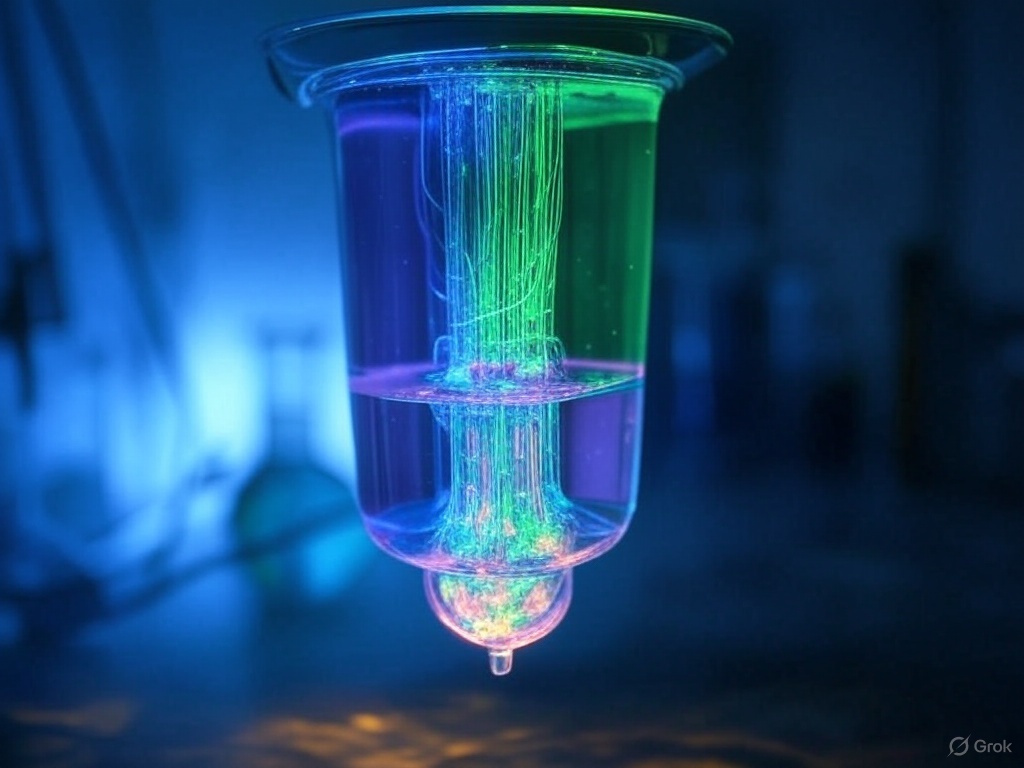
Their architecture holds a hybrid polaritonic bound state in the continuum with a large gap, 18.2 millielectronvolts, and two side modes. As the pump gets stronger, optical parametric oscillation pushes the system out of the single bound-state condensate and into those side modes. The result is a self-organized supersolid: a striped, one-dimensional lattice that spans the condensate. The detail that separates a real broken symmetry from a pumped pattern is how the stripes choose a phase. Single-shot images show the stripe pattern picking a position at random. Average many shots together and the density modulation washes out, because the lattice is not pinned to the same place every time. That stochastic selection is what you expect if the crystal is organizing itself rather than tracing a groove the fabricator cut. Interferometry showed long-range spatiotemporal coherence. The lattice was also non-rigid, which is another way of saying it can slide the way a supersolid should.
Argonne National Laboratory’s Center for Nanoscale Materials highlighted the work on June 10, 2026. The nanogratings were written in the CNM cleanroom on a JEOL electron-beam lithography tool, then paired with excitonic perovskite microplates. A scanning electron micrograph in the highlight shows hydrogen silsesquioxane gratings with a titanium dioxide cladding, the kind of ordinary nanofabrication sentence that makes the physics less magical and more copyable. Argonne’s point was access. A phase that used to live in a cryostat can now be studied under ambient conditions on a platform other groups can book.

What the Phase Is For, and What It Is Not
Nobody is shipping a supersolid processor. The honest uses sit one layer down. A condensate that holds a spatial pattern and still flows is a candidate for low-loss photonic memory, for sensors that read a tiny force as a shift in that pattern, and for analog simulators that let theorists watch a supersolid without building another cold-atom machine. Quantum communication groups care because a structured light field can carry more than a binary pulse. Quantum computing groups care because stability is the tax on every extra qubit. Neuromorphic ideas, the ones that treat a polariton fluid as a physical neural net, are why European projects such as Q-ONE and PolArt put money behind the Lecce line in the first place.
Those uses die if the state cannot be held, moved, or coupled to anything that is not a custom ridge. The 2026 perovskite result answers a narrower engineering question than the press metaphors do. Can the phase exist where the laboratory is warm? The measurement says yes, on that nanograting, at that pump power, with that perovskite. It does not say a phone will contain one. Driven-dissipative systems can mimic order without owning it. The Lecce paper’s defense was the modulation depth and the topological protection. The perovskite paper’s defense is the random phase of the stripes and the coherence that survives at room temperature. A second and third lab printing the same numbers on a different tool set is still the test that matters.

The AEGIS Alliance has followed other lab stories that sound like science fiction until the methods section arrives, from arguments about structure in the universe that instruments barely catch to a molecule chemists chased for half a century before they could build it. The common standard is not the metaphor. It is a controlled experiment that survives peer review and then has to survive being copied. The Nature paper is Trypogeorgos et al., volume 639. The room-temperature follow-on is Meng et al. in Nature Nanotechnology.
Skeptics should want the stripe experiment rerun on a grating they did not fabricate. They should also refuse the sentence that pure light was frozen. The record, stated without costume, is this. In March 2025 an international group showed a photonic-crystal polariton condensate can be solid and superfluid at once, in the cold. In March 2026 another group showed a perovskite nanograting can host the same kind of phase on a benchtop that is not a cryostat. If other waveguides print the same modulation and the same random stripe phase, the textbook chapter on supersolids grows a photonic branch next to the helium one. If they cannot, both papers remain elegant and local. The AEGIS Alliance will treat the next replication, not the next metaphor, as the result that counts.
More of that file lives under science, technology, and the main news desk. A crystal made of hybrid light is only a breakthrough if someone else can build it with the lights on.