
Eight Minutes of Recalled Anger Blunted Artery Relaxation for Forty Minutes — Anxiety and Sadness Did Not

The screenshot makes a cleaner villain than the paper does. For two years, and again through the summer of 2026, posts have circulated a claim that eight minutes of anger “paralyze” your arteries, cut dilation by half, and come from a 2026 trial with a title the journal never printed. The study those posts are gesturing at was published on May 1, 2024, in the Journal of the American Heart Association. Its title is “Translational Research of the Acute Effects of Negative Emotions on Vascular Endothelial Health: Findings From a Randomized Controlled Study.” The authors are Daichi Shimbo and colleagues at Columbia University Irving Medical Center, with collaborators at St. John’s University. The National Heart, Lung, and Blood Institute paid for it. What they measured is narrower, and more interesting, than a burst vessel.
Shimbo, a cardiologist and professor of medicine, designed the trial to answer a question observational papers had circled for decades. A 1994 study had suggested an angry outburst could roughly double short-term heart risk in some people. Nobody had isolated the lining. “We’ve long suspected, based on observational studies, that anger can negatively affect the heart,” said Laurie Friedman Donze, the NHLBI program officer, when the paper came out. “This study in healthy adults helps fill a real knowledge gap and shows how this might occur.” Shimbo’s own line, the one worth keeping, was more careful: “We saw that evoking an angered state led to blood vessel dysfunction, though we don’t yet understand what may cause these changes.”
The Number Is a Comparison, Not a Clamp
Researchers enrolled 280 adults from the neighborhoods around Columbia, ages 18 to 73, average about 26, none of them carrying a diagnosed cardiovascular disease or the usual stack of risk factors. Recruitment ran from August 2013 to May 2017. The experiment is a decade older than the memes. Each person sat for 30 minutes in a quiet, temperature-controlled room — no talking, no phone, no reading, no sleep — and was then randomized to one of four eight-minute tasks. Relive a memory that made them angry. Relive one that made them anxious. Read a stack of depressing sentences. Or count to 100 and stay flat.
Before the task and at 3, 40, 70, and 100 minutes after it, the team measured blood pressure, heart rate, and endothelium-dependent vasodilation with a reactive hyperemia index, a fingertip measure of how well a vessel widens when blood flow surges back after a brief squeeze. They also drew blood for endothelial cell-derived microparticles, which are scraps shed by a damaged lining, and for bone-marrow-derived progenitor cells that help repair it.
Here is the result the half-dilation headline flattens. From baseline to 40 minutes, the anger group’s reactive hyperemia index rose by a mean of 0.20, plus or minus 0.67. The neutral group’s rose by 0.50, plus or minus 0.60. The group-by-time interaction was significant, P = 0.007. The anger group’s vessels did not collapse to half their width. They failed to improve the way the calm group’s vessels did. The change under anger was about 40 percent of the change under counting, which is where “more than half” and “cut in half” entered the press release economy. The impairment was visible within minutes, clearest around the 40-minute mark, and then faded. Anxiety and sadness did not produce a matching, statistically solid hit on the same index. Blood pressure jumped more after anger and after anxiety than after the neutral task. The cell-injury markers did not move in a consistent way for any emotion.
That last sentence is the part viral graphics skip. A lining that sheds microparticles is being wounded. A lining that simply will not relax for part of an hour, while the repair cells stay put, is a control problem. Shimbo’s group said as much in the paper: a brief provocation of anger adversely affected endothelial health by impairing endothelium-dependent vasodilation, and the same brief provocation did not show a consistent effect on microparticles or progenitor cells. The endothelium is the inner skin of a blood vessel. When it cannot relax, flow suffers, and that failure is treated as an early step toward atherosclerosis, the hardening under most heart attacks and strokes. “Anger is bad for your blood vessel function,” Shimbo said. “It impairs the function of your arteries, which is linked to future heart attack risk.” He did not say one argument is a heart attack.

Ten Thousand Insults, and a Mechanism Nobody Nailed
The lab effect was temporary. The warning he attached to it was about repetition. “We showed that if you get angry once, it impairs your ability to dilate. But what if you get angry 10,000 times over a lifetime? This chronic insult to your arteries eventually may lead to permanent damage. That’s what we think is going on.” An occasional flash is not the finding. A file of the same forty-minute glitch, laid down for years in someone who already has plaque, is the finding he wants clinicians to hold.
The paper did not pin the chemistry. Shimbo listed the usual suspects: the autonomic nervous system, cortisol, arterial inflammation, and whatever else sits between a recalled insult and a finger cuff. The cohort was young and healthy. The emotions were staged. Only the short window was measured. Whether the same eight minutes lands harder in a 65-year-old on blood-pressure pills is a different study, and it has not been published as a sequel. Healio, reporting the release, noted that the work is sometimes referred to in the lab as the PUME study. The American Heart Association has spent the years since folding emotional regulation into its mind-heart-body materials. Endothelial function is one of the few places that slogan can be pointed at a number.
The practical list is not exotic, and it is not a cure. Mindfulness, exercise, yoga, and cognitive behavioral therapy have evidence as ways to change how often the eight-minute spike happens. People already living with heart disease have more to lose from treating rage as a personality trait. People who do not have heart disease should not read a P value of 0.007 as a personal prognosis. The honest use of the trial is narrower: anger is the negative emotion, among the three they provoked, that left a fingerprint on the vessel’s ability to relax, and it did so without the blood test that would have meant the lining was tearing.
The memes will keep the wrong year. A June 2026 post attributed the work to a 2026 paper with a title Shimbo did not write, and it told readers the vessels were paralyzed for nearly an hour. The index moved less, for about 40 minutes, in healthy volunteers who were remembering an insult in a quiet room. That is still a physical event. It is not a cartoon of an artery snapping. The difference matters, because a public that thinks one argument clamps the pipe shut will ignore the result that actually generalizes: the pipe forgets how to open, briefly, every time, and nobody yet knows which molecule is holding it.
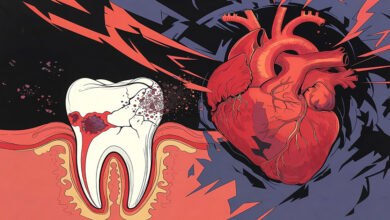
The AEGIS Alliance has covered other files where the popular version of a medical result outran the chemistry, including the U.S. government’s own cannabis patent and a cannabis study on opioid addiction that mainstream coverage treated as an inconvenience. A different route from the mouth to the same vessels is in the report on gum-disease bacteria turning up in calcified heart valves. More of this beat is in Health News.
This article is general information, not medical advice. If you have questions about heart health or anger, talk to a clinician.








I’m going to go ahead and enjoy my fits of lashing out anger, as I have no healthy alternative. Besides, it’s not like I wanted to retire.
And this is supposed to be cutting edge science? I have known this for 50 years.
so now i’m praying for the end of time!so hurry up and arrive!lol.