A Laser-Etched Black Metal Distills Real Ocean Water in Sunlight, Stacks the Salt as a Solid, and Pulls Lithium From Great Salt Lake Brine
Solar-Powered Desalination: A Breakthrough in Freshwater Production

A glass of drinking water is a solved problem until you ask where the next glass comes from. About 97 percent of the water on Earth is too salty to drink, to irrigate, or to run through a kidney. The industrial answer has been reverse osmosis: push seawater through a membrane with high-pressure pumps, keep the fresh side, and send a hotter, saltier leftover back to the sea. That leftover is called brine. It sinks, it can smother the seafloor, and it is the part of the plant that almost never appears in the ribbon-cutting photograph. The energy that drives the pumps usually comes from a grid that still burns something. When the grid fails, the plant fails with it.
Sunlight does not need that bargain. The question that has sat under this story since researchers first tried to boil a film of seawater with a solar-heated membrane is no longer whether a lab can fill a cup. It is whether the cup can be made without a toxic dump, without a chemical pretreatment, and without a power plant standing behind the panels.
Rice Heated the Membrane, Not the Whole Ocean
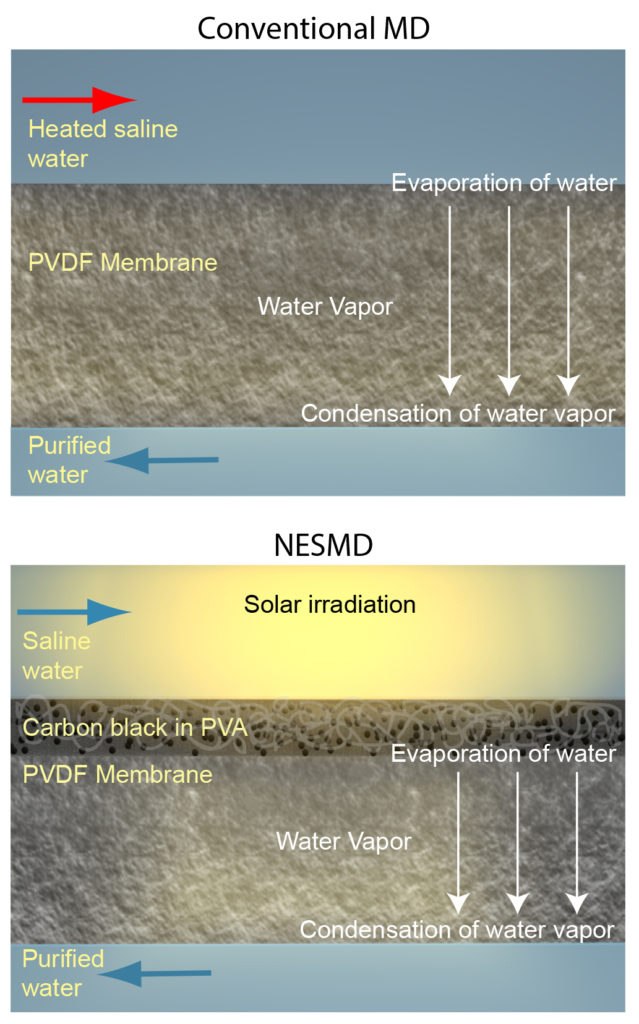
The diagram above is the architecture that made the argument concrete in 2017. At Rice University, Qilin Li and colleagues in the Nanotechnology-Enabled Water Treatment center published nanophotonics-enabled solar membrane distillation, NESMD, in the Proceedings of the National Academy of Sciences on June 19 of that year. Conventional membrane distillation heats a tank of feed water so vapor can cross a hydrophobic membrane and condense as fresh water. NESMD puts light-absorbing nanoparticles in the membrane itself. Sunlight heats a thin layer of water at the surface. The rest of the tank stays comparatively cool. In a small module under focused sun, the group reported a flux above 5.38 kilograms per square meter per hour, solar efficiency above 20 percent, and salt rejection above 99.5 percent. A pilot-scale reading without heat recovery pointed toward roughly four liters a day from a square meter under ordinary summer sun. Modest numbers. The point was the physics: you do not have to boil the sea to distill a drink.
A 2020 follow-up from the same Rice group put a stand-alone NESMD testbed on real seawater from Galveston Bay and on simulated brines as salty as 200,000 parts per million. Over consecutive five-to-eight-hour runs in Houston weather, total dissolved solids dropped by at least 99.5 percent, with an average flux of at least 0.75 liters per square meter per hour near full sun, and with internal heat recovery so the rig did not need an outside electric heater or a second water stream for cooling. That is a laboratory-to-courtyard machine, not a coastal city. It is also the reason a drawing of two membranes still belongs in this article. One design heats everything. The other lets the sun do a local job.
Rochester Refused to Make Brine at All
The hidden invoice of desalination is not the water you bottle. It is the hypersaline stream you are legally allowed to call someone else’s problem. On May 27, 2026, Chunlei Guo, a professor of optics and physics and a senior scientist at the University of Rochester’s Laboratory for Laser Energetics, and his group described a different end of that invoice in Light: Science & Applications. Their panels are black metal textured with femtosecond lasers. The grooves do two jobs at once. They swallow nearly all the sunlight that hits them and turn it into heat. They also superwick: a thin film of seawater races across the etched surface instead of beading up.
The salts do not stay on the working face. The group borrowed the coffee-ring effect, the same reason a drying droplet leaves a dark rim. Flow during evaporation shoves dissolved solids toward untreated “passive” zones at the edges. The active surface stays clear. There is no chemical pretreatment and no extra grid power. Tested on water from the Pacific, the Atlantic, and the Indian Ocean, and tracked with the sun over a week, the panel evaporated about 1.76 kilograms of water per square meter each hour under one sun, at about 74 percent solar-to-vapor conversion, while recovering nearly all of the salt as a solid rather than as brine. The salt harvest sat near 62 grams per square meter per hour, which is what you would expect if you distill ordinary seawater and keep the minerals instead of throwing them back.
Guo told Physics World the advance in plain language: “The most important advance is that our system can desalinate real ocean water continuously using sunlight alone, without generating waste, with little to no maintenance and while recovering valuable minerals such as lithium.” He added that the superwicking surface “overcame the clogging bottleneck that has limited solar desalination until now,” and that the run was “the first time we have achieved stable, low-maintenance, high-efficiency and nearly 100% salt-recovery performance with actual seawater.”
A companion paper in the Journal of Materials Chemistry A pushed the leftover further. The team embedded hydrogen-titanate nanoparticles in the laser-etched grooves. On samples from Utah’s Great Salt Lake, the panels captured about half of the lithium in the desalination residue while other salts passed. Lithium is the metal inside the battery packs whose price collapse The AEGIS Alliance has tracked in the long slide of pack costs and the tax and sodium-ion fight that followed. A desalination panel that returns drinking water and a battery metal is not a municipal plant. It is a different accounting of what used to be called waste.
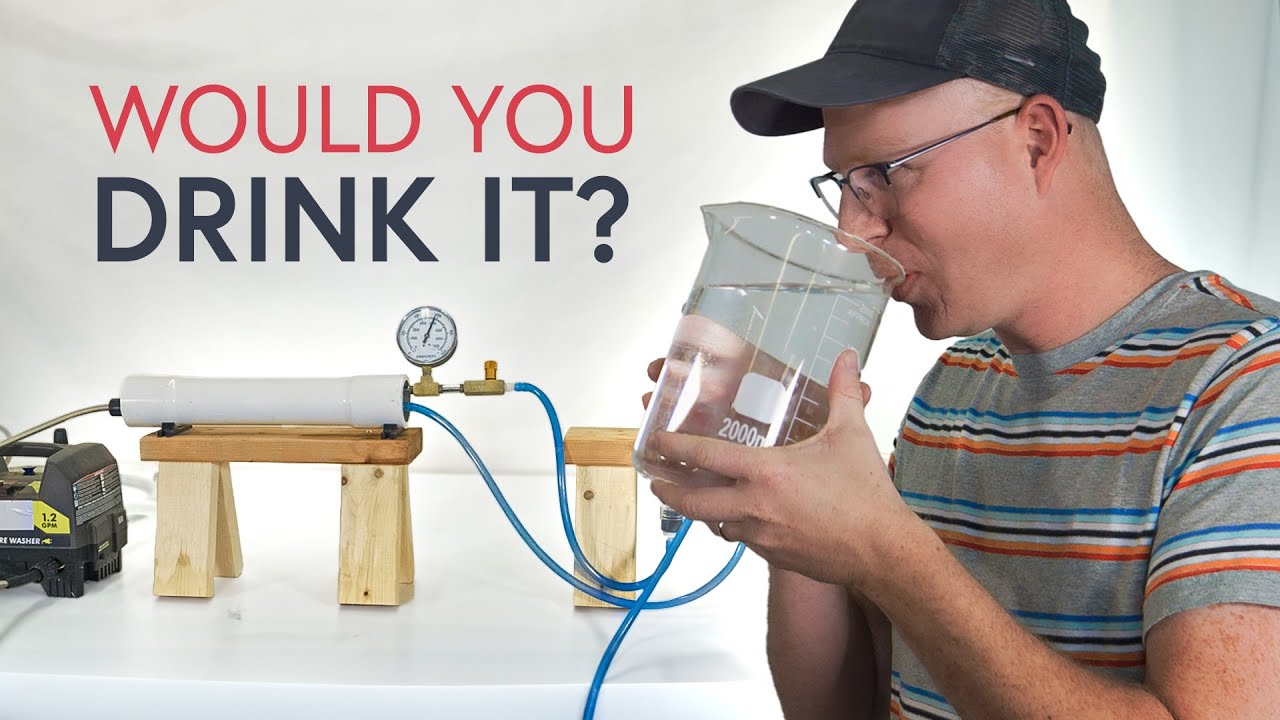
MIT’s Battery-Free Box Was Never a Seawater Miracle
A second camp has been easy to misread. In October 2024, MIT News described a solar desalination system from mechanical engineering professor Amos Winter, graduate researcher Jon Bessette, and staff engineer Shane Pratt that needs no extra batteries and no grid tie. It is electrodialysis: an electric field pulls salt ions out of water moving through ion-exchange membranes. The control loop retunes the desalting rate three to five times a second so the machine follows passing clouds instead of storing electricity for them. Winter’s line was blunt: “Compared to how you would traditionally design a solar desal system, we cut our required battery capacity by almost 100 percent.”
The six-month trial was not on the ocean. It ran at the Brackish Groundwater National Desalination Research Facility in Alamogordo, New Mexico, on real wells. The prototype produced up to 5,000 liters a day and, on average, put more than 94 percent of the panels’ electrical energy straight into desalting. That is a village-scale number, and for brackish groundwater it is the right machine. The same MIT report was careful about the next step. Adapting the design to seawater would not deliver the same energy advantage. Membranes and ion-exchange stacks get harder as the salt load rises. Rochester’s thermal panel and MIT’s electric stack are answers to neighboring problems, not the same gadget with a different sticker.
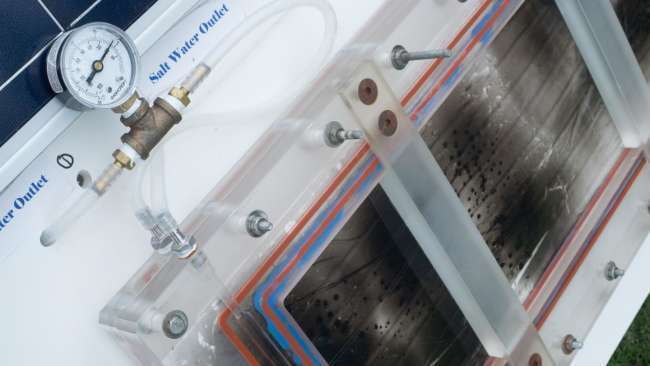

Other groups have chased the same sunlight with different scraps. Dalhousie researchers in Nova Scotia have worked photothermal materials that include carbon from used tires. Greek and Gulf pilots have fielded small solar stills aimed at islands and work camps. None of them replaces a coastal reverse-osmosis plant on a Monday morning. All of them say the fossil-fuel version is a procurement choice.
Meanwhile, a $2.8 Billion Plant Is Still Building a Brine Highway
The industrial counterexample finished a milestone in mid-September 2026, and it did not pretend to retire brine. Western Australia’s Alkimos Seawater Desalination Plant, a 2.8 billion dollar project north of Perth, completed two of the longest desalination intake and outfall tunnels in the country. Tunnel-boring machines named Mary and Karli spent 15 months as deep as 20 meters under the seabed, advancing up to 50 meters a day and installing about 32,000 locally made concrete segments. The intake tunnel runs 2.5 kilometers. The outfall runs 4 kilometers so concentrated brine can be carried offshore and dispersed. Premier Roger Cook called the tubes “an amazing feat of engineering” and “two of the longest undersea tunnels in Australia,” built with materials made in the state.
The plant is aimed at 2028. Stage one is designed for 50 billion liters of drinking water a year, enough to help supply more than 2.5 million people and to lean less on groundwater that a drying climate is already thinning. Stage two would double that if the money follows. The tunnels were bored under the reef on purpose. The brine still goes back to the ocean. That is the honest shape of reverse osmosis at city scale in 2026: extraordinary civil engineering in the service of a waste stream that Guo’s group is trying to turn into a pile of salt and a pinch of lithium.
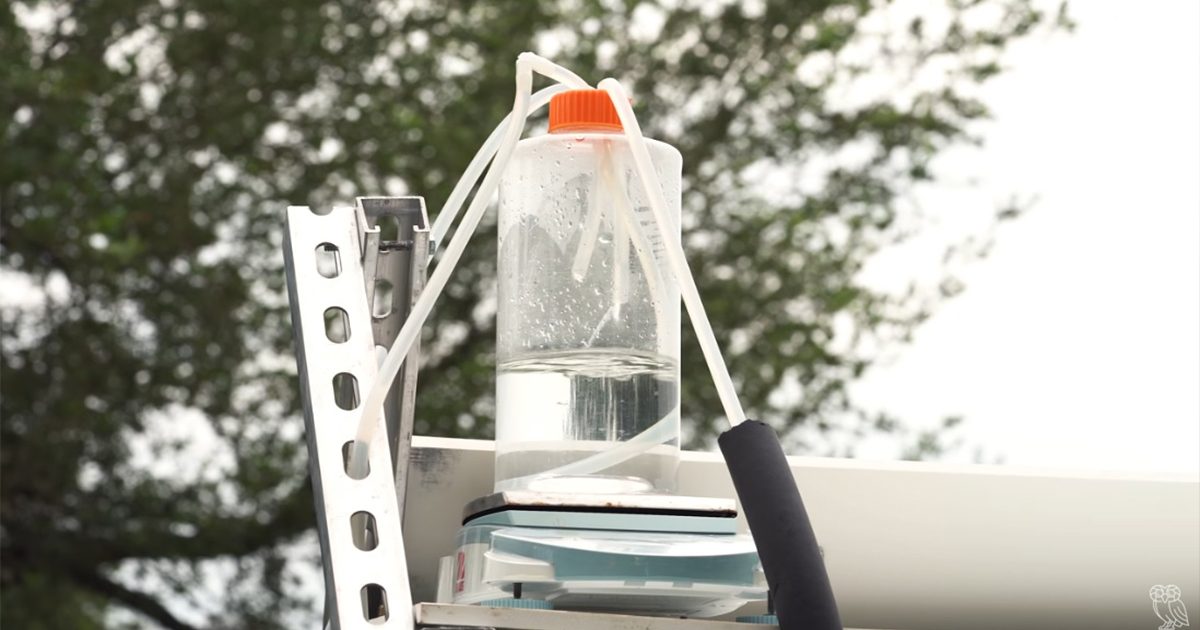
None of the solar machines above is a reason to cancel Alkimos. A square meter of black metal evaporating under two kilograms of water an hour will not water Perth. A trailer in New Mexico will not replace a 4-kilometer outfall. What they do is remove the alibi that brine, grid power, and chemical pretreatment are laws of nature. They are design decisions. Sunlight can distill real ocean water, stack the salt where a person can pick it up, and, on a salt lake already mined for industry, pull a battery metal out of the residue. The cities that keep building brine highways are choosing the highway.
For more of The AEGIS Alliance on the science and the water politics around it, see Science and Environment.