East Lansing Billboards Put Colorado’s Cannabis Tax Haul Next to a Rhinoceros the World Wildlife Fund Said Is Not Medicine

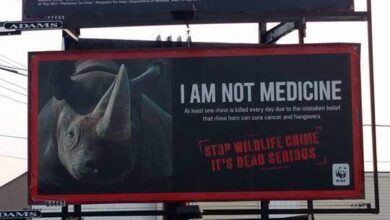
Sometime around the fall of 2017, Joseph Peeler photographed two billboards stacked on the same structure in East Lansing, Michigan. The top board belonged to Weedmaps. It told drivers that legal marijuana in Colorado was throwing off hundreds of millions of dollars in taxes. The bottom board belonged to the World Wildlife Fund. A rhinoceros faced the traffic. The line was “I AM NOT MEDICINE,” with the campaign name STOP WILDLIFE CRIME underneath. One sign priced a regulated drug. The other refused a fake cure. They were not in conversation with each other. The photograph made them a conversation anyway.
Peeler’s picture is the kind of roadside accident that ages into an argument. Colorado had opened regulated adult-use sales in 2014, the first state to do it, and by the time the board went up the tax checks were large enough to brag about on plywood. Michigan, where the photo was taken, had not yet opened an adult-use market of its own. The rhino board was doing a different kind of work. It was trying to kill a price. Horn was being sold, especially in parts of East Asia, as medicine and as a status object. The biology does not cooperate with the medicine claim. Rhino horn is keratin, the same protein family as hair and fingernails. There is no clinical special property that appears when the keratin happens to have been cut off a living animal. The trade exists because the story exists, and because a dead rhino is easier to move than a live one.
What Colorado’s Tax Board Would Say If Someone Repainted It
The Weedmaps number was early. The Colorado Department of Revenue’s Taxation Division said on September 17, 2026, that the state collected $18,980,768 in marijuana tax and fee revenue in July 2026, a few tens of thousands above June. Calendar 2026 through July stood at $132,910,105. Since collections began in February 2014, the cumulative total was $3,242,877,945. A department table through June had put the cumulative figure at $3,223,897,176, which matches the July addition. The peak year was 2021, at $423,486,053. Calendar 2025 brought in $236,449,405. The board’s tense was right and its scale was small. The market that produced those checks has also cooled. Annual sales slid after the 2021 peak, and 2025 sales were about $1.32 billion, down from more than $2.2 billion at the high. Tax revenue followed. Legalization did not freeze a boom in place. It created a taxable market that behaves like other taxable markets, including the part where the line goes down.
The money has a destination, which is the part a billboard never has room to print. Colorado stacks a 2.9 percent state sales tax, a 15 percent retail marijuana sales tax, and a 15 percent excise tax on wholesale transfers, before local add-ons. Excise proceeds have fed school construction through the BEST program. The Marijuana Tax Cash Fund has been appropriated to behavioral health, public health, K-12, and housing. Cannabis tax in Colorado has outrun the combined take from alcohol, tobacco, nicotine products, and cigarettes, and it is still a thin slice of the state budget. The honest version of the Weedmaps board is not “problem solved.” It is “a prohibited market was moved onto a ledger, and the ledger is public.”
Other states have been painting their own versions of that board without calling it a billboard. The U.S. Census Bureau, which began tracking state cannabis excise taxes in the third quarter of 2021, said states and the District of Columbia took in an estimated $3.55 billion between July 2025 and June 2026, and more than $15.8 billion across the five years of that series. The second quarter of 2026 alone was about $987.5 million. In the Census window, California led with more than $3.3 billion, then Washington, Illinois, Colorado, and Michigan. That series is excise tax from late 2021 forward. It is not the full history. An industry tally published in August 2026 put cumulative state cannabis taxes since legalization near $29.1 billion, with California and Washington still the long leaders and 24 states plus the District running adult-use systems. The two totals disagree because they start on different days and count different lines. Both are large enough to make the East Lansing board look like a down payment. Wintersville, Ohio, has already routed cannabis tax into road paving and water lines. A Maryland candidate has campaigned on using it for teacher pay. The argument is no longer whether the money exists. It is who gets the next check.
Michigan’s place on the Census list is the local punch line. The photograph was taken in a state that later built the market the top board was advertising somewhere else. East Lansing drivers can now buy legal cannabis in their own state and argue about their own tax, which is what happens when a roadside ad outlives the law it was mocking or promoting. The AEGIS Alliance’s file on Northern Michigan University’s medicinal plant chemistry degree caught one early institutional response to that shift, years before the tax checks got boring enough to pave a street in Ohio.
The Rhino Board Was Never a Metaphor
The bottom board has a ledger too, and it is counted in animals. On World Rhino Day, September 22, 2026, South Africa’s Department of Forestry, Fisheries and the Environment said the country remained home to the world’s largest rhino population. At the end of 2025 the minimum estimate was 15,096 animals, at least 12,531 of them white rhinos and 2,565 black. That was a 4.9 percent increase on 2024. From January through August 2026, poachers killed 230 rhinos nationally, compared with 248 in the same months of 2025. Kruger National Park lost 114 in that stretch, down from 123. KwaZulu-Natal lost 29, down from 67. The same release warned that the national drop hid local spikes, including Mpumalanga and North West. Poaching in 2025 equaled about 2.2 percent of the population, under a rough 3.5 percent sustainability line the department cited. Every one of those deaths still removes a breeder or orphans a calf. A percentage that looks survivable on a spreadsheet is a specific animal in a specific park.
The full-year numbers, released earlier, show why a single good summer is not a victory lap. Reuters reported on February 10, 2026, that 352 rhinos were killed in South Africa in 2025, a 16 percent drop from 420 in 2024 and 499 in 2023, the second straight annual decline of that size. Inside that improvement, Kruger went the wrong direction: 175 rhinos killed in the park in 2025, up from 88 the year before. Hluhluwe-iMfolozi in KwaZulu-Natal went the other way, from 198 in 2024 to 63 in 2025. Private reserves carried a smaller share of the killings than the state parks. Dehorning, more rangers, and integrity work inside Kruger are the tools the department credits. None of them cancel a buyer who still thinks keratin is medicine.
The demand does not stop at one border, which is why a Michigan billboard about a southern African animal was not a non sequitur. Zimbabwe marked the same World Rhino Day by saying population growth had beaten the 5 percent annual target in its prior management plan. The Herald quoted ZimParks on a 2026 return of critically endangered black rhinos to Matusadona National Park, using capture, translocation, and post-release monitoring, with satellite tags, camera traps, and DNA profiling in the toolkit. Namibia’s press was still putting poaching on the front page the same week. A growing herd and a poaching report can be true on the same Thursday. The WWF line on the East Lansing board was aimed at the buyer, not the ranger. Rangers can dehorn a rhino. They cannot dehorn a rumor.
Put the two ledgers back on the same pole and they stop looking like a quirky photo. Colorado can show a cumulative tax number past $3.24 billion and a sales curve that has already slumped. South Africa can show a rhino population that grew in 2025 and 230 animals killed in eight months of 2026. One market was pulled into the open, taxed, and argued over in public. The other still runs on a medical claim that a chemistry textbook can refute and a criminal market that does not care. The AEGIS Alliance has covered both kinds of stories for years, from the U.S. government’s own cannabinoid patent to the poaching cases that do not fit on a billboard. The activism desk is here: Activism. The international file is here: International News.
Peeler’s frame still works because neither board was embarrassed by the decade that followed. The tax board was too modest. The rhino board was still necessary. A legal market and a wildlife crime are not the same scandal, and the photograph never said they were. It said a highway is wide enough for both, and that what a society chooses to sell, tax, ban, or kill for is sometimes readable at 60 miles an hour.