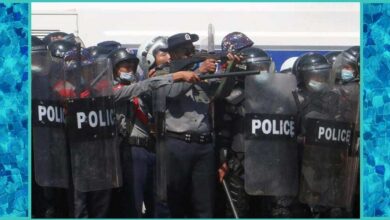
Myanmar Police Leveled a Weapon at Anti-Coup Crowds in Naypyitaw After the Tatmadaw Detained Aung San Suu Kyi

NAYPYITAW, MYANMAR — The photograph on this page is not a metaphor. On February 9, 2021, eight days after Senior General Min Aung Hlaing’s Tatmadaw detained State Counsellor Aung San Suu Kyi and the elected civilian government, a police officer in the capital leveled a weapon at people who wanted her released. Reuters photographer Stringer made the frame. Water cannon, rubber bullets, and live fire were already in use against crowds that had filled the streets after the February 1 takeover. The generals called the seizure a correction and a state of emergency. The people in front of that muzzle called it a coup.
Myanmar had been under military rule from 1962 until 2016, when Suu Kyi’s National League for Democracy won a landslide. The party won an even larger mandate in the November 2020 election. The army did not let the new parliament sit. Before dawn on February 1, soldiers detained Suu Kyi, President Win Myint, and scores of ministers and lawmakers. Phones went dark in parts of the country. A military television announcer read out the emergency. Within a week the Civil Disobedience Movement had doctors, teachers, railway staff, and bank clerks refusing orders, and the streets of Yangon, Mandalay, and Naypyitaw belonged to people carrying flowers, pots, and the three-finger salute.
The first week was not bloodless, and it did not stay a protest story. The Guardian described water cannon hitting Naypyitaw crowds on February 8, with some people knocked down and others handing branches and flowers to police who had briefly stopped firing. By mid-March the weapons were battlefield rifles. Human Rights Watch later documented the March 14 killings in Yangon’s Hlaing Tharyar industrial township: security forces kettled demonstrators, fired on people trying to reach the wounded, and killed at least 65 protesters and bystanders. A verified clip from the Aung Zeya Bridge that day caught officers looking down at the street and discussing whom to shoot. One voice off camera said, “Just shoot them in the head.”
Lethal force against the Civil Disobedience Movement did what coups of this kind usually do when the public will not go home. It produced an armed resistance. People’s Defence Forces grew out of neighborhoods that had been shot at. Long-standing ethnic armies that had fought the Tatmadaw for decades opened new fronts or deepened old ones. The war that followed has killed combatants and civilians in numbers that independent monitors now put well past 90,000, with Armed Conflict Location and Event Data tallies and 2026 compilations of that dataset pushing combined deaths past 100,000. The United Nations has put internal displacement at about 3.7 million. A September 2026 briefing drawn from conflict data called it Asia’s deadliest active war, with about one person in five facing acute food insecurity.
A closed courtroom, then a sash
Suu Kyi did not return to a microphone. Closed-court cases stacked a sentence that The Associated Press has described as 27 years on charges widely viewed as political. She turned 80 inside that system. In April 2026, the same month Min Aung Hlaing prepared to wear a civilian title, the military said she had been moved from prison to house arrest. The International Crisis Group noted that on August 3, 2026, with a Thai visit on the calendar, the regime allowed her to meet the International Committee of the Red Cross in Naypyitaw. A visit from the Red Cross is not a trial. It is proof of life arranged for an audience.
The path from the February 9 photograph to a presidential oath ran through a stage-managed election and a parliament the army already owned. Min Aung Hlaing stepped down as commander-in-chief so he could take a civilian chair. On April 3, 2026, the Pyidaungsu Hluttaw elected him the country’s 11th president with 429 of 584 votes. Nyo Saw of the military’s Union Solidarity and Development Party took 126 votes and became first vice president. Nan Ni Ni Aye, also USDP, took 29 and became second vice president. Speaker Aung Lin Dwe administered the oaths on April 10 inside a parliament building damaged in the March 28, 2025 earthquake. The president’s office said the new government would strengthen a “disciplined multi-party democratic system” and build a federal union on peace and reconciliation. The International Crisis Group called the arrangement military consolidation, not a transition. The BBC, Al Jazeera, and Reuters described the same fact from different desks: the man who ordered the 2021 crackdown had been given a letterhead.
The war did not change clothes
The sash did not stop the bombing. Crisis Group’s August 2026 watch recorded regime forces pushing in the north and southeast while airstrikes on opposition-held areas killed dozens of civilians. On August 21 a strike on a monastery in Myaung township, Sagaing, killed at least 14 people. On August 24 a strike on a school in Arakan Army-controlled Paletwa township, Chin State, killed five. On August 11 the United Nations said the military had escalated aerial attacks on civilians since July 2025 using low-cost paramotors and drones, the kind of aircraft a village can hear before it can see. A New York Times account from central Myanmar in June described the same pattern from the ground: drones on a community where reporters had slept, fighter-jet contrails, armed paragliders, and at least nine civilian killings confirmed locally that rights groups had not yet logged. In March, about 240 military airstrikes killed more than 400 people, many in the dry central zone known as Anyar, according to ACLED figures cited in that reporting. In mid-April two gyrocopters hit a village in Monywa township and killed at least 17.
The March 28, 2025 earthquake made the arithmetic worse. A magnitude 7.7 shock tore through Sagaing, Mandalay, and Naypyitaw while the civil war was already general. Published casualty counts have not settled on one number. Diplomatic and humanitarian counts have run from more than 3,000 deaths, with thousands injured, to figures approaching 4,200 killed. The junta announced a temporary ceasefire and asked for aid. Researchers and relief groups say the bombs did not stay parked. One Australian foreign-policy review counted more than 600 deadly attacks on civilians after the quake and restricted access to the wrecked districts. A builder whose Mandalay condominium, Sky Villa, collapsed and killed 206 people was later sentenced to five years with hard labor for causing death by negligence. The wider death toll of the disaster sat beside a war the courts were not sentencing.
Min Aung Hlaing spent the late summer of 2026 collecting handshakes. Crisis Group logged his August 6–7 visit to Thailand, an August 17–18 trip to Russia, and an August 21 stop in Belarus, followed by a visit from Vietnam’s foreign minister. In September, Malaysian Prime Minister Anwar Ibrahim offered to invite him in the hope of speeding Rohingya returns. That invitation sits next to a legal record the presidency does not erase. The Gambia’s case at the International Court of Justice accuses Myanmar of genocide against the Rohingya. The Associated Press has reported that in 2024 the International Criminal Court opened an investigation after its prosecutor applied for an arrest warrant for Min Aung Hlaing over crimes against humanity in the military’s persecution of that minority. A columnist in Kuala Lumpur put the contradiction in one line that traveled: a leader accused in those forums was being offered a red carpet for a repatriation talk. Sending refugees back into the hands of the army that drove them out is not a humanitarian schedule. It is a political one.
What the February 9 frame still shows
Resistance maps are not a victory parade either. Ethnic armies and newer units hold stretches of countryside and a list of towns, while the Tatmadaw, helped by conscription, more drones, and Chinese backing, has stabilized parts of a front line it was losing in 2023 and 2024. Major cities remain under military control. Operation 1027, launched in October 2023 by the Three Brotherhood Alliance, showed that the army could be pushed. It did not show that a parliament elected under that army’s rules could speak for the townships those bombs still hit.
The AEGIS Alliance does not confuse a parliamentary rubber stamp with legitimacy. The officer in the Naypyitaw photograph was enforcing a decision. The man who made it now signs papers as president. The war did not end when he changed clothes, and the people who stood in that street in February 2021 were not voting for the ballot that followed. Related reporting sits on our International News desk and in the Politics file, beside the UK spycops inquiry into security states that spy on dissent, and the ICC warrant that brought Rodrigo Duterte into custody over a different campaign of killing.