Israeli Gunfire at U.S.-Backed Gaza Food Sites Killed More Than 2,600 Aid Seekers, and Rafah Is Still Being Shot


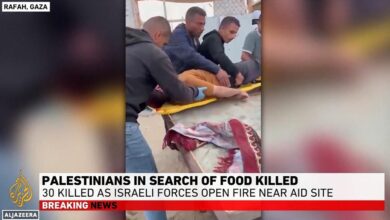
The first mass shooting at a U.S.-backed food site in Rafah was sold as crowd control. It was a design. On June 1, 2025, Gaza’s Health Ministry counted at least 31 Palestinians killed and more than 200 wounded as they walked toward a Gaza Humanitarian Foundation hub. The distribution-line killings did not stop at that morning. By October 9, 2025, the ministry’s running toll of people killed while seeking aid stood at 2,615, with 19,177 wounded, in the public accounting of those months. A ceasefire announced the next day let the foundation leave. It did not give the dead back, and it did not stop Israeli gunfire in the same southern strip.
On September 26, 2026, ambulance crews said a Palestinian child was killed by Israeli gunfire in Rafah’s al-Mawasi, the coastal zone where displaced families had been pushed. The logo on the tent is gone. The geography of the killing is not. That is the fact anyone still calling June 1 a misunderstanding has to sit with.
Four gates where there used to be a system
Israel sealed Gaza on March 2, 2025, and kept food, water, fuel, and medicine out for about eleven weeks. When a trickle returned, it did not return through UNRWA. The Gaza Humanitarian Foundation, backed by Washington and Jerusalem, opened on May 26 with a handful of contractor-guarded mega-sites. Families walked miles, often through areas the army had told them to leave, to reach a sack of flour.
Jake Wood, a former U.S. Marine hired as the foundation’s first executive director, quit on the eve of operations. He said the scheme could not meet basic rules of neutrality. More than 170 charities, including Oxfam and Save the Children, refused to join it. UN officials called the model a death trap. Our report on catastrophic conditions in Gaza laid out the hunger math. The shooting was the enforcement mechanism.
The design was the tell. UNRWA and partner agencies had run a dense net of neighborhood points. GHF collapsed that net into chokepoints an army could see, fence, and fire across. People who wanted flour had to present their bodies at the only doors left open. Then the doors became kill zones. A genocide does not need a new invention every season. It needs a logistics plan that makes survival itself a walk through a field of fire.

What a contractor, a newspaper, and the hospitals described
The International Committee of the Red Cross took in scores of gunshot and shrapnel cases after the June 1 Rafah incident. Nasser Hospital logged dozens of bodies and well over a hundred wounded that day. Israel said troops fired warning shots at suspects. Haaretz later reported that soldiers were ordered to shoot unarmed crowds near the food lines, a drill some of them called Operation Salted Fish. Benjamin Netanyahu called the reporting a blood libel.
Anthony Aguilar, a retired U.S. Army lieutenant colonel who worked the sites through subcontractor UG Solutions, used a different noun. In an interview that is still the clearest insider account, he said he watched Israeli forces fire a tank’s main gun and a coaxial machine gun toward unarmed crowds and call it a warning. “I call that a war crime,” he said. A belt-fed machine gun is an area weapon. It does not whisper. Doctors Without Borders treated patients from the hubs through that summer and described the points as sites of orchestrated killing. On August 1, 2025, the same day a U.S. envoy toured a GHF site, a 15-year-old was killed near the Al-Shakoush hub while trying to get food. UN human rights experts demanded the foundation be dismantled as a cover for military and geopolitical aims.
Warning shots that empty a hospital ward are not warnings. They are rules of engagement that treat a hungry civilian as a problem to be pushed with live ammunition. The man who said so on the record was not a spokesman for any armed faction in Gaza. He was a contractor the project had put on the ground.
The AEGIS Alliance has covered enough international files to recognize the sequence. Close the real aid system. Open a boutique replacement with cleaner branding. Blame the dead for standing in the wrong place. Months after the tents came down, influencers were still defending the foundation’s name. Reputation is not a body count. It is evidence that the branding failed.
A shutdown is not an erasure
The October 10, 2025, ceasefire let GHF abandon the sites. On November 24 the foundation said its mission was over and pointed at a figure of 187 million meals. The UN human rights office had already counted well over a thousand aid seekers dead, most of them near GHF points, most of them attributed to Israeli fire. The Health Ministry’s later total, past 2,600, made the self-congratulation obscene.
Israel kept blocking established agencies after the truce. UNRWA still could not bring its own food through the gate. The famine finding IPC issued for Gaza City in August 2025, and the starvation deaths around it, sit on the same page as those aid-line dead. One policy: constrict the strip, then shoot people who walk toward the door you left open. OCHA’s September 2026 updates show the sequel. More than 1,400 Palestinians killed after the ceasefire announcement. Rations cut to about half the minimum calories in the first half of September because stocks ran thin. The tents with the American-Israeli logo are gone. The doctrine that built them is not.
Qatar, Egypt, and Jordan had to go on the record in January 2026 after a single day of strikes killed dozens under the supposed truce. Our report on those ceasefire violations is the political twin of this one. Mediators can type the word calm. An army that already shot a food line does not need a new theory to keep shooting a tent camp in Rafah.
The Flour Massacre was the template
February 29, 2024, already showed the method. Israeli fire on people around aid trucks in Gaza City, the killings Palestinians call the Flour Massacre, killed at least 118 people by the Gaza Health Ministry’s count. GHF industrialized the geometry. Private contractors. A small number of chokepoints. An army that calls live rounds a warning. The United States paid for the branding. Israel supplied the rifles. Palestinians supplied the bodies that made the nightly numbers.
Anyone still arguing that June 1 was an isolated incident has to explain the next four months. Isolated incidents do not produce more than 2,600 dead at food sites. They do not produce a foundation so radioactive that 170 charities would not touch it. They do not produce a UN expert statement calling the project a cover for military aims. They do not produce a U.S. military veteran, hired to guard the flour, using the words war crime on camera.
The United States had a choice about whether to underwrite a replacement for the UN system. It chose the replacement. That choice is part of the death toll, not a footnote under it. When American officials toured a hub on the same day a teenager was killed trying to reach another hub, they were patrons inspecting a project that already had a casualty ledger. The AEGIS Alliance coverage of athletes who refused to treat Gaza as background noise exists because official language kept failing. Crowd control is what you call it when you do not want to say the bread line was shot.
A child killed in al-Mawasi in September 2026 is not a GHF statistic. The sites are closed. He is the proof that closing the logo did not close the policy. The AEGIS Alliance will not treat a body count at a soup line as a misunderstanding. Anyone who copies the GHF model is copying a kill zone and calling it charity. Keep Wood, Aguilar, Doctors Without Borders, and the Health Ministry on the same page as the denial. The record is not confused. The public-relations strategy is.