Gilbarco Told Greensboro Workers They Could Stay Home, Then Ordered Them In the Next Day or Be Fired


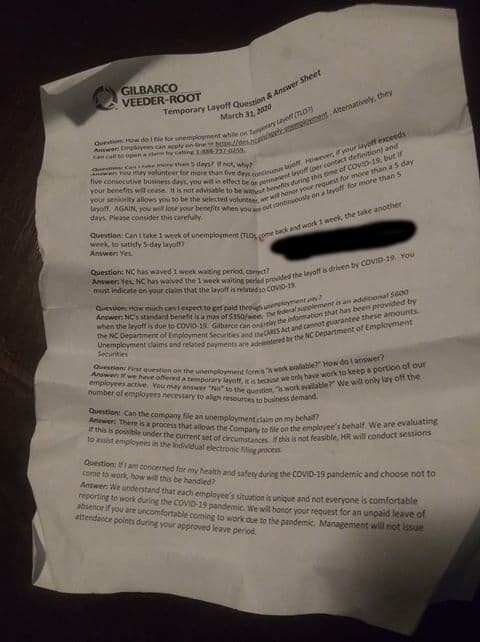
GREENSBORO, NORTH CAROLINA — The paper is dated March 31, 2020. Workers at Gilbarco Veeder-Root say it was in their hands on Wednesday, April 1, at the fuel-dispenser plant on 7300 West Friendly Avenue. If you did not feel safe coming in while COVID-19 was tearing through North Carolina, the company would honor unpaid leave and would not hang attendance points on you. A layoff longer than five days could be turned into a permanent separation. Help filing for unemployment was on the table. On Thursday, April 2, workers told The AEGIS Alliance, that letter was dead. Report to the building or risk being fired. They asked not to be named. One of them put the reversal in a single breath.
“My employer Gilbarco Veeder-Root in Greensboro, North Carolina said on Wednesday and wrote us a letter saying we can be off work on Wednesday, and if we don’t feel safe we can stay home. Then on Thursday they recalled this letter and said that everyone has to come to work, and we all don’t feel safe.”
The letter did not appear out of a calm spring. Two weeks earlier, on March 17, Gilbarco had published its own COVID-19 notice. Nonessential travel was banned. Travel to countries the Centers for Disease Control had flagged was banned. At the Greensboro campus the company said it was cutting person-to-person contact: no crowded rooms, no big meetings, workstations spread out. More than half the Passport help-desk operators could already log in from home, and the company said it was pushing that to 100 percent by the end of the week. Service-station equipment reps and the technical assistance center were being sent remote. The supply chain, the notice said, had not been hurt. The sentence that matters is the one about the factory floor: Greensboro production was still running at full capacity. The people who could answer a phone from a kitchen were offered a laptop. The people who built the dispensers were offered a policy that lasted a day.
Full Capacity, Then a Quiet Case Count
Fuel pumps were treated as critical infrastructure, and the company was not wrong that a gas station without a working dispenser is a closed gas station. The fight was about who absorbed the risk of keeping that network up. By early June the risk had a head count. On June 5, 2020, and again in a follow-up, Gilbarco confirmed to WFMY News 2 that employees at the Greensboro headquarters had tested positive. The statement called the company an essential business “that keeps critical fueling infrastructure running,” said safety was the top priority, and then narrowed the number to “a small number” of employees who were self-quarantining. Privacy, the company said, blocked anything more specific. Anyone with extended contact would be quarantined and tested. The building had been deep-cleaned. Temperature checks, masks, distancing, and hand-sanitizer stations were in place, and people who felt sick were asked to stay home.
Workers talking to the station told a sharper version. A spokesperson would not give a number. Employees said managers had announced the 15th positive case on the floor and that the illness was moving through the plant. The gap between “a small number” and “the 15th” is the gap between a press statement and a shift change. People who had been told on April 1 that fear was a lawful reason to stay home had, by June, a building where the virus was no longer hypothetical. The April 2 order had already answered the question of what the company would do with that fear.
Neighbors noticed the quiet. One Greensboro resident asked a local television station in mid-June why a coronavirus outbreak at Gilbarco was not on the air. Another posted the WFMY headline and stopped there. The company’s own public feed, in the same stretch, was explaining how to wipe down a point-of-sale terminal. The internal story and the customer story were not the same story. Customers were told the fueling network was being protected. The people inside the network were told to clock in.
OSHA Counted Complaints and Wrote Few Tickets
They were not the only plant in that bind, and the federal agency that is supposed to be the backstop was not writing tickets at anything like the rate of the complaints. OSHA’s own year-end accounting for fiscal 2020 said the agency received 20,541 complaints and that 9,189 of them were coronavirus-related. It said it investigated every complaint. Through November 12, 2020, the Department of Labor announced a different number that tells you what “investigated” meant in practice: 232 citations arising from coronavirus inspections, and proposed penalties of $3,148,452. The citations that did land were mostly familiar ones — no written respiratory program, no fit test, no medical evaluation, a death or an illness that was not recorded — plus the occasional use of the general duty clause, the catch-all that applies when no specific standard covers the hazard and the agency can document that the employer knew.
A Government Accountability Office review, GAO-22-105711, later described the hole those workers were standing in. From February 2020 through June 2021, OSHA relied on standards written for other dangers and on voluntary guidance. Inspectors struggled to make a respirator rule fit a virus, and a general-duty citation takes a stack of paper most field offices did not have time to build while the complaints were still arriving. There was no COVID-specific standard in force before June 2021. When the big emergency rule finally came, in November 2021, it told large employers to require vaccination or weekly testing. The Supreme Court blocked it in January 2022, drawing a line between a hazard that is particular to a workplace and a hazard that is simply life during a pandemic. The healthcare emergency rule was the piece that survived longer. A fuel-dispenser factory in Greensboro was never going to be rescued by a standard aimed at hospitals, and it was not rescued by the complaint line either.
That is the context for a one-page letter that lived for about twenty-four hours. A worker who stayed home on the strength of the March 31 question-and-answer sheet had no OSHA rule to point at on April 2 when the sheet was pulled back. Attendance points, the threat of firing, and a labor market that was about to collapse were the enforcement mechanism that actually operated. The AEGIS Alliance wrote at the time about what the stimulus bill did and did not do for people in that spot, about the jobs that did not come back, and about a Kaiser Permanente swab trial that found unused test kits coming back positive. The Gilbarco letter is the local version of the same fact: the paperwork said one thing, and the shift said another.
The Parent Company Moved to Raleigh. The Campus Stayed
The corporate name over the door changed before the year was out. In October 2020 Fortive spun off about 80 percent of a new company, Vontier Corporation, and sold the rest of its stake in January 2021. Vontier trades on the New York Stock Exchange as VNT. It is headquartered in Raleigh, at 5438 Wade Park Boulevard, not on Friendly Avenue. Its brands include Gilbarco Veeder-Root, Matco Tools, and Teletrac Navman. Reported 2025 revenue was about $3.08 billion, with net income around $406 million. Mark Morelli is president and chief executive. Karen Francis is chairman. Gilbarco still builds and services the dispensers, payment systems, and tank monitors that sit on retail fuel islands, and the Greensboro campus is still listed at 7300 West Friendly Avenue. The workers who were told to swallow April 2020 so the pumps would not skip a day are not in the spinoff slide deck.
The AEGIS Alliance published the letter because a company does not get to write a stay-home policy on a Wednesday and shred it on a Thursday without the page surviving. The March 17 notice told the public the plant was at full capacity and the help desk could go home. The March 31 sheet told the floor that fear would not be punished. April 2 told the floor to forget the sheet. June told the city there was “a small number” of infections while people on the floor counted toward 15. OSHA, that year, turned 9,189 coronavirus complaints into 232 citations. Vontier got a ticker symbol. The censored question-and-answer sheet is still the cleanest evidence of what those workers were promised and how fast the promise was revoked. More of this record is filed under health news at The AEGIS Alliance.