
Heal-Berg’s Iceberg Skyscraper Promised Lasers Would Turn Carbon Dioxide Into Oxygen. Mammoth’s Fans in Iceland Show the Real Math

In 2017 a pair of designers asked a skyscraper jury to imagine an iceberg that could inhale a warming sky. Luca Beltrame of Italy and Saba Nabavi Tafreshi of Iran called the drawing Heal-Berg. It took an honorable mention in the eVolo 2017 Skyscraper Competition, the annual contest that treats tall buildings as arguments rather than floor plates. The argument was blunt. Build a floating machine, park it where the air is worst, and turn carbon dioxide back into oxygen.
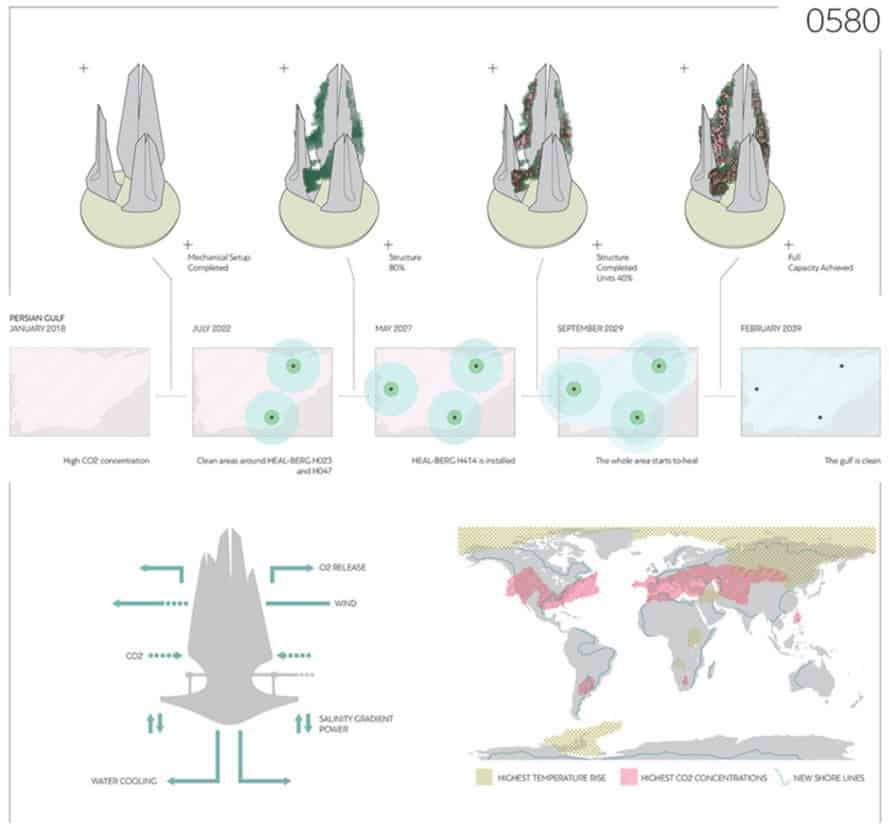
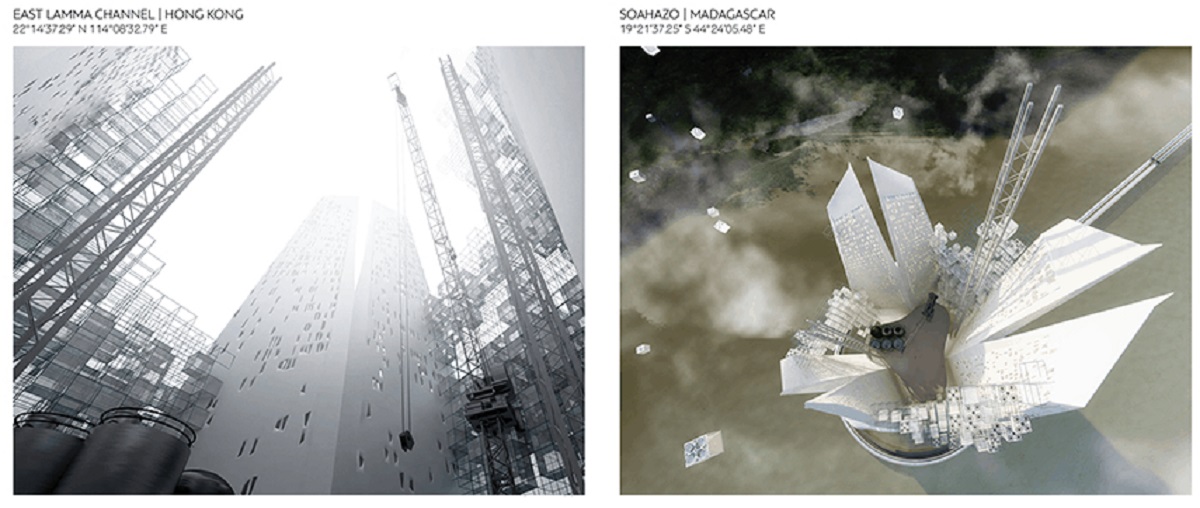
Their own text still reads like a manifesto stapled to a rendering. “Our vision for HEAL-BERG is to develop independent complexes (in terms of energy and mobility), created to cease, heal and reverse the process of climate change and its impacts on the planet,” they wrote. “We went on a mission to gather some of the most recent innovative technological breakthroughs from all around the world, and combine them into a greater whole working toward a single goal: survival.” The drawing showed oxygen ducts, wind channels, a suction fan, drone lifts, and a high-energy laser labeled as the step that would crack CO2. Antarctica was one proposed station. Other boards dropped the same white mass beside Hong Kong and Madagascar, as if a mobile berg could commute between a gulf and a skyline.
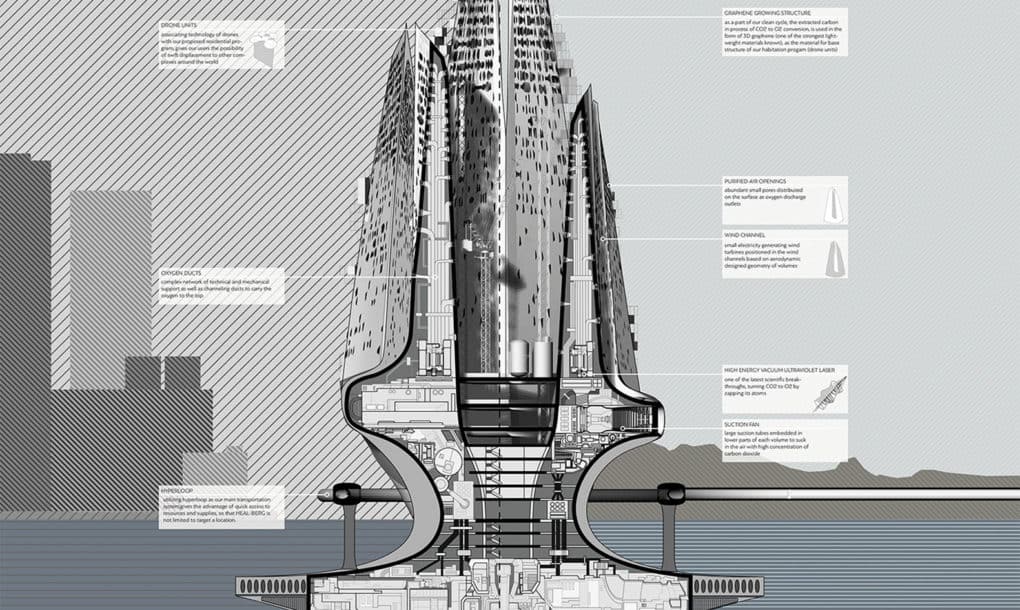
Four ideas held the concept together. The air system was the laser, borrowed from a real laboratory result and then inflated to the size of a city. Power would come from the salinity difference between water layers, a method engineers call osmotic or blue energy, plus turbines cut into the shell. The frame would be graphene, the carbon sheet often described as about 200 times stronger than steel by weight. And the berg would not be an empty filter. It was drawn as a place to live, with homes inside and drones for the errands a street would normally do.
The laser was the part that sounded like science and behaved like science fiction. In October 2014 a team at the University of California, Davis, including physical chemist Cheuk-Yiu Ng, published evidence in Science that a vacuum-ultraviolet laser can split a carbon dioxide molecule into a carbon atom and an oxygen molecule, not only into carbon monoxide and a single oxygen atom. Phys.org’s account of the paper put the yield at about 5 percent, plus or minus 2, in a narrow band of wavelengths between 101.5 and 107.2 nanometers. The point of the experiment was the early atmosphere, and maybe Mars or Venus, where hard ultraviolet light from a star might have made a little oxygen before photosynthesis existed. It was a pump-probe measurement in a vacuum chamber. It was not a permit to bolt a ray gun to an iceberg and call the sky finished. Open air is almost all nitrogen and oxygen. Carbon dioxide is a thin slice of that mix, a few hundred parts per million. Grabbing it, holding it, and breaking it with a laser at city scale would burn more energy than the drawing admits.
That is the useful crack in the rendering. Heal-Berg treated dilution as a design flaw architecture could style its way past. Every real attempt to pull CO2 out of the wind has had to admit the dilution first. Fans, filters, heat, and a place to put the carbon: those are the unglamorous parts. The berg skipped them and drew a laser instead.
What a Working Machine Looks Like When the Laser Is Gone
The machine that actually went to work does not look like ice. The Swiss company Climeworks opened Orca in Iceland in 2021, then switched on a larger plant named Mammoth at Hellisheidi on May 8, 2024. Mammoth was drawn for a nameplate of up to 36,000 tons of carbon dioxide a year, about ten times Orca, across 72 collector containers in six modules. Fans push air across a solid sorbent. Heat releases the gas. The partner Carbfix injects it underground, where it mineralizes in basalt. The electricity is geothermal, from the same Hellisheidi field, which is the one overlap with Heal-Berg that is not a metaphor. Both projects refused to power a carbon machine with a smokestack.
On September 10, 2026, co-founder and co-CEO Jan Wurzbacher said the plant had finally started to behave like the drawing on a very small patch of itself. Upgraded sorbent and mechanical changes more than doubled capture in collector containers that had been running the new setup for more than six months. Two of those containers hit the original design peak of about 1.37 tons of CO2 a day, a rate Climeworks said the first containers had missed by about half. Operating cost per ton fell by more than 50 percent over the year, the company said, without publishing the dollar figure. Net removal, after downtime, weather, and the emissions of running the system, was 675 tons in the first half of 2026, against 119 tons in the first half of 2025. Bloomberg described that as nearly a sixfold rise. The upgraded containers were running at a capacity factor of roughly 40 to 50 percent. Climeworks plans to put the same upgrades on all 12 containers in one module before the end of 2026, and to start testing a next-generation sorbent at Mammoth at the beginning of 2027. In the lab, the company has talked about a tenfold gain in how long that sorbent lasts, and a fourfold gain in process density, which would mean fewer boxes for the same removal.
Read the 675 tons against the brochure. Six hundred seventy-five tons in six months annualizes near 1,350 tons. The nameplate is 36,000 once the full set of containers exists and runs as designed. Mammoth is a first-of-a-kind plant whose operators spent eighteen months chasing reliability instead of maximum tonnage, and they have said so. That honesty is the opposite of a competition board that jumps from 2018 to a clean gulf in 2039. It is also why direct air capture is still the expensive way to deal with carbon. Nobody serious argues that fans in Iceland replace a closed coal plant. They argue, more narrowly, that some emissions will be left after everything cheaper has been done, and that those leftovers need a machine that can be counted.
The other materials in the Heal-Berg pile have moved, just not into a floating city. Graphene shows up in laboratories and a few industrial products, not as the skeleton of a residential berg. Salinity-gradient power has pilot plants and a long list of clogged membranes. Wind turbines are ordinary, including the awkward afterlife of their blades. The AEGIS Alliance looked at one of those afterlives in Lund, where old rotor tips became a curtain wall on a parking garage while the heavy roots waited on a second job. That is climate hardware being reused because it already exists, which is a humbler cousin of a drawing that tried to invent the hardware and the city in the same sheet.
Climeworks has also been hauling a mobile capture rig between climates, from Icelandic cold toward Saudi heat and, the company said in September 2026, on toward Canada. Heal-Berg wanted that kind of mobility in a single sculptural object. The test rig is a reminder that climate, dust, and humidity change what a filter can do, and that a drawing set in Antarctica does not answer a question about Riyadh. A falling battery price changes the electricity story around any of these machines. It does not repeal the physics of dilute gas.
Heal-Berg belongs in the archive of ideas that were directionally obsessed and mechanically casual. The obsession, getting carbon out of the air and refusing to power the attempt with fossil fuel, has aged better than the laser. The casual part is why the honorable mention should not be mistaken for a bid package. Architecture can still use the drawing. It can ask what a building owes the air around it, the way an older generation asked what a building owed the street. The machines that cash that question are currently boxes on a lava plain, not a white tower with drone elevators. Anyone who wants the longer argument about energy that does not start with a smokestack can start with The AEGIS Alliance’s file on solar power used to push salt water toward fresh, then the environment and science desks.








What twaddle. CO2 is the life of this planet. Plants die without it.and then we all starve.
Optimum carbon is 1440ppm. That’s the level commercial glasshouses operate at to enhance plant growth.
If CO2 drops much below where it is now it will be an extinction event for all life on earth.
Interestingly the same people telling you CO2 is too high and needs to be lowered are also the people calling for global depopulation.
Time to wake up and snap out of the delusion.
Learn 2 new words = Industrial Hemp = 1 acre of Industrial Hemp = 4 acres of trees! Also Google – Henry Ford’s 1942 “Hemp car” – you won’t read about this in your history books in school! Metal Braveheart Dave has spoken…
Media: https://www.facebook.com/photo.php?fbid=7983185701726443&set=p.7983185701726443&type=3