Lund’s Niels Bohr Garage Wears Danish Rotor Tips While the Heavy Blade Roots Wait to Become Noise Walls

https://www.youtube.com/shorts/60Jm71I_BF8
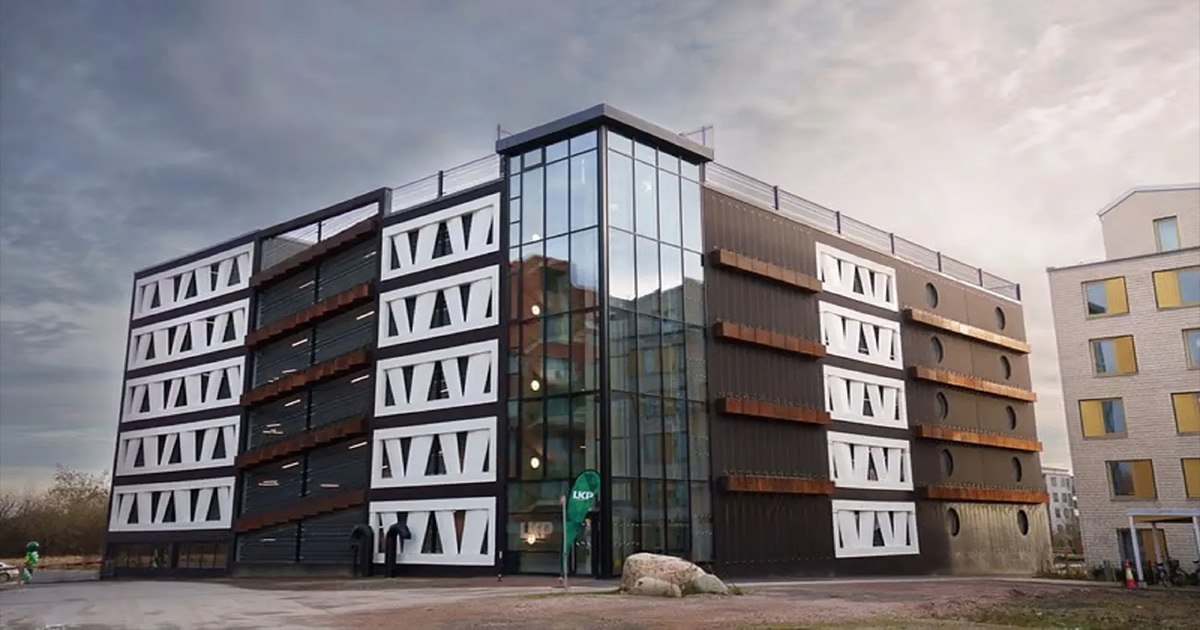
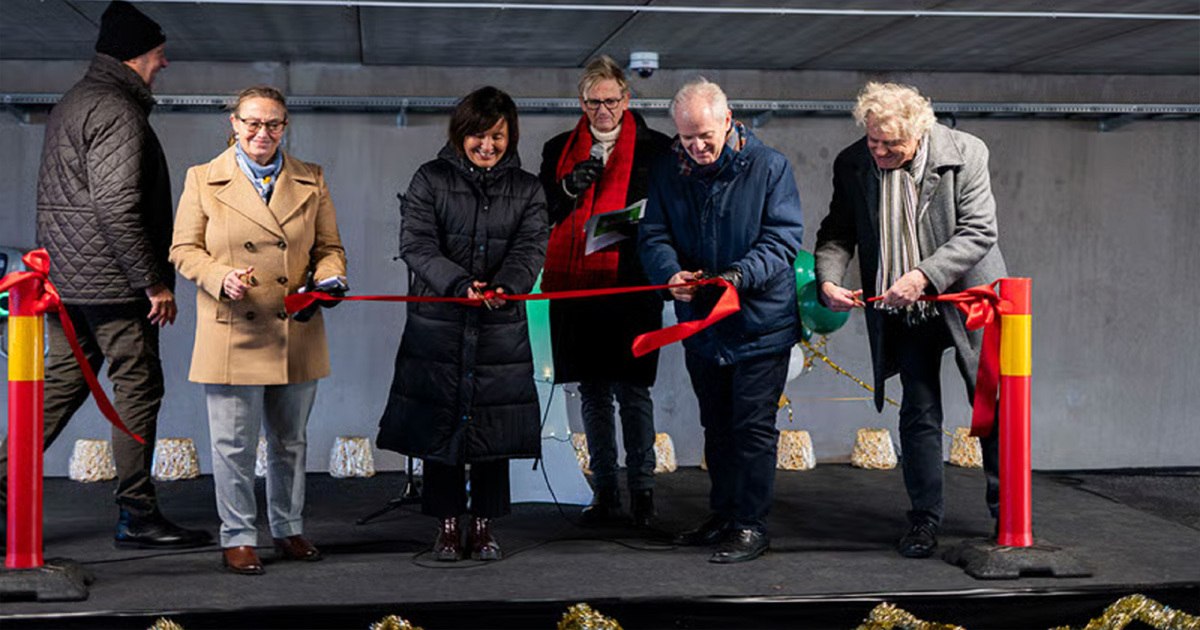
The tips of 57 Danish rotors are doing a job they were never molded for. They are the skin of the Niels Bohr car park in Lund, a five-storey municipal garage in Brunnshög that Lunds kommunala parkeringsbolag opened in December 2025 and that Vattenfall still calls the first car park in Europe built this way. The blades do not hold the floors. They are curtain wall, cut from the narrow end of rotors that spent about two decades over Nørre Økse Sø in Jutland. What the sidewalk photos leave out is the heavier half. A Swedish research review published in early 2026 says each blade was about 23 metres long, that three three-metre panels were sawn from the slender portion for the façade, and that the root sections, about 13 metres each, are still sitting with LKP in Lund, earmarked for a later life that includes noise barriers.
That split is the real design. Architect Jonas Lloyd of Lloyd’s Arkitektkontor wanted the wall to stay recognizable. His office calls the approach visible sustainability. A commuter is supposed to see fiber, curve, and portholes and understand that the cladding used to harvest wind. The roots, thick and awkward, were never going to make a pretty elevation. They are the inventory problem the ribbon-cutting did not solve.
A demolition planned around a parking deck
The farm came out of service in 2023. The physical takedown ran into 2024, and the timing is why the garage exists at all. A circular-design study hosted on Sweden’s DiVA portal describes a collaboration among Vattenfall, the Danish dismantling firm Kingo, and Lloyd’s office that ran in parallel with the CIRCUBLADE research project from 2022 to 2024. Because the garage was already on the drawing board, the blades could be cut for a known building instead of being chopped for a landfill or a kiln. Twenty-nine turbines supplied the 57 blades Vattenfall donated. Later international write-ups, including a September 2026 feature that sent the photographs around again, have said 19 turbines. The company and the architect’s account are the ones that match the blade count on the wall.
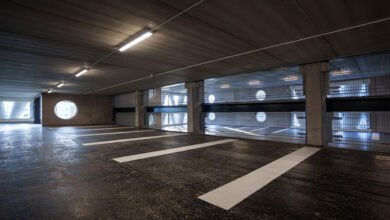
LKP runs roughly 28,000 spaces across Lund. Niels Bohr is both short-stay and long-stay parking for a district built around labs, housing, and the MAX IV and ESS research campuses. The house has 365 stalls, 40 of them with EV chargers, a roof array, and a battery so cars can take power after dark without dragging the grid. Planters sit in the same plane as the laminate. Naming the building after Niels Bohr ties a Danish waste stream to a Swedish science park without pretending either country has finished the decommissioning problem.
Paul Myllenberg, LKP’s chief executive, has said the idea raised eyebrows inside the company and that reality exceeded expectations. Anne Mette Traberg, Vattenfall’s country manager for Denmark, called the finished garage visible and concrete proof that sustainability can meet cost, schedule, and safety. Those three tests are the ones reuse stunts usually fail. Lund passed them once, on one building, with donated parts and a contractor who knew the cut list before the turbines hit the ground.
Why the pretty half is the easy half
A blade is glass or carbon fiber locked in a thermoset resin. Heat does not soften that resin. It chars. The U.S. Department of Energy has said for years that about 90 percent of a turbine’s mass already has a scrap path. Towers and copper go back to market. The leftover tenth is almost always the blade. In the American plains, early retirements were sawn into sections and buried, including in Casper, Wyoming. Lloyd has said a magazine story about that burial pile is what turned a waste headline into a façade.
Chemical recycling, cement kilns, and resins designed to unzip on command are the industrial answers. Vestas and Siemens Gamesa have both published processes. None of them is cheap enough, or common enough, to swallow the first generation of European onshore farms coming down in the same decade that offshore blades longer than a football field are going up. Reuse skips the factory. It also skips scale. A city can clad one garage. It cannot clad a fleet.
Vattenfall has banned landfill for its blades and has promised to reuse, refurbish, repurpose, or recycle every blade, nose cone, and nacelle cover by 2030. The company has already turned laminate into ski cores, insulation, and solar-panel frames, and it has turned at least one nacelle into a tiny house. Lund is the first time the parts are large enough, and public enough, that a stranger can argue about them from a sidewalk. The company operates more than 1,400 turbines. When those rotors come down, the photogenic tenth will still need more than one municipal deck.
The roots, and a Dutch screen that actually got measured
LKP still had material after the façade went up. The company ran a public contest for ideas and offered a month of free parking to the winner. That is a press stunt. It is also an admission. The DiVA review is more specific than the contest copy. The remaining root sections are in Lund and are planned for a later stage, including as noise screens. Roots are the heavy end. A 2024 materials paper that tracked this exact cutting plan put the tip-side façade stock near 170 three-metre pieces and sent the 13-metre roots toward a barrier concept. The garage used the light end. The loud end is still in the yard.
The Netherlands has already tested whether that second job is real. On July 2, 2025, startup Blade-Made and Rijkswaterstaat unveiled a 60-metre Blade Barrier along the A58 near Oirschot, built from two whole retired blades and a cut section, varying between three and four metres high. On February 3, 2026, the road authority said the first measurements put the screen’s noise reduction in the same range as a standard concrete barrier about 3.3 metres tall. Monitoring on cost, safety, maintenance, and durability runs through the end of 2026. Acoustic parity on a test stretch is not a procurement program. It is the first number a highway agency can put next to a brochure.
If Lund’s roots follow that path, the garage stops being a one-off sculpture and becomes the tip of a two-product system: façade panels from the slender laminate, barriers from the root. If the roots stain in a yard for another five years, the contest was the strategy. Other concepts in the same research lane imagine blades standing the full height of a building, on the order of 160 blades, with a construction start discussed for 2026. That is a different structural bet than Lloyd’s infill. It is also a reminder that architects are still drawing the third life while the second life is only half installed.
What a driver is actually buying
Brunnshög is one of Sweden’s largest development zones, planned around research infrastructure and a tram. A multi-storey garage looks like a contradiction until the chargers and the battery are counted. LKP is not arguing that cars should vanish. It is arguing that the cars that remain should lean on local generation, and that the box that stores them should not be dead concrete. The same habit shows up in older reporting from The AEGIS Alliance, from an iceberg-shaped tower sold as a climate machine to the quieter fact that battery prices have fallen far enough to change what a parking deck does at night.
Critics of blade reuse have a fair maintenance point. Laminate that spent twenty years in a Jutland wind field will keep taking ultraviolet light and freeze-thaw cycles on a Swedish façade. Fasteners need inspection. If a panel delaminates over a travel lane, the eye-opener becomes a claim. Lloyd designed the blades as infill, not structure, which limits how far a failure can travel. That is competent engineering. It is not a template you photocopy onto every municipal deck in Europe. Coatings weather. A 20-metre curve is a nightmare to truck through a historic center. Insurance still has to stamp a non-standard cladding.
The public argument is larger than Lund. The climate cases moving through U.S. courts are aimed at oil and gas, but the same audience is watching whether wind’s own trash pile undercuts the industry’s pitch. A garage that shows its rotors is a useful photograph. A measured noise screen in North Brabant is a more useful number. Neither one absorbs the volume coming off the hubs. Cement kilns and unzippable resins will still have to carry the bulk. Drivers in Brunnshög will decide the rest the way drivers always do: whether the stall is close, the charger works, and the ramp is not a wind tunnel. Fifty-seven tips that were headed for a pit are now a wall. The roots are still waiting for their second job. That waiting pile, not the ribbon, is the test Vattenfall’s 2030 pledge has to pass.
For more circular-design reporting from The AEGIS Alliance, see the environment desk and the science coverage that follows how energy hardware actually leaves the field.