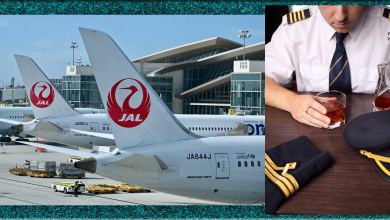
Japan Airlines Scrubbed Dallas-to-Tokyo Flight JL11 After a Captain’s Hotel Drinking Drew Police, Then the Layover Ban Failed

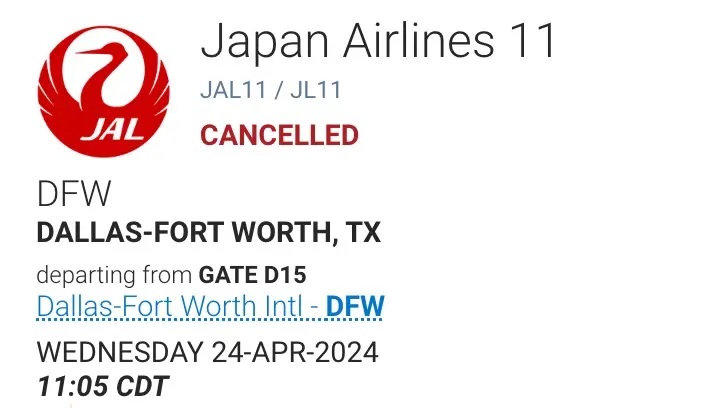
Japan Airlines told 157 people booked on flight JL11 that Dallas-Fort Worth to Tokyo Haneda would not leave on the morning of April 24, 2024, because of a crew scheduling problem tied to a crew member’s poor health. That was the passenger-facing version. The version the airline later gave Japan’s transport ministry was narrower and uglier. The 49-year-old captain scheduled to command the Boeing 777-300ER, registration JA742J, had spent the layover drinking with colleagues until hotel staff called the police. Breath tests before the planned departure read zero. The 12-hour bottle-to-throttle clock had technically expired. Japan Airlines canceled the flight anyway, because a clean breathalyzer is not the same thing as a captain fit to take a widebody across the Pacific.
The captain had arrived in Texas on the morning of April 22 at the controls of JL12 from Haneda. TRAICY, citing the airline’s account, put his career at 21 years and three months, his time in the left seat at one year and one month, and his total flight time at 10,368 hours. That is not a rookie résumé. It is also not a shield. By about 6 p.m. local time he was at dinner with another captain, a first officer, and four cabin attendants, seven people out of an inbound crew of 16. The party moved to the hotel lounge, then, around 11 p.m., into the captain’s room. Across those three sittings the group bought the equivalent of about seven bottles of wine and somewhere between 12 and 18 cans of 330-milliliter beer. Beer that went unopened was later thrown out. The volume was a group total, not a personal confession, which is exactly why it became a management problem: nobody in the room was keeping a public tally for the person who would be expected to sign for the airplane two nights later.
Hotel staff warned the room that the noise had carried. Around 2 a.m. on April 23 the gathering broke up. The captain was loud in the corridor. Police questioned him for about two hours and issued a verbal warning. He was not arrested. The hotel reached the company around 5 a.m. Japan Airlines decided, before any alcohol test, that this captain should not operate. A replacement sent from Japan would have shoved the departure deep into a delay, so at about 4 p.m. on April 23 the carrier killed JL11, the 11:05 a.m. departure on April 24. Most of the 157 passengers left the same day on American Airlines, some nonstop and some through Chicago. The airline reported the case to the Japan Civil Aviation Bureau on April 25.
A rule written for a number, not for judgment
After a run of pilot-drinking cases in 2018 and 2019, including a Japan Airlines pilot in London whose reading was far over the company limit and who later served time in Britain, the carrier drew a hard line: no alcohol inside 12 hours of departure, and a pre-duty reading of zero. For an 11:05 a.m. push on April 24, that clock stopped at 11:05 p.m. on April 23. The Dallas party was already over by 2 a.m. on April 23. Tests five hours and two hours before report time found no alcohol. On paper, the captain had followed the rule he was hired to follow. In the internal interview, the Yomiuri Shimbun reported, he said he had not meant to drink too much and that the intoxication had come on without him noticing. That sentence is the whole case. A rule that only asks whether ethanol is still in the blood will clear a man whose colleagues, a hotel, and the police have already decided he was not in control of himself.
Japan Airlines apologized in the language airlines use when they know the next sentence will be quoted against them. Inappropriate conduct caused by a flight crew member’s drinking had produced a cancellation, the carrier said, and the company took it seriously and would work to stop a repeat. The Ministry of Land, Infrastructure, Transport and Tourism told the airline to come back with a prevention plan that would actually work. On April 26, once the story was public, Japan Airlines told pilots not to drink at all on layovers, for the time being. In June the order was widened in public reporting to cabin crew as well. The ban was lifted on October 1, 2024. It did not survive the autumn.
On December 1, 2024, Japan Airlines flight JL774 from Melbourne to Narita, a Boeing 787, sat while the airline sorted a drinking violation among its pilots. Three pilots were assigned. One captain initially showed alcohol. A later test read zero, and the flight eventually left 3 hours and 11 minutes late with 103 passengers and 11 crew, arriving at Narita 2 hours and 42 minutes behind schedule. A follow-up found that two of the pilots had drunk more than the company’s own quantity limit during the layover, even though the final breath test was clean enough to fly. On December 11 the layover drinking ban for pilots went back into force. The ministry had already moved toward a business-improvement order over the 2024 cluster. The Dallas case was no longer a one-hotel story. It was the first public crack in a policy the airline had just relaxed.
The checkbox kept clearing, and the delays kept stacking
The pattern crossed into 2025. On a Honolulu layover, a Japan Airlines captain broke the destination drinking rule and was grounded. Flight JL793 from Honolulu toward Nagoya’s Chubu airport was among the services shoved back, with passenger disruption reported as long as 18 hours across the affected bank of flights. Aviation desk TRAICY carried the grounding. No one was hurt. That is the wrong measure. The product being sold on these routes is a 13-to-14-hour nonstop over the Pacific, DFW to Haneda at roughly 6,485 miles, operated now on a mix of Japan Airlines Airbus A350-1000s and American Airlines Boeing 777s under the joint network. A captain who is legal on a breathalyzer and untrustworthy on judgment is a scheduling problem only until the day the weather, a mechanical fault, or a medical emergency asks for the judgment the test cannot see.
In May 2026 the problem moved out of the cockpit and into the cabin in a way that finally hit executive pay. On a Hiroshima layover, a chief flight attendant in her 50s and a colleague in her 30s kept drinking past the point when the 12-hour rule said they should have stopped. Reporting on the case described two beers and two small glasses of wine at the hotel bar. A later pre-duty check failed. One reading was described at about 0.05, over the U.S. FAA on-duty threshold of 0.04 and well above Japan’s stricter aviation limit. The pair was pulled, a replacement was assigned, and the flight left roughly 40 minutes late. Japan Airlines then barred more than 6,000 flight attendants from drinking on layovers. Chief executive Mitsuko Tottori, who began her own career as a flight attendant in 1985, took a 30 percent pay cut for two months. Other executives took smaller cuts. A business-improvement order tied to the earlier cockpit cases was already on the books from December 2024. Dallas was the layover that taught the company to ban drinking, lift the ban, and then watch the same failure mode reappear in Melbourne, Honolulu, and Hiroshima.
Passengers in Texas never got that institutional history at the gate. They got a health-and-scheduling explanation, a rebooking, and an apology. The gap between those two stories is the part worth keeping. Airlines have strong incentives to describe a captain’s police warning as a medical unfitness call, because “poor health” is a category customers already understand and “we let a command pilot drink until the hotel called the police, then watched him pass a breath test” is not. Both descriptions can be narrowly true. Only one of them tells a traveler why the 777 never pushed.
The AEGIS Alliance has tracked the same trust problem on the manufacturing side of commercial flying, including the death of Spirit AeroSystems auditor Joshua Dean weeks after Boeing whistleblower John Barnett, and the collapse of Spirit Airlines after its chief executive called the industry a rigged game. Crew fitness and airframe integrity fail in different rooms. They land on the same people. More of the international file is on the International News desk, with the U.S. end of the route covered under US News. Aviation Wire and the Yomiuri Shimbun’s Japan News published the Dallas chronology the airline did not put on the departure board.