Pearl Harbor Families Won the Red Hill Jet-Fuel Case, Then the Checks Came In Near $27,000 and the Troops Were Shut Out

The families who drank jet fuel at Joint Base Pearl Harbor-Hickam did not imagine the rashes, the gut trouble, or the pets that got sick with them. A federal judge in Honolulu said so in May 2025. The United States was liable. What followed was a master class in how a government can lose the fact and still set the price. By June 2026 the Justice Department was calling checks of roughly $27,000 a person a fair resolution. The Army major whose family helped force the case into a courtroom said her household had already sat through more than 800 medical appointments. Active-duty troops who bathed their children in the same water were told, in the same courthouse, that a doctrine from 1950 barred them from suing at all.
The Red Hill Bulk Fuel Storage Facility is a World War II tank farm carved into the ridge above Oahu’s aquifer. In May 2021 a piping failure dumped jet fuel into a fire-suppression line. It sat there, largely unnoticed, until the night of November 20–21, 2021, when a second accident pushed it into the drinking water of about 93,000 people. Some 9,715 households in Navy, Army, and Air Force neighborhoods were on that system. Residents smelled fuel. The state health department issued an advisory. Navy officials denied there was a problem and asked the state to take the warning back. Then they admitted it. A 2014 leak of roughly 27,000 gallons had already told anyone paying attention that these tanks leak. Public pressure, not the chain of command’s first instinct, is what eventually forced the military to drain them. The complex is now in a long decommissioning. In September 2026 the Navy was still inviting the public to open houses about the work.
Feindt v. United States was filed in August 2022 under the Federal Tort Claims Act. A second case, Hughes v. United States, followed, and a third, Whaley, was brought for service members themselves. Together the civilian filings came to represent more than 6,500 claims, with thousands more people described across the litigation as sickened or displaced. In the spring of 2024, U.S. District Judge Leslie E. Kobayashi ran a bellwether trial with 17 plaintiffs, military spouses, children, and family members chosen to stand in for the rest. The government had already admitted negligence and a nuisance. It still argued that the illnesses were not the fuel. Nastasia Freeman, a military spouse who stood with the lead family after the trial, said the symptoms started like the flu and got worse, pets included. “We were essentially lied to,” she said. “They insisted it was alright even though we knew the water was dangerous.”
A Finding of Liability, Then a Discount
On May 7, 2025, Kobayashi ruled that the United States was liable under the Federal Tort Claims Act and Hawaii law. Stars and Stripes reported the award the next day: a little under $600,000 for all 17 people, against about $7 million they had sought. Pain-and-suffering damages ran from $5,000 to $75,000. Each plaintiff also received $1,000 for loss of enjoyment of life. Four of them split $38,489 for future medical care. Patrick Feindt, the lead plaintiff, was the only person awarded economic loss, $2,144, because the judge wrote that no one else had credible proof of wage damage. He and his two children together were awarded just over $61,000. The government’s own post-trial brief had recommended no more than $458,792. The ruling landed closer to the defendant’s number than to the families’.
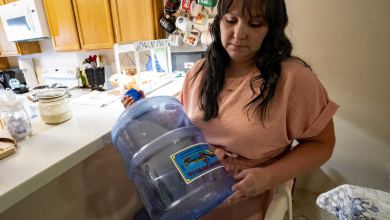
Army Maj. Amanda Feindt, Patrick’s wife, was not in that 17. She was on active duty, living in military housing on Ford Island when the water turned. She told Stars and Stripes the family of four had already been through more than 750 medical appointments, including surgeries, and that no dollar figure would undo “the lasting harm and institutional betrayal” after “the Navy knowingly poisoned them and contaminated Hawaii’s most precious resource — its water.” By the summer of 2026 she was counting the appointments past 800. The family had moved to Virginia. She said her daughter, then 8, still had neurological problems, and her son, then 6, had permanent lung damage. A Defense Department inspector general report in July 2025 found she had been restricted from lawfully communicating with Congress about the spill.
Lead attorney Kristina Baehr of Just Well Law had argued for sums much closer to what a contaminated childhood actually costs. She called the bellwether numbers disappointing and said the families had still prevailed against the odds. Prevailing meant a judicial finding that the water was poisoned and the illnesses were not psychosomatic. It did not mean the checks matched the chart.
Seventeen Million Dollars, and a Door Shut on the Uniform
The bellwether became a price list. On May 19, 2026, the district court approved a batch of settlements in Feindt and Hughes. On June 22 the Justice Department’s Civil Division paid them: about $17 million to 629 plaintiffs. The department’s announcement said settlements had been reached with about 3,600 civilian plaintiffs, and that more motions were waiting on the court or on the Treasury. More than 300 people had cleared every hurdle except a signed release. About 400 others had accepted offers as far back as October 2025 and were still being asked for proof they qualified. Associate Attorney General Stanley Woodward and Assistant Attorney General Brett Shumate described the payments as fair and just.
Baehr’s clients did the arithmetic the press release skipped. Roughly $27,000 a person is about $50,000 under the band she says Kobayashi’s order set for adults, somewhere between $38,500 and $76,000 before anyone talks about children. Attorney’s fees can take up to a quarter of what is left. Honolulu Civil Beat reported that the Feindt family accepted $37,500 on the adult side of the tort case and refused $15,000 for their daughter and $5,000 for their son. Mandy Feindt said the offer for her son would not cover what it cost the family to sit through two and a half weeks of trial in Hawaii. Baehr said that within the same stretch of weeks the government did approve two settlements inside the judge’s range, one at $45,000 and one at $55,000, and that she hoped those figures would pull the rest of the docket up. About 3,000 civilian claims were still unresolved when the $17 million went out the door. People settle low when they are tired. The United States knows that.
Service members were not offered even that bargain. On May 5, 2026, Kobayashi dismissed the Whaley case for lack of jurisdiction under the Feres doctrine, the 1950 Supreme Court rule that bars troops from suing for injuries “incident to service.” She called the result overly harsh and unjust. Feindt and Hughes, the civilian cases, stayed open. Baehr’s point on appeal is the one a parent would make without a law degree. These troops were bathing babies and cooking dinner in base housing. They were not on a flight line. Whether that argument moves a doctrine the court has refused to retire for 75 years is the next fight. Until it does, the person in uniform who drank the fuel is worth zero in this courthouse, and the spouse beside them is worth a settlement the Justice Department can fit in a press release.

The Aquifer Is Still the Bill
Money is the part of Red Hill that fits in a headline. The water is the part that does not. In July 2026 Civil Beat reported that the Navy had passed up a chance to put filtered Red Hill water to use and had instead wasted up to 5 billion gallons since the crisis. The University of Hawaii at Manoa’s Red Hill Registry held its fifth scientific oversight workshop at the end of August 2026 to read exposure data for the 93,000 people who were on that system. The tanks can be emptied. The medical charts do not empty with them.
Red Hill is also a template. A military installation sat on a civilian aquifer, treated the first complaints as a public-relations problem, and then spent years litigating the difference between “we spilled” and “you are sick.” Private companies have run the same play on drinking water. The AEGIS Alliance reported on Nestlé pulling water from Canadian towns on expired permits, and on contaminated water pumped toward a Canadian river. A different spill, measured in dead fish rather than sick children, is the liquid-nitrogen release that killed hundreds of thousands of fish in an Iowa river. The common fact is that the people downstream find out last.
Kobayashi’s liability finding is real. Attorneys have treated it as the first time a case of this kind has pinned a military water poisoning on the United States in open court and refused the suggestion that the patients made it up. The checks that followed are also real, and they are small on purpose. A family that lost a house, a posting, and a child’s healthy lungs is being asked to treat $27,000 as closure, while the soldier who lived in that house is being asked to treat Feres as fate. Hawaii’s aquifer does not grade on that curve. The registry is still meeting because the exposure is still in people. That is the case the settlement does not close.
More of this reporting is on The AEGIS Alliance’s Environment and US News desks.