Campbell River’s Blood Pipe, the PRV Sample, and a Closed-Containment Pilot That Still Will Not Replace Open-Net Salmon Farms

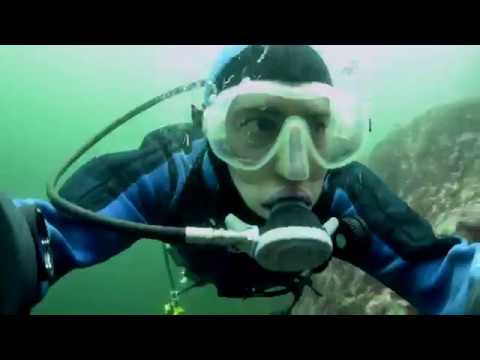

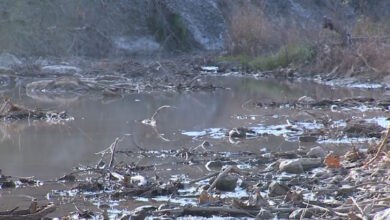
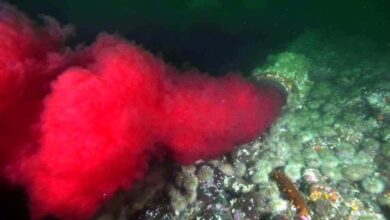
The first thing the camera caught was not a theory. It was a color. Quadra Island photographer Tavish Campbell dropped onto the outfall pipe at Brown’s Bay Packing, just north of Campbell River on Vancouver Island, and his lights hit a cloud of red so thick he later said he nearly choked on his regulator. The pipe was emptying the blood and offal of farmed Atlantic salmon into Brown’s Bay, on the edge of Discovery Passage, the tight channel a huge share of British Columbia’s wild salmon have to swim. Campbell called the short film Blood Water: B.C.’s Dirty Salmon Farming Secret. It landed in late November 2017, and it did what years of papers on sea lice and viruses had not done. It made the waste visible.
Campbell and a dive partner filmed the Brown’s Bay outfall in April and October 2017, during and after the spring out-migration of juvenile sockeye, and a second plant, Lions Gate Fisheries, dumping the same kind of effluent into Tofino harbour in June. The fish being cut at Brown’s Bay that day had been raised at a Discovery Islands site, loaded onto a packer, and hauled to the plant. Campbell put a fine-mesh net over the pipe, carried a sample to the surface, and sent it for testing. The blood was not sterile. It carried piscine orthoreovirus, the Atlantic virus usually shortened to PRV, which is tied to heart and skeletal muscle inflammation in salmon. Intestinal worms were visible under a microscope. Norway, where this industry was built, already required heavy disinfection of blood water because processors there had linked disease outbreaks to infectious plant waste. British Columbia was still treating the discharge as ordinary permitted effluent.
The footage moved faster than the regulators. Federal fisheries minister Dominic LeBlanc told reporters the images were designed to shock and that he was concerned. He said Ottawa was already rewriting the Fisheries Act and that he wanted practical ideas for protecting wild salmon. British Columbia environment minister George Heyman ordered a review of the plants in the video. A spokesperson noted that two of the facilities had been issued discharge permits more than twenty years earlier, and that one permit was being updated for filtration and disinfection. That was the official posture in December 2017: shock, then a promise to modernize paperwork that had been sitting on a shelf since the 1990s.
The pipe did not go quiet. In 2019, new underwater video showed the same Brown’s Bay outfall still pushing blood into the channel. CTV’s Melanie Nagy put the problem in one line: blood byproduct was flowing into the water directly in the path of wild salmon. Alexandra Morton, the biologist who had spent years sampling farmed and wild fish along this coast, later wrote that salmon raised at Raza Island were being gutted at Brown’s Bay, and that a 2022 report from Fisheries and Oceans Canada found young salmon exposed to that plant’s effluent became infected with PRV. On April 19, 2019, she noted, the plant was set to dump on the order of twenty times more blood than on the day the original samples were taken, while processing about 32 million pounds of fish a year. In October 2023, staff in Heyman’s own ministry wrote a warning letter reporting that Brown’s Bay Packing had breached its permit more than once. A provincial minister could still tell critics the federal department considered the risk low. The federal report Morton was pointing at did not say the risk was low. It said the effluent needed further disinfection.
That is the part of this story that got flattened into a single gross-out clip. The blood was not a metaphor for the farms. It was a second door. Open-net pens already sit in the migration path and shed sea lice, waste, and pathogens through the mesh. The processing plants then take the same fish, cut them, and return infected blood to the same water. Wild salmon meet the industry twice: once as juveniles swimming past the pens, and again as the waste from those pens’ harvest.
The farms themselves became the larger fight. In December 2020, then fisheries minister Bernadette Jordan moved to phase open-net pens out of the Discovery Islands. Companies went to court and won an early round. On February 17, 2023, minister Joyce Murray refused to re-issue licences for 15 Atlantic salmon farms in that archipelago, the same corridor Campbell had been filming. The Federal Court upheld her in June 2024. Mowi Canada West, the largest player left in the appeal, took it higher. On January 29, 2026, the Federal Court of Appeal dismissed that appeal in Mowi Canada West Inc. v. Canada, 2026 FCA 19. Chief Justice Yves de Montigny wrote that the minister had been entitled to take a highly precautionary approach in waters that matter to migrating wild salmon and to First Nations rights. The Union of B.C. Indian Chiefs called it the second time a court had confirmed the minister was right to reject advice that would have left the farms in place. Grand Chief Stewart Phillip said open-net pens pose unacceptable risks to migrating salmon and to Indigenous responsibilities to protect them.
Ottawa had already set a wider clock. On June 19, 2024, the federal government said conventional marine net-pen salmon farming in British Columbia would not be licensed after June 30, 2029. A draft transition plan circulated. The Pacific Salmon Foundation expected a final plan in 2025. It slipped. By spring 2026 the foundation was still waiting, and it was still funding field work, including monitoring by researchers such as Campbell, through 2028 around former farm sites. Production in the province’s farmed sector has fallen by more than 40 percent since 2015 as sites closed and capital waited on a deadline. Industry voices, including the B.C. Salmon Farmers Association, argue the missing science is a finding that farms must be eliminated to save wild fish, and that sockeye returns have kept swinging after the Discovery Islands closures, including a weak dominant-cycle run in 2026. That argument treats uncertainty as a reason to keep the nets. The Court of Appeal treated uncertainty as a reason the minister could act.
Campbell River is now being asked to pilot the thing that is supposed to replace the nets. On September 21, 2026, Canada’s Ocean Supercluster and Norwegian firm Bluegreen announced a $51 million project, with $14.5 million in public supercluster money, to adapt Bluegreen’s floating “Marine Donut” closed-containment system in Campbell River. The Wei Wai Kum First Nation approved a memorandum of understanding to keep talking about the project. Bluegreen has already run two production cycles with SalMar in Norway, including a 2024 harvest and a second cycle stocked in May 2025, in a unit of about 22,000 cubic metres drawing water from 40 metres down, with a Norwegian biomass cap of 1,100 tonnes. The Campbell River unit is smaller. A Bluegreen executive has said it is a post-smolt pilot meant to prove biology and economics on the Pacific, not a near-term substitute for the existing ocean farms. The Coalition of First Nations for Finfish Stewardship welcomed the money and asked Ottawa to say, plainly, what happens to the farms that are still in the water.
Wild First’s response to the design, not the press release, is the useful one. Semi-closed systems, the group said on September 30, 2026, do not eliminate viruses, bacteria, or parasites. If the goal is to protect wild salmon, containment has to actually contain. Land-based indoor farms, the other replacement politicians like to name, are not waiting in the wings at commercial scale. LocalCoho in New York closed in 2025. Gaia Salmon filed for bankruptcy in 2025. Salmo Terra in Norway failed before its planned 8,000-tonne site was built. People who have actually run recirculating systems in this province, including veterans of Kuterra, have been blunt that British Columbia is not ready to swap the entire ocean sector for tanks.
None of that returns the blood to the pipe and calls it solved. PRV is an Atlantic virus introduced to this coast with the farms, and it has been linked to poorer survival in Chinook and coho. Tenacibaculum maritimum, a marine bacterium amplified around Atlantic farms, is a separate risk to sockeye, Chinook, and coho. Discovery Passage is still the highway. Brown’s Bay still sits on it. The 2029 date is a political fact, not a treatment plant. Between now and that date, the fish still swim past whatever Ottawa leaves in the water, and past whatever the packing plants are still allowed to discharge.
The investigative record is still the one Campbell shot with a camera and a plankton net. Provincial permits from the 1990s, a federal lab result from 2022, a warning letter from 2023, a Court of Appeal judgment in January 2026, and a donut-shaped pilot announced in the same town in September 2026 are all downstream of that red cloud. Readers who want the other half of how corporations treat public water can start with Nestlé’s expired California permits and the Canadian towns where Nestlé pumped on lapsed paperwork. More of this desk’s reporting lives in Environment and International News.