Google Capped Meta’s Gemini Capacity and Forced a Rival to Ration Tokens Because the Machines Ran Out First


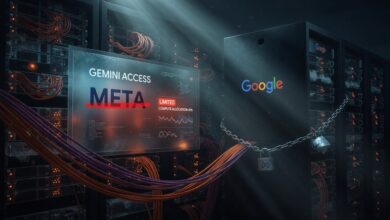
The industry sold a simple story for two years. Foundation models would behave like electricity. You would pay for tokens the way you pay for storage, and the plant would always have another rack. In March 2026, Google told Meta that story was finished. Alphabet could not deliver the Gemini capacity the social giant wanted to buy. The cap sat inside both companies for months. The public found out on June 28, when the Financial Times printed what engineers already knew. Internal Meta projects slipped. Staff were told to treat tokens like ration cards. Other Google customers took smaller cuts. The AEGIS Alliance is less interested in the rivalry headline than in the warehouse fact underneath it.
CNBC repeated the FT account. Forbes put the industrial point in one line: you cannot inflate a bubble in something the market is rationing. Model quality is no longer the scarce input. GPUs, power contracts, water, and cooling plants are. A company that owns those plants now writes the queue.
Meta Was Renting a Rival’s Brain for Housework
Gemini access was not a demo booth. Meta had been buying the models through cloud and API channels for safety pipelines, scam detection, harmful-content takedowns, customer-service automation, internal coding assistants, and production work across Facebook and Instagram. Trade desks said Gemini beat Meta’s own Llama models at the unglamorous work of catching fraud and pulling down abuse at platform scale. That is why a cap inside Google’s fleet shows up as delayed tools on Meta’s campus. The shortage did not start as a press fight. It started as a missed delivery.
Two companies that sue each other over social-app design still share a power grid when the models get large enough. The AEGIS Alliance file on the Los Angeles addiction verdict and Meta’s later multibillion-dollar state settlement sits on the same calendar as this rationing story. One season they are defendants in a design case. The next season one of them is a customer the other cannot fully serve. That whiplash is the new normal of the stack. Legal enmity does not generate megawatts.
By mid-July, enterprise analysts were treating the episode as the moment buyers could see the bottleneck on their own invoices. Meta told engineers to conserve tokens and accelerated a shift back onto in-house models, including work described in trade coverage as a move toward Muse Spark and other internal stacks. That is not a strategy slide. That is a company that just learned a vendor can say no to one of the richest buyers on earth. If Meta can be told to wait, a mid-market firm with a safety chatbot is not at the front of any line.
Rationing Is Industrial Policy Without a Press Conference
When a cloud vendor rations a rival, every smaller customer should assume they are further back in the same queue. Governments talking about sovereign AI are talking about this queue. Energy regulators staring at data-center interconnects are talking about this queue. Meta can spend its way toward its own clusters. Most firms cannot. They will live inside someone else’s ceiling and call it a service-level agreement.
Microsoft’s Fairwater fight in Wisconsin, covered in The AEGIS Alliance noise-lawsuit report, is the same scarcity wearing a different complaint. A multi-billion-dollar campus that neighbors say never sleeps is what “more compute” looks like on a residential street. Google rationing Gemini is what “not enough compute” looks like on an invoice. Both stories are about electricity, land, water, and racks that take years to stand up. Neither story is about a clever prompt.
Chipmakers are already pricing that limit. The AEGIS Alliance file on Micron’s red day after a presidential shout-out is memory supply meeting political theater. High-bandwidth memory commitments tied to NVIDIA customers are the same bottleneck wearing a ticker symbol. The Gemini cap is the software version of that hardware fight. Tokens are just the unit the warehouse uses when the warehouse is full.
Power markets noticed first. Utilities in several states have already started telling data-center developers that interconnects are years out. That is the same sentence Google delivered to Meta, translated into grid language. A model launch can be announced in a keynote. A substation cannot. The companies that booked the power first will keep the models. The companies that booked the press first will wait.
A Ceiling Teaches the Market Who Owns the Plant
Google did not publish a white paper titled “Meta gets less.” It enforced a warehouse constraint and let the FT print it three months later. Other customers took smaller cuts. That sentence should scare any company that built a product roadmap on infinite Gemini tokens. Enterprise buyers spent two years being told that foundation models would become a utility, priced like object storage and available like bandwidth. Utilities fail in public when the plant cannot keep up with the neighborhood. The Gemini cap is that failure wearing a cloud invoice.
It also hands Google a quiet form of industrial leverage. The company that owns the scarce racks decides who gets to run the scarce models. That is not a conspiracy. It is what happens when demand outruns concrete. Storage got cheap because disks stacked. Models got expensive because each new generation wants more watts than the last building can deliver. When the generators belong to three or four firms, those firms write the rules for everyone else. Governments that talk about AI safety without talking about interconnects are talking about the wrong layer of the stack.
The boom’s unwritten sentence — there will always be another rack — is now a written limit. Smaller customers should read the Meta cap as a preview of their own contracts. The queue does not start at the Fortune 10. It ends there. Anyone still budgeting as if tokens were infinite is budgeting for a world that ended in March and was only announced in June.
What Buyers Should Do With a Ration Card
The practical lesson is ugly and simple. Dual-source the models. Measure token burn like a fuel bill. Do not stake a customer-facing product on a single vendor’s spare capacity. Assume the next generation of models will demand more power than the last campus can deliver on time. Assume the vendor will serve itself first. Assume a press embargo will hide the cap until the warehouse problem is already old.
Readers who want the wider technology file can stay on The AEGIS Alliance technology and business desks. The AEGIS Alliance’s angle is not that Google snubbed Mark Zuckerberg. It is that the rack ran out, the token became a ration card, and the companies that already own the generators now decide who gets to think at scale. That decision will outlast this particular feud. It will show up in every contract that still pretends intelligence is a utility.