Greetings world! We are The AEGIS Alliance, with, Anonymous allies. As the State of California has been suffering from yet another wave of wildfires this year, corporations come to mind, one of most interest being Nestle, and their unlawful actions in California, and other states, even in other countries. This December, there have been wildfires in Los Angeles, San Diego, Santa Barbara, San Bernardino, and Ventura counties in California. Some of it is still not contained at this time. Overall, the several December blazes have burned over 256,000 acres and forced 212,000 residents to evacuate their homes, over 1000 structures, including many homes, were destroyed.
The question is, did Nestle play a key contributing factor in California’s drought-ridden conditions? The reason why is that of the year 2015, Nestle had been bottling water in California on expired permits for 27 years. It is unknown as to just how many unfathomable amounts of water that Nestle drained from California, over those past decades. This is cause for alarm, with so much water being extracted from California, and thereby being a key contributing factor in California’s very dry ground conditions. Nestle also has a bad reputation in Oregon and is the cause of protests in the state of Washington. Nestle also extracts water in other U.S. states.
However, the United States is not alone in Nestle bottling water on expired permits. Nestle has also been caught bottling water on expired permits in Canada, in recent times. Nestle had been bottling so much water in these Canadian towns, that it was being done faster than the aquifers were able to be replenished, until Canadian authorities stepped in, and did something about it. This makes it obvious, that Nestle has used these same greedy practices in California for many years, thereby being a key factor in the very dry ground conditions. It makes billions of dollars in profit by extracting water for practically nothing when compared to the massive income taken in by it.
Erin councillor Bridget Ryan is asking council to oppose a permit request for a water bottling operation in Hillsburgh. White Wolf is seeking a 10-year permit to take up to 1.1 million litres of water per day from the former Nestle/Blue Triton well. https://t.co/OW9UY70Wle
Unlawful bottling of water isn’t the only type of crime to humanity by Nestle. They’re also a chocolate company, that is known to use child labor in cacao plantations. Nestle also has a history of lax labor laws, which allows them to evade close scrutiny of its labor practices. Nestle dodges accountability by having factory locations in places such as Columbia, North Korea, and China while avoiding the many more legal protections in the United States. Nestle has also been the cause of much outrage by Environmental and Human Rights activists, and many others over the years, for their bad practices. There have been protests to boycott nestle products, and for more than what is included in this video. Nestle has gotten off very light, for their atrocious crimes to humanity over the decades.
how i feel opening up my paper topic for my sustainability class and seeing water scarcity as a topic knowing i can get graded for dissing the shit out of Nestle pic.twitter.com/lTUvH8pqfz
If it were up to us, Nestle would be charged for contributing to many accounts of wildfires, destruction of property, costs of emergency services, and perhaps even the deaths of those innocent lives taken by these wildfires over the years in California. All because Nestle extracted unfathomable amounts of water on expired permits for 27 years in the state of California, with nothing being done about it.
In the years since this report first aired, the story has taken several major turns. In 2021, Nestlé sold its entire U.S. and Canadian bottled-water business — including the Arrowhead brand pumped from California’s San Bernardino National Forest — to the private-equity firms One Rock Capital Partners and Metropoulos & Co. for roughly $4.3 billion. The operation was rebranded as BlueTriton Brands, but the underlying fight over Strawberry Creek did not change hands so cleanly. California regulators made clear the sale would not stall their enforcement.
In September 2023, California’s State Water Resources Control Board approved a cease-and-desist order blocking BlueTriton from diverting millions of gallons of water out of the Strawberry Creek watershed — the same creek tied to the permit that expired back in 1988. Campaigners summed up the case bluntly: one cannot sell what it does not own, and the board found that neither BlueTriton nor its predecessors had ever perfected a valid pre-1914 water right to the creek. Strawberry Creek feeds the Santa Ana River, a source of drinking water for roughly 750,000 residents, and conservationists argued the decades of pumping had helped desiccate a fragile ecosystem already strained by climate change. The company disputed the findings and pursued appeals, while activists pointed to data showing it had drawn far more water than permitted.
The corporate shell game continued in November 2024, when BlueTriton merged with Primo Water to form Primo Brands Corporation, now trading publicly on the New York Stock Exchange. The names on the bottles keep changing, but the core grievance that drove this report — a multinational profiting off public water in a drought-prone, fire-prone state, long after its permits lapsed — remains very much alive.
In January 2025, BlueTriton went to federal court seeking an injunction after the U.S. Forest Service denied a pipeline permit in the San Bernardino National Forest — another attempt to keep the Arrowhead operation flowing after California’s water board had already told the company to stop diverting Strawberry Creek. The fight has now spanned Nestlé, BlueTriton, Primo Brands, the State Water Board, and the Forest Service. The creek is still public. The bottles are still for sale.
The water board’s order did not survive the next courtroom. On May 8, 2025, Fresno County Superior Court Judge Robert Whalen Jr. threw out the cease-and-desist. He wrote that the State Water Resources Control Board had gone “beyond the limits of its delegated authority.” A BlueTriton spokesperson said the ruling confirmed the board had exceeded its power over the Arrowhead Springs diversions in Strawberry Canyon. Board spokesperson Jackie Carpenter said the agency “strongly disagrees” and that the legal, engineering, and hydrogeologic record still supported the 2023 decision. The bottles did not have to stop because a judge said the wrong agency had tried to stop them.
The forest permit is a separate case, and it has not produced a clean ending either. On July 26, 2024, San Bernardino National Forest district ranger Michael Nobles denied BlueTriton’s application for a new special-use permit and told the company to cease operations and plan the removal of pipes and boreholes. BlueTriton sued the Forest Service. Save Our Forest Association, which had sued the Forest Service on June 25, 2024 to force an end to the diversions, stayed in the case because the shutdown order was frozen while the company’s lawsuits ran. In April 2026 the San Manuel Band of Mission Indians moved to knock that environmental suit aside, and the filing dragged the band’s own water claims near the old Arrowhead Springs Hotel into the argument. Primo Brands, the public company that absorbed BlueTriton, is the name on the corporate chart now. Arrowhead Drinking Water Company is still the name that shows up on some of the state paperwork, a surrendered corporate title the bottlers never really let die.
The same wells are being fought over under new letterhead far from San Bernardino. On September 30, 2026, the Wellington Advertiser in Ontario reported that Erin councillor Bridget Ryan had asked her council to oppose a 10-year permit for White Wolf, a bottler seeking up to 1.1 million litres a day from the former Nestlé and BlueTriton well in Hillsburgh. That is the Canadian half of this report, still open, still measured in millions of litres, still sitting on a permit application instead of a restoration plan.
The December 2017 fires were not a metaphor The AEGIS Alliance invented to make a point about a Swiss food company. They burned more than 256,000 acres in Los Angeles, San Diego, Santa Barbara, San Bernardino, and Ventura counties and pushed 212,000 people out of their homes. Dry fuels do not need a bottling plant to burn. They also do not refill themselves while a pipeline on an expired special-use permit keeps taking the headwaters. The names changed from Nestlé Waters North America to BlueTriton to Primo Brands. The creek did not get a new name. Strawberry Creek still feeds the Santa Ana, and the Santa Ana is still drinking water.
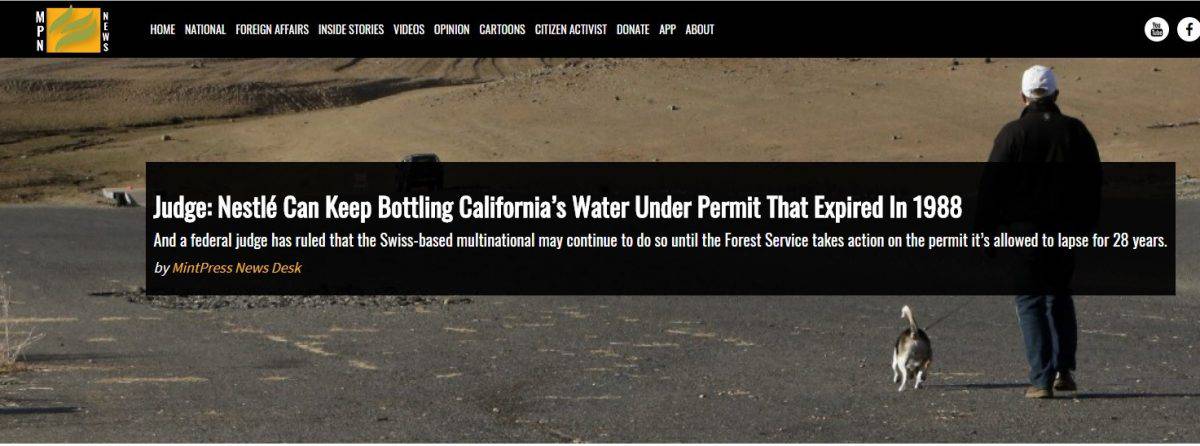
Image: A judge ruled in 2016 that Nestle can keep bottling water on expired permits. (Credit: MintPressNews.com)
“The AEGIS Alliance does not claim to be a leader of Anonymous, The AEGIS Alliance has Anonymous Allies.”
“They, are Anonymous. They do not forgive this. And they will not forget it. You should have expected the Legion.”
Majority Owner of The AEGIS Alliance. I studied in college for Media Arts, Game Development. Talents include Writer/Article Writer, Graphic Design, Photoshop, Web Design and Development, Video Production, Social Media, and eCommerce.
Help support our social and human rights issues agenda and independent journalism. We appreciate your help. Thank you:
Zelle Tag / PayPal / Venmo username: aegisalliance
CashApp: $aegisalliance
Manage Consent
To provide the best experiences, we use technologies like cookies to store and/or access device information. Consenting to these technologies will allow us to process data such as browsing behavior or unique IDs on this site. Not consenting or withdrawing consent, may adversely affect certain features and functions.
Functional
Always active
The technical storage or access is strictly necessary for the legitimate purpose of enabling the use of a specific service explicitly requested by the subscriber or user, or for the sole purpose of carrying out the transmission of a communication over an electronic communications network.
Preferences
The technical storage or access is necessary for the legitimate purpose of storing preferences that are not requested by the subscriber or user.
Statistics
The technical storage or access that is used exclusively for statistical purposes.The technical storage or access that is used exclusively for anonymous statistical purposes. Without a subpoena, voluntary compliance on the part of your Internet Service Provider, or additional records from a third party, information stored or retrieved for this purpose alone cannot usually be used to identify you.
Marketing
The technical storage or access is required to create user profiles to send advertising, or to track the user on a website or across several websites for similar marketing purposes.
To provide the best experiences, we use technologies like cookies to store and/or access device information. Consenting to these technologies will allow us to process data such as browsing behavior or unique IDs on this site. Not consenting or withdrawing consent, may adversely affect certain features and functions.
Functional
Always active
The technical storage or access is strictly necessary for the legitimate purpose of enabling the use of a specific service explicitly requested by the subscriber or user, or for the sole purpose of carrying out the transmission of a communication over an electronic communications network.
Preferences
The technical storage or access is necessary for the legitimate purpose of storing preferences that are not requested by the subscriber or user.
Statistics
The technical storage or access that is used exclusively for statistical purposes.The technical storage or access that is used exclusively for anonymous statistical purposes. Without a subpoena, voluntary compliance on the part of your Internet Service Provider, or additional records from a third party, information stored or retrieved for this purpose alone cannot usually be used to identify you.
Marketing
The technical storage or access is required to create user profiles to send advertising, or to track the user on a website or across several websites for similar marketing purposes.











When it’s nature, you get what you deserve