Continent-Sized Blobs Under Africa and the Pacific Are Different Ages, and Theia’s Debris May Still Sit on Earth’s Core
Unveiling Earth's Restless Interior: A New Theory on Plate Tectonics

Two continent-sized masses sit about 1,800 miles down, parked on the molten outer core, and they are not copies of each other. One lies under Africa. The other lies under the Pacific. Seismologists started seeing them in the 1980s because earthquake shear waves slow by roughly 1 to 3 percent as they pass through. Slower waves mean the rock is hotter, denser, or chemically unlike the mantle around it. The jargon is Large Low-Shear-Velocity Provinces, or LLSVPs. Each pile can rise the equivalent of about 100 Mount Everests. Together they hold a few percent of Earth’s volume and a much larger share of the deep interior’s personality. No drill will ever touch them. Every claim about their birth arrives as a wave from a big earthquake or as a supercomputer run trying to keep that wave honest.
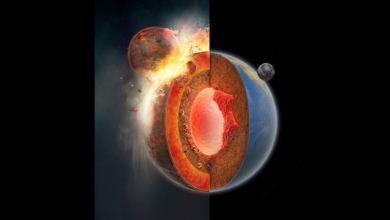
The cinematic origin is a dead planet. In 2023 a Nature paper led by Qian Yuan, then at Caltech, argued that the piles are wreckage from Theia, the Mars-sized body that struck the young Earth about 4.5 billion years ago and threw the debris that became the Moon. In that model, iron-rich Theia mantle sank and stayed, like wax settled at the bottom of a lava lamp. The appeal was that one collision solved two embarrassments: where the Moon came from, and why two slow patches sit on the core-mantle boundary. The test was chemical. Leftover planetary interior should not look like recycled ocean crust that has been diving into the mantle for hundreds of millions of years.
Three Clocks, None of Them a Drill
Newer papers did not kill Theia. They refused to let it be the only story. On February 6, 2025, James Panton of Cardiff University and colleagues, including Oxford seismologist Paula Koelemeijer, published circulation models in Scientific Reports covering a billion years of mantle flow. Their paper, “Unique composition and evolutionary histories of large low velocity provinces,” concluded the blobs can grow from ordinary seafloor recycling. Cold oceanic crust sinks, piles up above the core, and evolves on its own. “They are evolving by themselves,” Panton told Live Science. The same models killed the twin story. The Pacific pile is younger and holds about 50 percent more recently subducted crust, refreshed for roughly 300 million years by the Ring of Fire. The African pile is older, more mixed, and more buoyant, which is why it stands higher off the core. They look alike to a speed measurement mainly because temperature, not chemistry, dominates how fast a shear wave travels.
A second clock measures stillness. A Nature study published January 22, 2025, by Arwen Deuss’s group at Utrecht University tracked not only travel time but energy lost along the path. The waves barely weakened. That pattern fits unusually large mineral grains, the kind that grow when material sits still for an enormous span of time. “They must have been there for at least a billion years,” Deuss said. Utrecht’s public summary put a floor near half a billion years and allowed that the piles could be older. The team argued there is less flow in Earth’s mantle than textbooks usually draw. Large grains are a kind of clock that does not care whether the original rock was a slab or a planet. They care that whatever it was, it stopped moving long enough to crystallize at a scale seismology can feel.
A third clock is isotopic, and it points back at Theia without proving the piles are her grave. On November 20, 2025, Science published work by Hopp and colleagues measuring iron isotopes in lunar samples, Earth rocks, and meteorites. Earth and the Moon share a mass-independent iron signature that sits at one end of the meteorite range. Mass-balance calculations put all of Theia, and most of the other material that built Earth, in the inner Solar System. Theia may even have formed slightly closer to the Sun than Earth did. That result tells you where the impactor was born. It does not, by itself, tell you whether her mantle is still sitting under Africa. A December 2025 Planetary Science Journal study on asteroid-sized Theia debris supplied the missing physical step. Fragments around 50 kilometers across can survive 4.5 billion years of convection as piles that look like LLSVPs. Fragments around 25 kilometers across largely cannot. Stronger, drier rheology survives better, which lines up with noble-gas evidence for a dry plume source and with attenuation measured from Earth’s normal modes. Theia debris is allowed by the physics. It is not required by it.
A Basal Magma Ocean, a Carbonaceous Coin Flip, and the Volcanoes on Top
There is a fourth ingredient, and it comes from the core rather than from space. On September 12, 2025, Jie Deng of Princeton, Yoshinori Miyazaki of Rutgers, Qian Yuan, and Zhixue Du published in Nature Geoscience a model in which a basal magma ocean was contaminated by material exsolving from the core early in Earth’s history. “They are fingerprints of Earth’s earliest history,” Miyazaki had said of the piles in related comments. The picture that is hardest to kill is a blend. Primordial dregs and core leakage could have seeded the piles. Slabs could have topped them up for four billion years. Theia fragments, if they were large enough and strong enough, could sit inside the same warehouse. A September 2026 abstract for the Europlanet Science Congress, by Duarte Branco, Pedro Machado, and Sean Raymond, added a dynamical constraint on the impactor herself. Matching Earth’s carbonaceous mass fraction, Mars’s much smaller one, and the timing of the last giant impact gives roughly even odds that Theia was a carbonaceous body, or a non-carbonaceous embryo that had already swallowed one. The coin flip is about the impactor’s recipe. The piles still have to be caught storing that recipe after billions of years of stirring that never quite stirs them away.
Whatever the inventory, the piles are not inert. Researchers tie them to the deep plumes that feed Hawaii, Iceland, and Réunion, and to some of the largest volcanic outbursts in the rock record, including events associated with mass extinctions. Because they change how heat leaves the core, they may also shape the magnetic field that shields the surface from the solar wind. The African pile has been linked to the African superswell, to uplift, to river courses, and to landscapes where early humans lived. Informal nicknames call the African mass Tuzo and the Pacific mass Jason, after geoscientists who pushed plume theory. The names are optional. The heat is not. A hotspot that looks like a tourist volcano on a postcard can be the surface expression of a pile that has been sitting on the core since before complex animals existed. Some modelers now argue that because ocean crust is far thinner than continental crust, heat rising off a mostly submarine Pacific pile has an easier path into seawater than heat rising under a continent. That is a climate argument hiding inside a seismology argument, and it is still a model, not a thermometer.
The method stays indirect on purpose. Seismologists wait for large earthquakes, compare how long shear waves take to cross the lowermost mantle, and measure how much energy they lose. Tomography turns the delays into maps. Geodynamic codes then ask whether sinking slabs, a Theia remnant, core leakage, or some mix can reproduce the maps. Each camp can point to a paper that fits its favorite ingredient. None can send a probe. That is why the 2025 attenuation study, the 2025 circulation study, the November 2025 isotope study, and the September 2025 core-exsolution model mattered more than another cutaway painting of red blobs. The maps got sharper. The origin story got less cinematic, which is usually a sign the science is working.
Classroom globes still show a shell and a core. They do not show two warehouses of slow, hot rock the size of continents, different ages, different mixes, parked on that core. The AEGIS Alliance files deep-Earth puzzles alongside other research that rewrites the textbook, including plans for farms on Mars, a line of argument that the universe itself might be conscious, and the science and unexplained desks. If Panton is right, the Pacific warehouse is still taking deliveries from the Ring of Fire. If Deuss is right, both warehouses have sat still long enough for crystals to grow huge. If Yuan is right, some of the inventory arrived on a world that no longer exists. If Hopp is right, that world formed in the inner Solar System, near Earth, maybe sunward of it. Those sentences can all be partly true. The core does not care which journal wins the week. The piles under Africa and the Pacific are not twins, they are old, and they are still moving heat toward the thin crust where people live.