The CIA Once Sorted Flying Saucer Files for Mulder and Scully Fans, and Washington Is Still Deciding Which UFO Records You Can Read

The Central Intelligence Agency once did something rare for a place that stamps paragraphs for a living. It sorted a stack of its own flying-saucer files into two fandoms. On a 2016 post still sitting on cia.gov under the title “Take a Peek Into Our X-Files,” the agency told readers it would help them through a Freedom of Information Act pile from the 1940s and 1950s, and it did the sorting out loud. Some documents, it said, were for people like Fox Mulder. Some were for people like Dana Scully. The wink was the point. Washington has spent the decade since trying, and failing, to retire the joke.
The Mulder pile was the sightings. One paper logged flying saucers reported over East Germany in 1952. Another was the minutes of a branch chief’s meeting on UFOs dated August 11, 1952. A third collected reports over Spain and North Africa that same year. A fourth was a survey of flying saucer reports dated August 1, 1952. A fifth described saucers reported over uranium mines in the Belgian Congo. These are not bedtime stories the internet invented. They are CIA reading-room documents from the summer the United States spent looking up, the same summer radar returns and lights over Washington, D.C., forced the Air Force to hold a press conference and blame temperature inversions. The Congo item is the one that still snags historians, because it puts an unidentified report on top of a strategic metal, not a cornfield. Mulder, in the show, would have opened that one first. The agency knew that. It said so.
The Scully pile was the machinery that tried to close the Mulder pile. It included the Scientific Advisory Panel on Unidentified Flying Objects that met January 14 through 17, 1953, the meeting history calls the Robertson Panel, after physicist H. P. Robertson. It included a March 15, 1949, office memorandum on flying saucers, a October 2, 1952, memorandum to the CIA director, minutes of an Office of Scientific Intelligence advisory group on January 21, 1953, and a December 3, 1952, memorandum for the record. Scully’s character wanted a lab result and a conventional explanation. The panel’s actual recommendation was blunter than a lab result. After reviewing cases, including film, the scientists told the government that UFO reports were not a direct threat, and that the real risk was clogged communication channels and a public that could be stampeded. They recommended a program of education and debunking. That sentence is why the CIA’s joke still has a bruise on it. The skeptic file was not only “here is the weather balloon.” It was “teach the public to stop asking.”
One film sat in both piles then and sits in them again now. In July 1952, Navy chief photographer Delbert Newhouse filmed objects over Tremonton, Utah. Navy analysts worked the frames. Edward Ruppelt, the Air Force officer who ran Project Blue Book in its hungriest years, treated the case as one that would not go away. The Robertson Panel watched the film in January 1953 and folded it into the debunking recommendation. When the Department of War’s PURSUE releases reached a sixth batch in September 2026, the Tremonton footage was in the stack again, beside Edward Ruppelt audio and papers tied to a much later Pentagon program. Seventy years, same film, new portal. The CIA had offered it to Scully fans as a solved argument. The Pentagon was offering it to everybody as a record that still needed a narrator.
The office that was supposed to end the argument
The word the government uses now is UAP, unidentified anomalous phenomena. The All-domain Anomaly Resolution Office, AARO, was written into the 2022 National Defense Authorization Act and described as fully operational in 2024. Its job is the Scully job with a budget: collect the reports, resolve what can be resolved, and tell Congress the rest. Critics say the office was built to be the new Robertson Panel. AARO’s defenders say most reports are balloons, drones, birds, and sensor error. Both descriptions can be true of a caseload. They cannot both be true of a single case that survives the explanation.
On September 9, 2025, the House Oversight Committee’s Task Force on the Declassification of Federal Secrets held a hearing titled “Restoring Public Trust Through UAP Transparency and Whistleblower Protection.” Representative Anna Paulina Luna chaired it. The sworn witnesses were Air Force veteran Jeffrey Nuccetelli, Navy Senior Chief Alexandro Wiggins, journalist George Knapp, Air Force veteran Dylan Borland, and Project on Government Oversight counsel Joe Spielberger. The moment that left the hearing was not a speech. Representative Eric Burlison played footage he said came from an MQ-9 Reaper off the coast of Yemen on October 30, 2024, an AGM-114 Hellfire fired at a fast-moving object that appears to keep moving after the impact. The Pentagon did not, in that room, hand the public a resolved case file for the clip. It handed the public a reason to keep the Mulder pile open.
The 2026 argument moved from one hearing to a release schedule. PURSUE, the White House-directed unsealing effort posted through the Department of War, has pushed batches of documents, video, and audio onto a public portal, with officials promising more. A June 2026 tranche was heavy with FBI material, including agent accounts of orb sightings and a still-unresolved file AARO itself has called among the more compelling in its holdings, tied to an October 2023 encounter in the western United States. Coverage of that period also flagged a CIA document, newly public in the dump, describing a disc-like object reported over Harare International Airport in Zimbabwe in 2008. The agency that joked about Mulder in 2016 was, a decade later, having its own later paper put on the table by a different department.
The sixth release, tracked by archivists in September 2026, pulled the story backward and forward at once. Tremonton was there. So were papers connected to the Advanced Aerospace Weapon System Applications Program, the late-2000s Pentagon effort journalists refuse to shrink into a single ranch. Jeremy Corbell and George Knapp said senior officials could not locate the larger AAWSAP archive that program figures, including Robert Bigelow, James Lacatski, and Colm Kelleher, say was delivered to the Defense Intelligence Agency. That is a dispute about missing records, not a finding that the records describe craft. A public that cannot find a program it paid for does not become calmer.
Who is allowed to talk, and who is still covered
On July 31, 2026, Principal Deputy Director of National Intelligence Aaron Lukas told intelligence chiefs that nondisclosure agreements could not bar UAP disclosures to the president or to designees such as PURSUE. In September the Pentagon described a waiver for service members, civilian employees, and contractors, limited to communications with that team. Wired’s reporting made the hole obvious. It covered the Defense Department side. It did not, by itself, open the intelligence community. The CIA’s 2016 blog had invited readers onto a curated shelf. The 2026 waiver invited a narrower set of employees onto another one.
Congress has tried to build a third shelf. The House-passed fiscal 2027 defense bill, H.R. 8800, cleared on July 22, 2026, by 216 to 212, with language for a stronger National Archives UAP collection and an independent records review board. The Senate had not made that language law by late September. A review board on paper is the opposite of a blog post. It says the agency should not be the only editor of its own files. Until the provision survives conference, the editor is still the executive branch.
AARO has also been collecting other governments’ notes. A FOIA release described in late September 2026 covered an August 2025 workshop and showed the office lining up briefings with CRIDOVNI, Uruguay’s official unit, with 89 pages responsive and 19 withheld in full. Reporting in early September said AARO had moved toward a contract with the National UFO Historical Records Center in New Mexico, which holds a large private archive including J. Allen Hynek’s Blue Book papers. The shelf the CIA teased in 2016 is now a bidding problem and a classification problem wearing the same acronym.
None of this proves a visitation. The Robertson Panel’s caution about clogged channels was not insane in 1953, and it is not insane when drones, balloons, and spoofed sensors can imitate a mystery in an afternoon. What the CIA’s Mulder-and-Scully split accidentally admitted is that the government has always kept two sets of paper: the reports, and the effort to talk the public out of the reports. The 2016 post thought that was funny because a television show had already made the split famous. The hearings, the Hellfire clip, the Tremonton film in a 2026 dump, the pages withheld from a Uruguay file, and a waiver that stops at the CIA’s door are the same split without the laugh track. Mulder’s five documents are still about what was seen. Scully’s five are still about who was appointed to decide what seeing was allowed to mean.

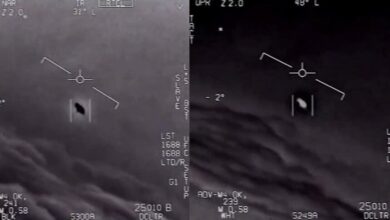
The AEGIS Alliance has followed this paper trail from the Navy videos into the hearing room. Read how the Pentagon’s acknowledgment of UFO tracking changed the public argument and what Jimmy Carter did with a light over Leary, Georgia. More lives in the unexplained, politics, and news.