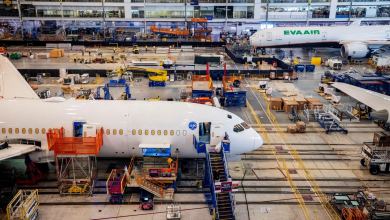
A signature in a Boeing traveler was never supposed to be the product. On May 6, 2024, the Federal Aviation Administration opened a formal investigation into the 787 Dreamliner after the company told regulators that workers at its North Charleston, South Carolina, factory had recorded required bonding and grounding inspections as complete when the tests had not been run. Those checks sit where the carbon-fiber wings meet the fuselage, the path that is supposed to carry lightning around fuel tanks, wiring, and composite structure instead of through them. The agency asked two questions that still organize the file: were the inspections actually performed, and did employees falsify aircraft records.
The admission did not begin in Washington. On April 29, 2024, Scott Stocker, then vice president and general manager of the 787 program, emailed the South Carolina factory after an employee flagged an irregularity during a conformity test. “We quickly reviewed the matter and learned that several people had been violating company policies by not performing a required test, but recording the work as having been completed,” Stocker wrote. Boeing said it disciplined multiple employees, notified the FAA, and started re-inspecting every 787 still inside the production system. A person briefed at the time put the potentially affected fleet near 450 airplanes, including about 60 still in Boeing’s hands. Engineers argued that design redundancies meant no immediate safety-of-flight issue. Regulators treated a signed-off lightning path that nobody had checked as something other than a clerical error.
The Wing Joint Came Back as a Crack Rule
The bonding probe was about a test that was never done. A later rule is about metal that may have been pulled too hard. On August 27, 2026, the FAA published Airworthiness Directive 2026-17-02 for certain 787-8, 787-9, and 787-10 airplanes. It takes effect October 1, 2026. Boeing’s own investigation found manufacturing errors and excessive preload at the lower side-of-body splice plates, the hardware common to the lower outboard wing skins. The company concluded that shim gaps may have exceeded engineering allowances and that high pull-up forces can seed fatigue cracks at fastener holes. If those cracks grow, the FAA wrote, primary wing structure can weaken until it cannot carry limit load, which is the regulator’s way of saying the airplane might not be able to keep flying and land.
The directive does not ground the fleet. It orders repetitive ultrasonic inspections of splice plates, rear and front spar terminal fittings, lower chords, and specified jack pads, plus detailed visual inspections of splice plates, and repairs if cracking is found. The FAA estimated the rule hits 17 airplanes on the U.S. registry. Aviation trade coverage of the same bulletin put the worldwide list at 77 jets, a thin slice of a Dreamliner fleet that now exceeds 1,100. Boeing has said the measuring method was corrected in production after the company found the shim problem years earlier, and that an August 11, 2025, alert requirements bulletin is the document the FAA turned into a legal obligation. Operators now own the downtime. A factory error discovered in the measuring of paper-thin shims became, seven years later, an ultrasonic appointment on the wing.
That appointment is not the only 787 paper defect moving through the Federal Register. A separate final rule, Airworthiness Directive 2026-20-01, was queued for publication on September 28, 2026. It covers certain 787-8, 787-9, and 787-10 airplanes after a report that cargo-liner joint sealing tape could be missing in particular areas. Without that tape, the FAA said, a fire could propagate into the cabin. The remedy is a detailed inspection and on-condition action, not a redesign announced at an air show. The bonding case, the shim case, and the tape case are different defects. They share a production habit: a step that was supposed to be verified left the factory as an assumption.
A Quiet Fine, a Bought-Back Supplier, and a Deal That Avoided a Conviction
The 737 line supplied the criminal context. On January 5, 2024, a door plug blew out of Alaska Airlines Flight 1282, a 737 MAX 9 that had left Renton without four bolts meant to hold the plug. The National Transportation Safety Board later said Boeing’s parts-removal process failed to make sure hardware taken off for rework was put back, and that FAA surveillance had not caught the repeat nonconformances. The Justice Department, which had already accused Boeing of breaching a 2021 deferred-prosecution agreement tied to the Lion Air and Ethiopian Airlines crashes that killed 346 people, did not take the company to trial. Prosecutors signed a non-prosecution agreement on May 29, 2025. On November 6, 2025, U.S. District Judge Reed O’Connor in Fort Worth dismissed the criminal information. Boeing agreed to pay more than $1.1 billion across a penalty, funds for crash families, and compliance oversight. Families called it a second escape. Boeing called it a chance to rebuild quality.
The rebuild had a price tag that was easier to hide than a plea. In September 2025 the FAA proposed a civil penalty for hundreds of quality-system violations it said it found between September 2023 and February 2024 at the Renton 737 line and at the Wichita fuselage plant then run by Spirit AeroSystems. The agency also said Boeing had presented two airplanes for airworthiness certificates when they were not airworthy, and that an employee had pressed a colleague doing delegated inspection work to sign off a MAX so a delivery date would hold. Boeing paid a $3.1 million settlement in January 2026. The payment became public in early September 2026, when the FAA confirmed the amount to Reuters. Three million dollars is a rounding error against a widebody program. The fact that it was paid in silence, eight months before the public heard, is the more useful detail. Penalties that arrive without a press release train a company to treat enforcement as a private invoice.
On December 8, 2025, Boeing closed its purchase of Spirit AeroSystems, bringing roughly 15,000 workers and the 737 fuselage work back inside the company that had spun that work out two decades earlier. Executives described the all-stock deal, valued near $4.7 billion in equity before assumed debt, as the end of arguing with a vendor about gaps and shims. Folding the supplier back in does not restore a bonding test that was marked done in Charleston. It does put the signature and the wrench in the same building, which is the minimum condition for a logbook to mean what it says.
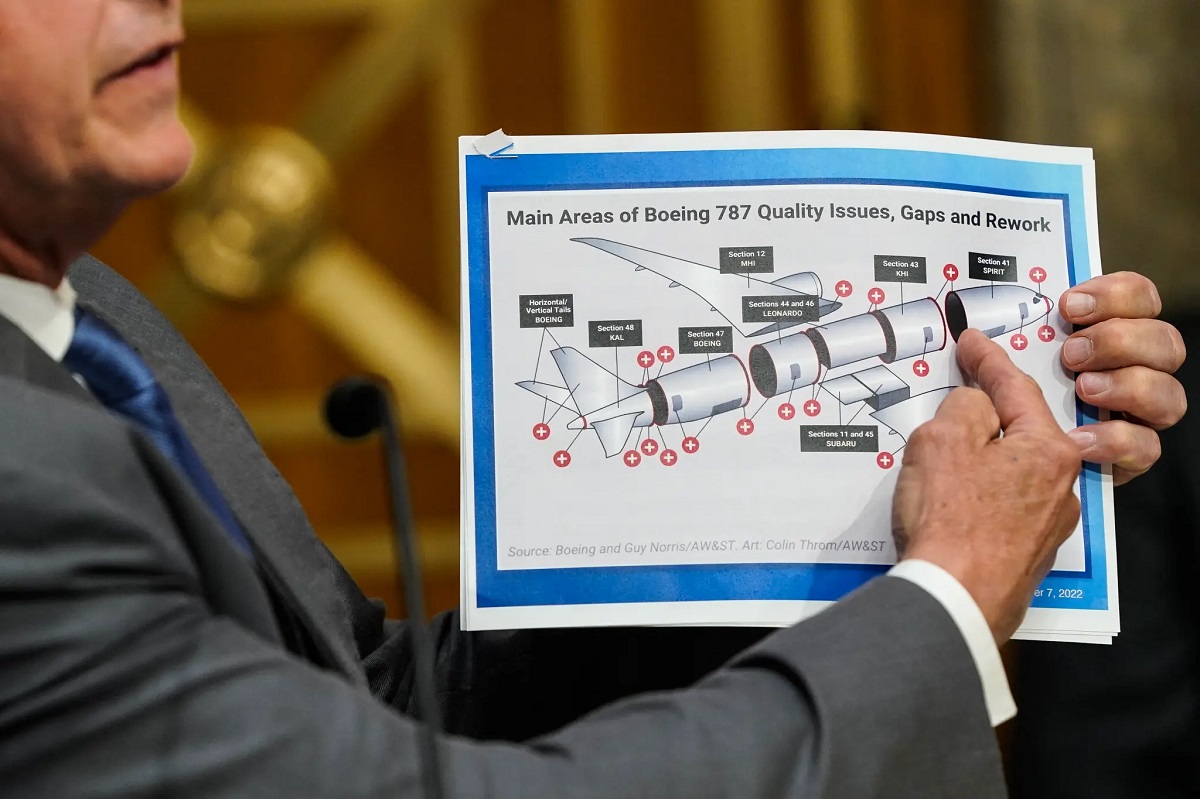
North Charleston was sold as the clean future of American widebody production: composite barrels, fewer fasteners, a factory that would not look like the old aluminum lines. Senate testimony in 2024 described fuselage-join gaps filled and signed under schedule pressure. Company leaders answered that the structure has multiple load paths and that no in-service accident had been tied to the missed bonding checks. That sentence is not the same as “the inspections happened.” The AEGIS Alliance has tracked fabricated official records before, including a Lee County, Florida, sheriff’s office accused of manufacturing evidence, and the sudden death of a second Boeing whistleblower in the same season the MAX criminal file reopened. The industrial economics of a squeezed airline market sit in a separate file, including how a Spirit Airlines chief executive called the U.S. industry a rigged game, on the U.S. News and technology desks.
Passengers do not read shim bulletins. They read a boarding pass. The 2024 probe made a false inspection stamp public. The 2025 non-prosecution deal priced a different Boeing crime and then closed the case. The October 1 wing directive sends ultrasonic probes back to the joint where the wing meets the body. The cargo-liner rule asks whether a strip of sealing tape is actually there before smoke has a path into the cabin. None of those steps answers the question a conformity tester raised in South Carolina in April 2024. If the box is checked and the work is missing, the traveler is a story. The FAA’s job, two years of directives later, is still to find out which sentences in that story are true.










They done
And the death of two whistleblowers but nothings being linked 🤔🤣🤣🤣
Whistle blowers have short life expectancies. Wonder why? (Sarcasm)
You talk about Boeing .. you be going