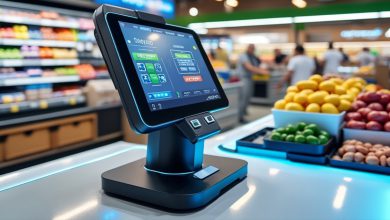
California never banned the self-checkout machine. It made the machine expensive to leave on. Sen. Lola Smallwood-Cuevas, a Los Angeles Democrat who chairs the Senate labor committee, wrote the first statewide attempt as Senate Bill 1446 in 2024. A grocery or drugstore offering self-checkout would have needed a dedicated attendant for no more than two stations, a 15-item cap, and a ban on age-restricted goods and merchandise locked behind anti-theft tags. Grocers would also have had to study how later AI checkout tools would hit jobs. The California Grocers Association and the California Chamber of Commerce opposed it. An industry-funded analysis claimed the mandate would force about 10,200 extra cashier hires at nearly $500 million a year. SB 1446 passed the Senate 25-12 in May 2024, moved through Assembly committees, and died before it reached Gov. Gavin Newsom. The $500 million figure survived. Lobbyists carried it into the next session like a receipt.
Smallwood-Cuevas returned in the 2025-2026 session with Senate Bill 442, narrower on purpose. Stores that kept the kiosks would have to leave at least one staffed manual lane open and assign one employee whose only job was watching the machines. Signs would still advertise a 15-item limit, though a shopper who exceeded it would not, by itself, trigger a fine. California’s 2011 ban on selling alcohol at self-checkout would expand to tobacco and to any item with a security tag an employee must remove. Adding new kiosks would require 60 days’ written notice to workers and unions. Penalties in the drafts ran up to $1,000 per violation per day, with an aggregate cap near $200,000. The Legislature’s bill record shows SB 442 passed the Senate 26-10 in the summer of 2025, backed by the United Food and Commercial Workers and the California Labor Federation. “This is about supporting our workforce, to make sure that they’re safe, but mostly to also make sure that they’re providing the level of service that customers expect and deserve,” Smallwood-Cuevas said on the floor. The Assembly Appropriations Committee postponed its August 29, 2025, hearing. The bill became a two-year file. Newsom’s office declined to take a position on pending legislation. Sacramento had a speech. It did not have a statute.
Three Cities Wrote the Statute Sacramento Would Not
Long Beach did not wait. In August 2025 the council passed a “Safe Stores are Staffed Stores” ordinance, the first of its kind in the country. The mayor signed it on August 21, 2025. It took effect September 21, 2025. Grocery and drug retailers must staff one dedicated employee for every three self-checkout kiosks, cap transactions at 15 items, keep alcohol and locked-case goods off the machines, and keep a human lane open whenever the kiosks are on. Fines can reach $1,000 a day. Several stores shut the machines off and taped up signs blaming the city. On August 21, 2026, almost a year after the signature, Economic Development Director Bo Martinez sent City Manager Thomas B. Modica a memo on early implementation. Staff had surveyed 13 affected businesses. Ten of the 13 had fully closed self-checkout. The rest had restricted it. Operators described longer lines and more employees standing at the front end. The city called that the public-safety result it had written down. Grocers called it a ban achieved by a staffing ratio. Several told the city the rule was already inside decisions about whether to open another Long Beach store at all.
Costa Mesa copied the model and softened one edge. On February 17, 2026, the council approved its ordinance 4-2. It took effect April 20, 2026, covering grocery and drug retailers, with one monitor for every three kiosks, a 15-item limit, and a staffed lane whenever the machines run. Unlike Long Beach, Costa Mesa added a 15-day right to cure after industry complaints. The city scheduled a 2027 review. Nate Rose of the California Grocers Association told Voice of OC that local ratios raise costs and prices. UFCW Local 324, which had pushed Costa Mesa, then took the same clipboard to Santa Ana. On May 19, 2026, the Santa Ana council passed its own “Safe Stores are Staffed Stores” ordinance unanimously. It covers retail drugstores and grocery stores larger than 15,000 square feet, requires the same one-to-three ratio, a manned lane whenever kiosks are open, a 15-item cap, and a ban on age-restricted and security-tagged goods at the machines. UFCW Local 324 President Jose Perez called the rules a benchmark that still allowed technology. The ordinance was written to take effect 30 days after adoption, which put it on the street in June 2026. Anaheim’s staff, earlier in the year, had already put a comparison chart of Long Beach, Costa Mesa, and SB 442 in front of their council. The chart is now missing a column. Santa Ana filled it.
The Bay Area is the next argument, and it is not a law yet. On September 17, 2026, the San Jose rules committee voted to study a package that looks familiar: a 15-item cap, one employee for every three operating kiosks, at least one staffed lane, a ban on tobacco and locked merchandise at the machines, and signs telling customers how to report a violation. The Mercury News and the East Bay Times reported that the full council is not expected to take the matter up until early 2027. Committee action creates no requirement. City officials cited as much as $400,000 a year in sales-tax revenue they link to retail theft, a figure that justifies a study and does not prove that San Jose’s self-checkout lanes caused the loss. If the council eventually copies Santa Ana, San Jose would be the first Bay Area city with the rule. Industry groups have already opened a counter-campaign, “Read the Receipts,” arguing that the mandates mean higher prices, longer waits, and chains pulling back from Long Beach, Costa Mesa, and Santa Ana. The fight has moved from a committee hearing in Sacramento to a receipt the shopper can time with a phone.
Most Stores Chose a Dark Kiosk Over a New Hire
National retailers had already started thinning the machines before any California city voted. Walmart reduced self-checkout at some stores. Dollar General pulled kiosks from hundreds of locations. Five Below shifted toward associate-assisted checkout and cited theft. Smallwood-Cuevas has used industry figures putting self-checkout shrink at more than $10 billion a year for food retailers, on the order of 16 times the loss at staffed lanes. Cashiers say one person is asked to stock, ring, override a weight error, check an ID, and watch a walkout at the same time. Shoppers say they are tired of scanning their own groceries and still waiting for a human to unlock a bottle of wine. California remains the only state with a flat ban on alcohol at self-checkout, and the grocers’ association has floated lifting that ban as a trade for the extra labor. Unions hear that offer as a request to legalize the thing the kiosk was never supposed to sell, in exchange for a clerk the store did not want to schedule.
Both descriptions can be true in the same aisle. A 15-item cap is easy to print and hard to enforce when a parent with a cart of cereal, produce, and bottle deposits blows past it. Long Beach retailers told the city that individually counted produce and California redemption fees turn a small basket into a violation. A one-to-three ratio is easy to write and expensive in a store that built eight machines to replace four cashiers. The August 21, 2026, Long Beach memo is the first hard local dataset. Ten of thirteen shops did not hire a monitoring crew. They turned the machines off. That is a policy result, not a glitch. If the political goal is fewer unattended scanners, dark kiosks count as success. If the goal is a clerk who can look a customer in the eye and still catch a walkout, the city bought more human lanes by making the experiment too costly to keep. Shoppers will decide with their feet whether a Sunday line is the price they wanted to pay for a person at the end of it.
Grocers warn that a patchwork is harder to run than one state statute. They are right about the paperwork and wrong if they expected the patchwork to wait. SB 442 can still come back and set a floor while allowing cities to keep stricter rules, which is how the stalled bill was already drafted. Until it does, the enforceable law is municipal: Long Beach since September 2025, Costa Mesa since April 2026, Santa Ana since June 2026, San Jose studying a 2027 vote, Anaheim holding a chart. The AEGIS Alliance tracks how theft, labor, and automation collide in U.S. News, politics, and crime news coverage, and in technology files such as the Hangzhou engineer who built a companion when the human system failed him. None of this is abstract in a store that already cut night cashiers and now has an inspector asking how many people are watching six machines. Sacramento still has a bill. Long Beach already has an answer, and the answer, in ten stores out of thirteen, was to switch the kiosk off.