Mexico Moved Its Next Judicial Election to 2028 After a 13 Percent Turnout While Washington Refused a 16-Year USMCA Extension


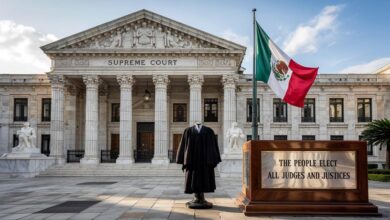
Mexico did not sample judicial elections. It replaced the appointment system with a ballot, swore in the winners, and then quietly moved the next round a year to the right. On June 1, 2025, voters were asked to pick thousands of judges and magistrates and all nine seats on a Supreme Court cut from eleven. About 13 percent of eligible voters showed up. Printed cheat sheets, the acordeones, listed ruling-party names so widely that election monitors treated them as part of the furniture. Every Supreme Court contender on those lists won. On September 1, 2025, the new bench took the oath before the Senate.
The second date is the one the original speeches did not advertise. On June 2, 2026, a new constitutional reform was published in the Official Gazette. It did not repeal popular election of judges. It postponed the next federal judicial election, which had been set for 2027, to the first Sunday of June 2028. Law firms reading the text said the package also lets the Supreme Court sit in two sections, tightens how candidates are evaluated, and widens the oversight tools of the Judicial Discipline Tribunal. Morena called the delay a chance to professionalize the process. The practical effect is simpler. The court elected in a low-turnout sweep gets more time in the chair before voters are asked to finish the job.
Who sits there, and who is already queued to preside
Hugo Aguilar Ortiz, a Mixtec lawyer from Oaxaca, took the most votes of any Supreme Court candidate, just over six million, and became chief justice. He is the first Indigenous person to lead the court since Benito Juarez. He once advised Zapatista communities and later worked inside the state on files that included the Maya Train. Activists who wanted a symbol got one. Analysts who wanted distance from the ruling coalition did not.
Three justices first appointed under Andres Manuel Lopez Obrador, Lenia Batres, Yasmin Esquivel, and Loretta Ortiz, won new terms on the same ballot. The 2024 reform said the presidency rotates every two years by vote total. Under that reading, Aguilar’s term as president runs to August 31, 2027, and Batres, second in the vote, would take the gavel the next day. A constitutional contradiction El Pais mapped in August 2026 is still sitting in the text. Another article says the full court elects its president every four years and that the winner cannot be immediately reelected. The drafters left both sentences alive. Sometime before September 2027 the ministers will have to decide whether the people already chose the next president or whether the ministers get to choose her. That is not a scheduling quibble. It is the reform arguing with itself.
On September 8, 2026, Aguilar delivered the first annual report in front of President Claudia Sheinbaum. La Jornada recorded the numbers he wanted remembered. The court took in 15,051 jurisdictional files and resolved 13,231, about 88 percent. Of 1,479 inherited matters, 44 remained. He said there was no backlog and no inefficiency, only real change. He claimed savings of more than 4.7 billion pesos and declared that privileges were over, including major medical insurance for ministers. He did not dwell on the court’s request for a 17.2 percent nominal budget increase for 2027, or on Sheinbaum’s August rebuke after six ministers voted to restore that insurance with public money. “The people also rule in the judiciary,” he said. A report delivered to the president who inherited the reform is an odd place to prove you take no instructions.
Washington blinked, then talked about cars
In 2024 and 2025, the U.S. embassy and Canada’s ambassador, Graeme Clark, framed the reform as a threat to independent justice and to the labor courts the United States-Mexico-Canada Agreement assumes. Investors wanted a bench that would enforce contracts without a campaign flyer. The six-year USMCA review arrived on July 1, 2026, and the public fight had moved. Reuters reported that U.S. Trade Representative Jamieson Greer refused to extend the pact for 16 years. “The United States did not agree to renew the USMCA in its current form,” he said. Mexico and Canada had asked for the extension. The agreement stays in force, with annual reviews, until it expires on July 1, 2036, unless the three governments confirm a longer term in writing.
Greer’s statement centered on trade deficits and reshoring, not a fresh seminar on elected judges. The U.S. goods deficit with Mexico was $197 billion in 2025, and with Canada $48.3 billion. Automotive rules of origin were the fight Mexico’s economy minister said was still open. Bilateral talks were booked for the week of July 20. On September 26, 2026, Sheinbaum was still describing separate negotiations with Washington on steel, aluminum, and vehicle tariffs alongside the treaty review. The judicial scare was the overture. The invoice was about cars and deficits.
That foreign anxiety was never only a moral argument. Mexico’s old appointment system was not a temple. It leaked, it sold information, and U.S. counsel often found it comfortable when nationalist statutes were on the table. Lopez Obrador’s answer was to blow up the machine rather than scrub it. The honest version is both things at once. The old court was not clean. The new court was not chosen by an informed public. Thirteen percent turnout, a pile of spoiled ballots, and party cheat sheets are a low-energy ratification of an amendment the legislature already had the votes to pass.
What the first year actually tests
The cases that matter are not the austerity applause lines. They are preventive detention, the militarization of public security, tax fights that touch foreign capital, and any file that pits a Morena statute against a treaty clause. A disciplinary tribunal can remind a circuit judge what loyalty costs. Faceless benches for organized-crime dockets can hide the name on the order. Letting the court split into two sections may clear the docket the 2024 reform created when it abolished the chambers and forced everything through the full bench. Speed is not independence.
Silvia Delgado, a former lawyer for Joaquin Guzman, won a criminal judgeship in Ciudad Juarez in that first election. One result did more to explain the panic than a dozen ambassador cables. A system sold as an anti-corruption cleanse produced a winner whose famous former client was the most famous trafficker in the hemisphere. Electing judges does not drain cartel money from campaigns. It can make the money more efficient. A candidate with a printed list needs to be recognizable on a flyer. Organized crime understands flyers.
Aguilar has talked about taking sessions out of the marble building to bring justice closer to the people. Travel is a photograph. Independence is a loss column: a ruling against the party that put you there, followed by still having the job in the morning. Human Rights Watch warned in 2025 that the election model was likely to make the judiciary more loyal to the government. The first annual report did not refute that warning. It managed it.
Readers who follow The AEGIS Alliance coverage of politics and captured institutions will recognize the move. Change the selection rules. Keep the patronage. Call the result the people. Our Costa Rica investor-justice file showed how fast Washington discovers the phrase rule of law when money is stranded. Mexico is the larger version. U.S. lectures about judicial independence also arrive with a history: privatization, IMF pressure, and a drug war that treated Mexican courts as a venue for protecting cross-border capital. Those lectures are easier to dismiss because of that history. Dismissal is not a blank check for Morena.
2028 is the test the speeches described
Half the remaining federal judges still have to face voters. If the 2028 round looks like 2025, turnout in the teens and acordeones in every plaza, the experiment is over as an experiment. It will simply be how the Mexican federal bench is staffed. If turnout jumps and names from outside the lists survive, the ruling party will have to live with a court it does not own. That is the only version of this reform that matches the speeches Sheinbaum still gives.
Until then the facts are blunt. The court is seated. The chief justice is Hugo Aguilar Ortiz, and the constitution cannot decide whether Lenia Batres inherits the gavel by vote total in 2027. The lists won the first round. The next ballot is June 2028, not 2027. The trading partners are unhappy about deficits even when they have stopped leading with judges. Democracy is not a slogan you print on a cheat sheet. It is whether a judge can say no to the party that put him there and still have a job in the morning.