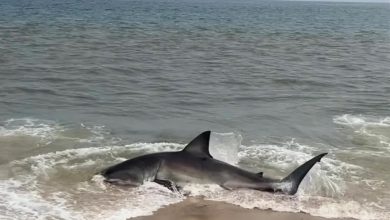
Beachgoers Pushed a Stranded Great White Off Nantucket’s Low Beach, Then the Island Kept Filming Whites in Ankle-Deep Water

A California visitor tossing a football on Low Beach in Siasconset thought her father had spotted a whale. Liza Phillips ran closer, saw the black eye and the jaws, and realized she was standing over a live great white shark pinned in the surf on August 16, 2024. The animal was sand-scraped. Its fins were caught. Its skin was raw from being dragged across the beach. Great whites force water over their gills by swimming. Once a large white is beached, the oxygen debt starts immediately. The AEGIS Alliance is keeping the clip because the rescue was improvised and filmed, and because Nantucket has spent the two summers since then proving Low Beach was not a one-off. Whites keep showing up in water thin enough to stand in, and the state has started writing rules for the people who go looking for them.
Phillips told the Nantucket Current the fish was helpless. She and houseguest Ted Rock watched for several minutes, hoping it would free itself. It did not. They waded in, rolled the shark, and shoved while staying off the mouth. Phillips went nearly underwater for the last push. The fish caught a wave and swam off. “You don’t expect yourself to feel bad for a great white shark because they are such apex predators and so scary,” she said. She hoped it would tell its “shark friends” she was a friend. To WCVB she was more specific: “You think of a great white as a predator, a beast, a monster, but watching it in that position, I was like, ‘Oh my God, this is really sad.'” She said a shove-and-run did not feel crazy “because there was no way it was going to turn around and bite my leg off.” That is a visitor’s read of a stunned fish. It is not a protocol.
She later told Storyful, in an account carried by USA Today, that the group was “watching this beautiful beast struggling and dying, full of sandburn rashes.” A friend took his shirt off. Someone on the video can be heard saying, “Give him a push.” The original Instagram reel is still at C-xm-4puZlE.
What response teams want instead of hands on the snout
Marine-animal teams still tell the public not to put hands on a large shark. Call a response group or local authorities. Keep people and dogs back. Do not stand over the mouth. Do not grab the gills. Do not turn the rescue into a souvenir circle. Phillips and Rock got away with a successful push. Other beachgoers will not. A ram-ventilating predator in six inches of water is still a predator. The right first move on most Massachusetts beaches is a phone call, not a shoulder in the surf. If the fish is clearly dying and no team is coming, the risk calculation changes, and the person who steps in owns that risk. A viral clip cannot underwrite it.
Ram ventilation is not a metaphor. A great white that cannot swim cannot breathe the way some smaller sharks can sit still and pump water. Sand in the gills makes it worse. August sun on a dry back makes it worse again. The window to get a large white into water deep enough to stroke is short. Trained crews use slings, boats, and people who have done it before. A football game on Low Beach became a rescue because the fish was out of time.
The island kept handing people a reason to touch a white
Nantucket sits in a white-shark corridor fed by a recovered gray-seal population. The Atlantic White Shark Conservancy has said abundance around Cape Cod rose over the past decade primarily because the seals came back. The island’s south and east shores are where those animals follow food. Low Beach in ‘Sconset is pretty. It is also a place where a white can end up in water too thin to swim. In June 2026 the island produced a different clip. Angler Elliot Sudal hooked a young great white on the south shore, estimated around eight and a half to nine feet, hauled it onto the sand, pulled the hook, and sent it back within seconds. The Guardian ran the footage because it looked like a man wrestling a maneater. Sudal said he posted it to show a fast catch-and-release, not a stunt. Set next to Phillips’ rescue, the two videos make the same point from opposite directions: people on Nantucket will put their hands on a white shark, and the water keeps offering the chance.
The state answered the angling half of that problem on July 31, 2026. The Division of Marine Fisheries filed emergency regulations barring shore anglers on Nantucket from using a metal or wire leader of 18 inches or longer together with a hook whose gap is larger than five-eighths of an inch. The rule already covered Cape Cod Bay and the eastern shore of the Cape. Nantucket had been left out of the 2025 version because the island has a long shore fishery for other sharks and, officials said, little evidence at the time that anglers were targeting whites. The spring and summer of 2026 changed that. DMF’s advisory said several documented incidents of shore anglers targeting and catching white sharks had created an “acute public safety risk.” Chumming from sunrise to sunset was already restricted, and mechanized or remote devices for deploying baited hooks were already banned. The emergency rule runs 90 days and expires on October 31, 2026.
Director Daniel J. McKiernan told the Marine Fisheries Advisory Commission in an August 20, 2026, memo that he does not plan to rush a public hearing just to extend the emergency language past those 90 days. He assigned staff to build possible amendments for 2027 so white-shark fishing is actually prohibited and swimmers are not the bycatch of a content clip. Sudal, speaking to the Boston Globe, blamed “influencers” chasing views and said locals already know whites are protected. The gear ban is aimed at the tackle that makes a white practical to hook from the sand, not at every rod on the island. Brown sharks and sand tigers can still be fished with legal terminal tackle.
A seal in ankle-deep water, and a robot named Marty
The research map filled in over the same summer. The Conservancy and the Massachusetts Division of Marine Fisheries tagged a 10-foot female, Marty, on July 16, 2026, the first newly identified white of the Cape season. The name is a partnership with Stop & Shop, whose in-store robot is also called Marty. The pings are not a joke. Her acoustic tag hit a receiver off North Truro 15 times, most recently at 5:32 p.m. on August 2, 2026, and every detection is logged in the free Sharktivity app. Chief executive Cynthia Wigren said the public would follow Marty, and that each pass over a receiver is data on how whites use the same water that fills Nantucket beaches in August.
Then the food chain showed up in the wash. Surfer reported on September 21, 2026, that Carrie Drayton and Tyler O’Brien were driving toward Great Point to fish when they saw something thrashing at a wash-over in the Coskata-Coatue Wildlife Refuge. Within moments the water was a red cloud. O’Brien filmed a great white tearing into a seal just feet from dry sand, in water that looked ankle to waist deep. The Conservancy’s explanation for why this keeps happening is not mysterious. Whites follow gray seals. Nantucket has seals. Shallow bars and wash-overs are where a hunt can happen in front of a truck. Phillips felt sorry for a beached predator in 2024. The September clip is the same species doing the job that brings it to the island in the first place.
That is the policy problem hiding under the applause for the Low Beach push. Massachusetts has spent years telling swimmers to download Sharktivity, heed the flags, and treat Cape and Islands beaches as seal country. The message works until a fish is flopping in the shore break, or feeding in it, and a visitor decides empathy or a phone camera is a plan. Phillips’ clip is moving. It is also a tutorial response teams did not ask for. The next person who copies it may meet a fish that is not exhausted. The fishing rule that expires at the end of October will not, by itself, stop a white from beaching on an ebb tide. It might stop the next deliberate hook-and-post from putting a hooked white, a swimmer, and a crowd in the same six inches of water.
For more wildlife reporting from The AEGIS Alliance, see Environment, the Louisiana beach dolphin file, and the sea lion haul-out file. Related coast reporting also lives under Science and U.S. News.
Phillips said she wanted the shark to survive. It did, at least long enough to disappear into a wave. Marty kept pinging off the upper Cape after her July tagging. Sudal’s fish went back in. A seal did not, in the shallows off Great Point. Low Beach will look empty again until the next white misses the depth. The AEGIS Alliance is leaving the 2024 rescue on the page because it is both a kindness and a warning, and those two things travel together on a Nantucket tide.