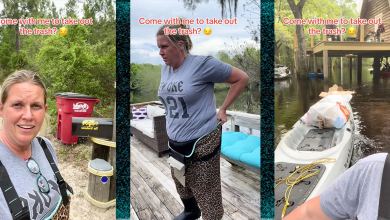

The dumpster is not far if you measure it on a map. On the Satilla River in Pierce County, Georgia, distance is measured in water over the steps, a locked gate, and whatever is swimming under a kayak that is also a garbage truck. Katie, who posts as Kayak Katie under the handle @southernadventurehunter, was 47 when a clip of that chore blew past nine million views in April 2024. She and her husband live in a wood cabin on stilts, water on every side when the river is up. The stairs to the porch disappear. The driveway becomes a swamp. Taking the trash out stops being a walk to the curb and becomes a procedure.
@southernadventurehunter
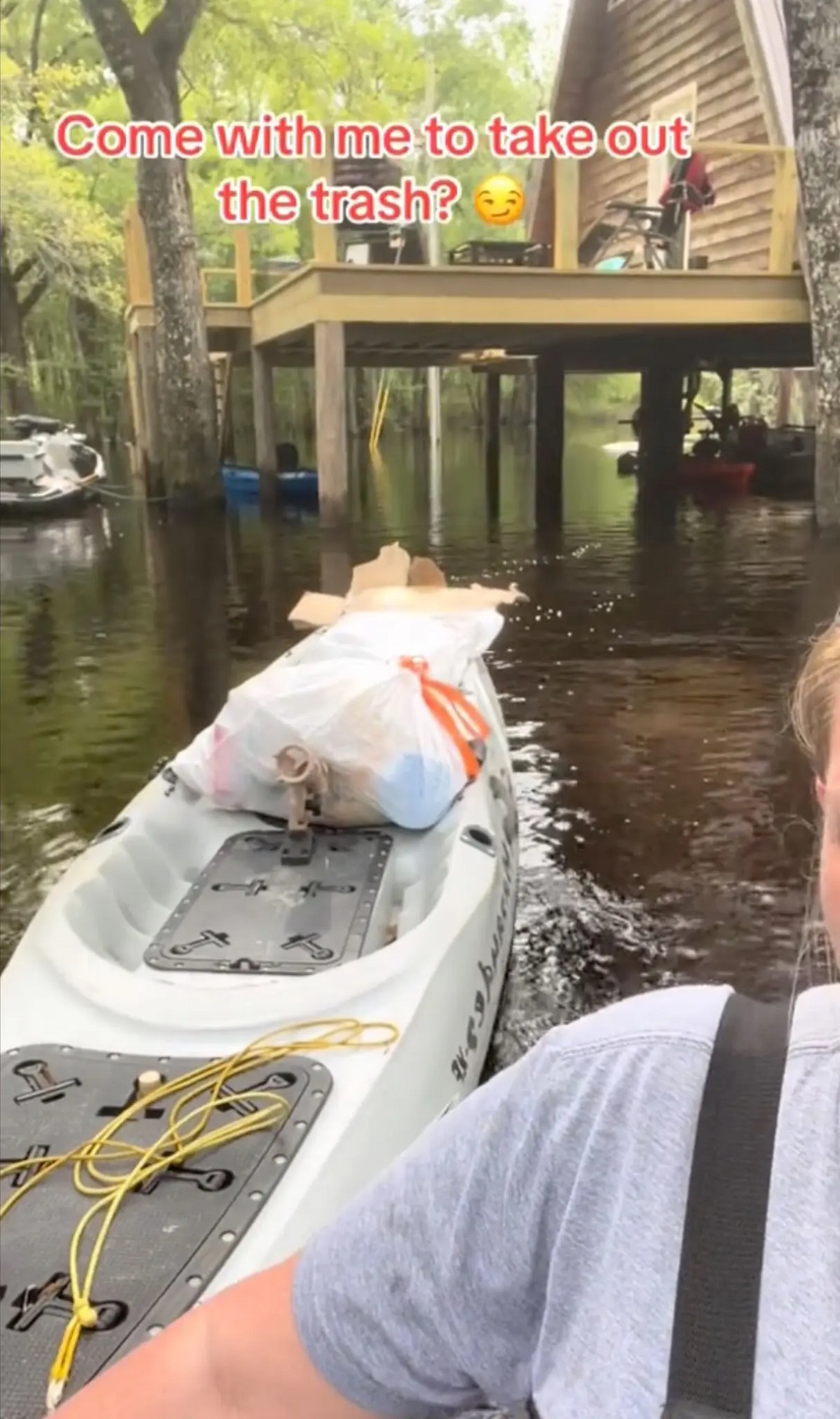
She narrates it like a checklist, because that is what it is. “Step one, get your gator waders. Step two, get your chihuahua. Step three, load the trash,” she says in the video Newsweek described. The dog goes inside the overalls. The bags go in the boat. Some writeups called the boat a canoe. She calls the life kayaking, and the account is named for it. On the far bank she gets on a four-wheeler and rides a dirt track to the bins on the main road. In the version that spread in late April 2024, the gate was locked. “Unfortunately, the guys locked it before they left this morning, so I have to walk the rest of the way,” she says. Then she does the whole thing backward. “We made it! Now let’s do it all again.”
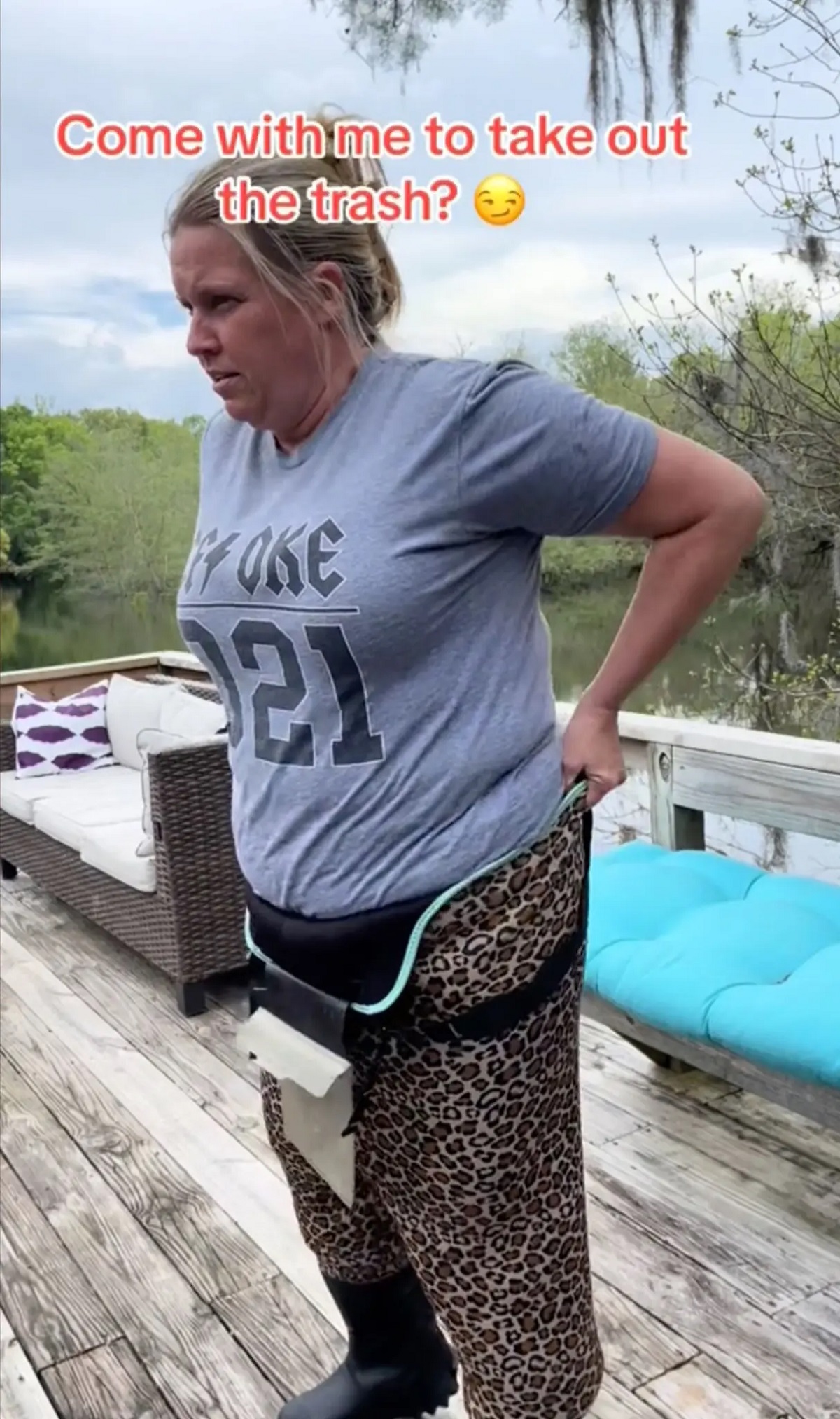
Newsweek reported that the April clip drew more than 9.5 million views and about 960,200 likes. Commenters did what commenters do with a life they would not live. They said the bags would stack up in the kitchen. They said this was what their husbands pictured every time someone asked them to take out the trash. The joke only works if you treat the river as a novelty. For her it is the road. She told Newsweek the routine is what happens every time the driveway floods, and she gave the line that should have been the headline instead of the scare: “I’m not afraid of gators, just mindful.”
Mindful Is a Safety Rule, Not a Slogan
Georgia is not short of alligators. A state wildlife fact sheet puts the population at roughly 200,000 to 250,000 animals, in marshes, swamps, rivers, and farm ponds. A June 2025 television segment on the Department of Natural Resources’ “gator wise” campaign rounded the same herd to about 225,000. The Satilla is blackwater, tea-colored from tannins, and it is exactly the kind of river those animals use. The internet heard “gator-infested” and pictured a gauntlet. The state’s own attack record is much smaller than the comment section. Newsweek, citing Georgia wildlife authorities, reported that from 1980 through 2023 the state logged nine alligator attacks on people, including one fatality, in 2007, and that those cases involved humans trying to make contact with the animal.
That number does not make a flooded porch safe. It does change what her checklist means. The waders are not a costume. The dog in the bib is not a bit, or not only a bit. Georgia’s advice, repeated by wildlife officers every warm season, is dull: do not feed them, do not swim with them, do not poke them, keep pets and children back from the edge because an alligator can lunge about its body length. Katie’s version of that advice is to dress for the water, keep the chihuahua off the surface, and cross with a purpose instead of lingering. “Mindful” is the whole doctrine in one word. Fear would keep a person from living there. Carelessness is how the nine attacks happened.

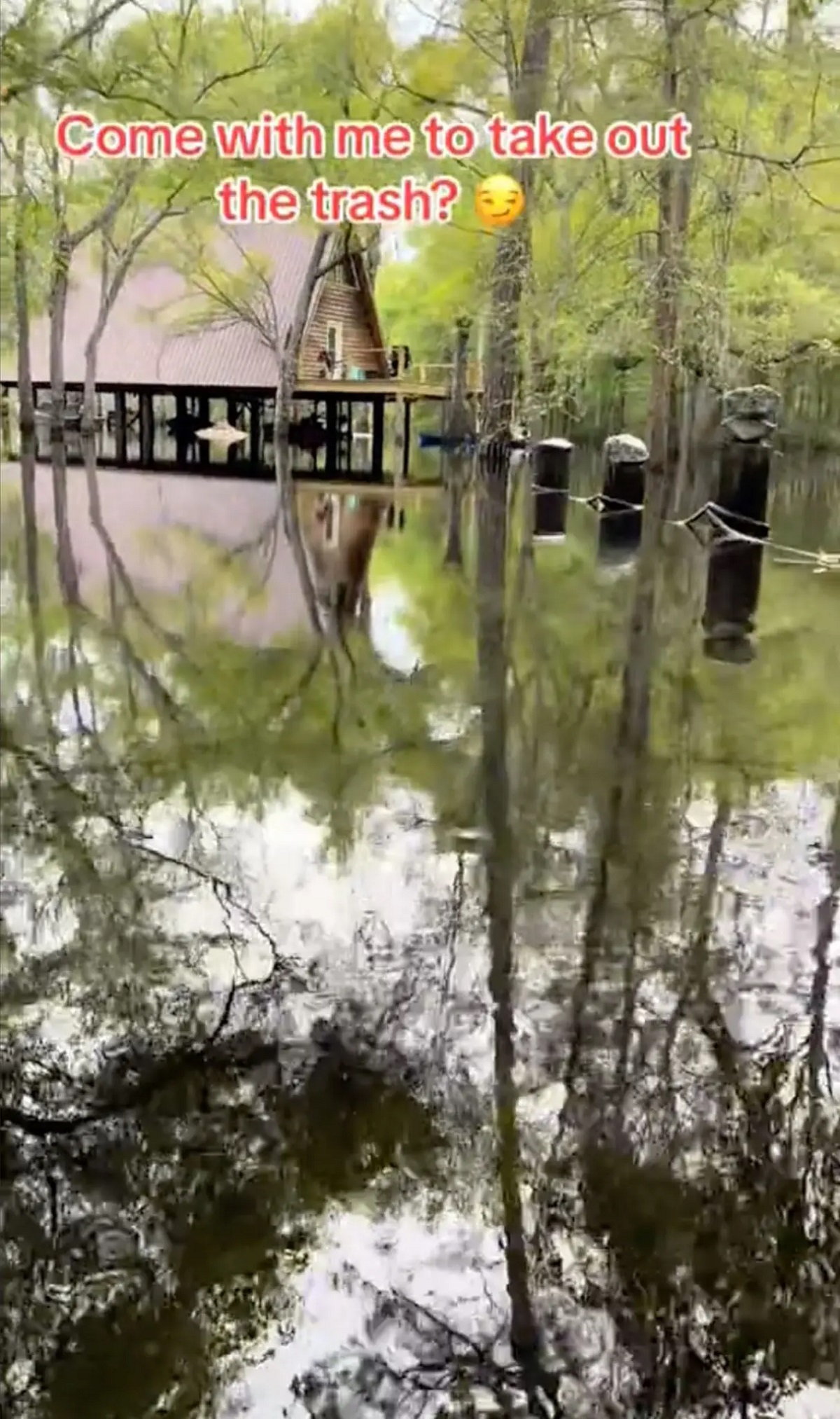
The Satilla does not stay at one height, which is why the trash run is sometimes a walk and sometimes a crossing. On June 3, 2026, she posted from the same house after getting home and finding the river up. Rocks that mark the edge were under water. The boat ramp had taken on more of the flow. She talked through the gauge upstream at Waycross, which she said had hit 12 feet that day, and she said the water at her place would keep rising for two or three days even after Waycross crested. That is how a coastal-plain river works. Rain that falls inland arrives later, brown and high, and the porch steps go under on a delay. A person who lives on pilings learns to read a gauge in another town the way other people read a traffic app.
The house has its own failures that have nothing to do with teeth. On June 26, 2026, she filmed a repair from the kayak, sitting on the stairs, talking about an air-conditioner drain line that had been hanging in the river. It had clogged so badly that water poured back into the house. Mud came out in clumps when they cleared it. She hung the line so it could drain, then found it still was not behaving. In the same clip she says she has been on the river her whole life and still would not have known “all of this” until she started living in the house. That line is more useful than the viral checklist. Familiarity with a river is not the same as knowing how a building on that river fails. The trash run made her famous. The drain line is the actual residency test.
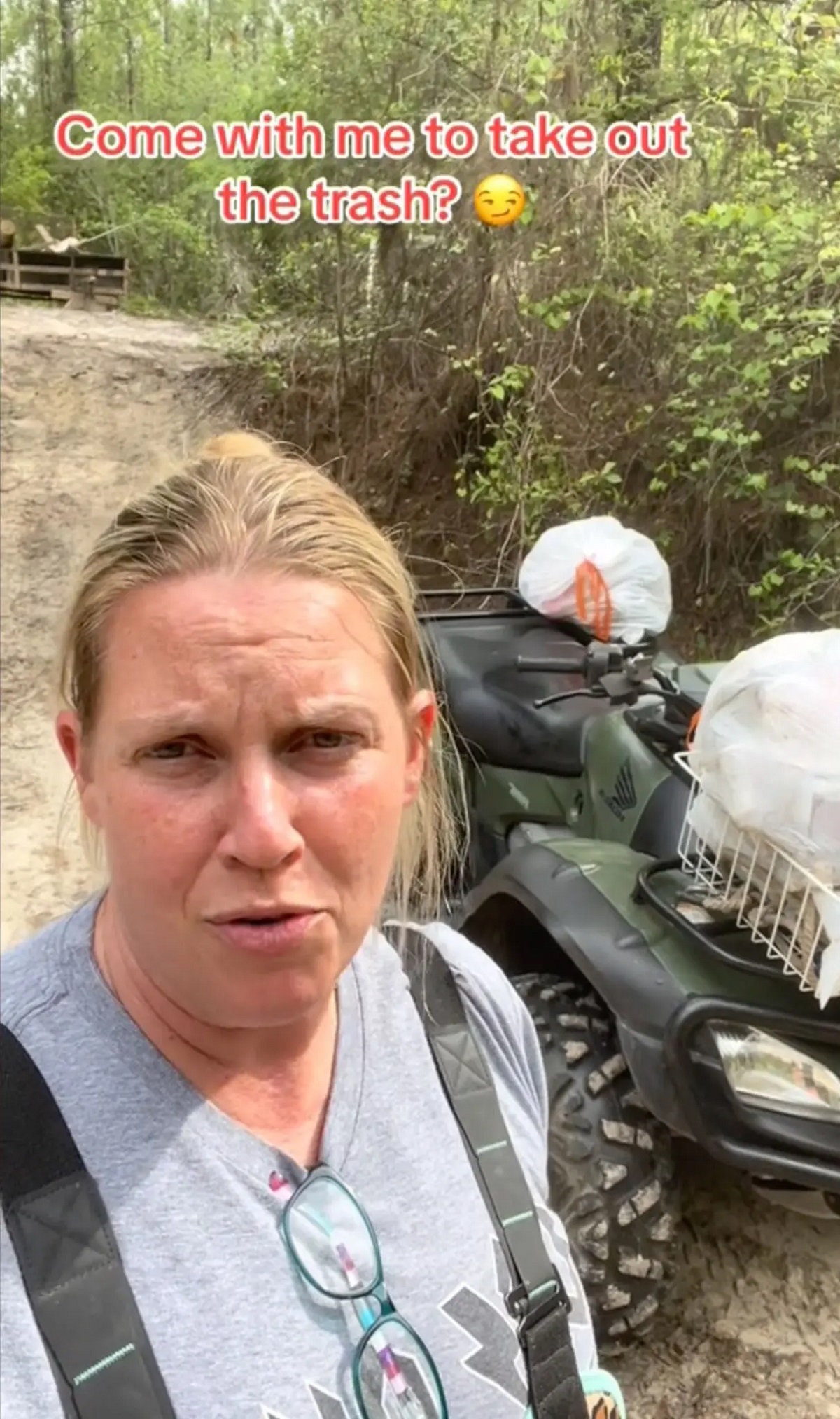
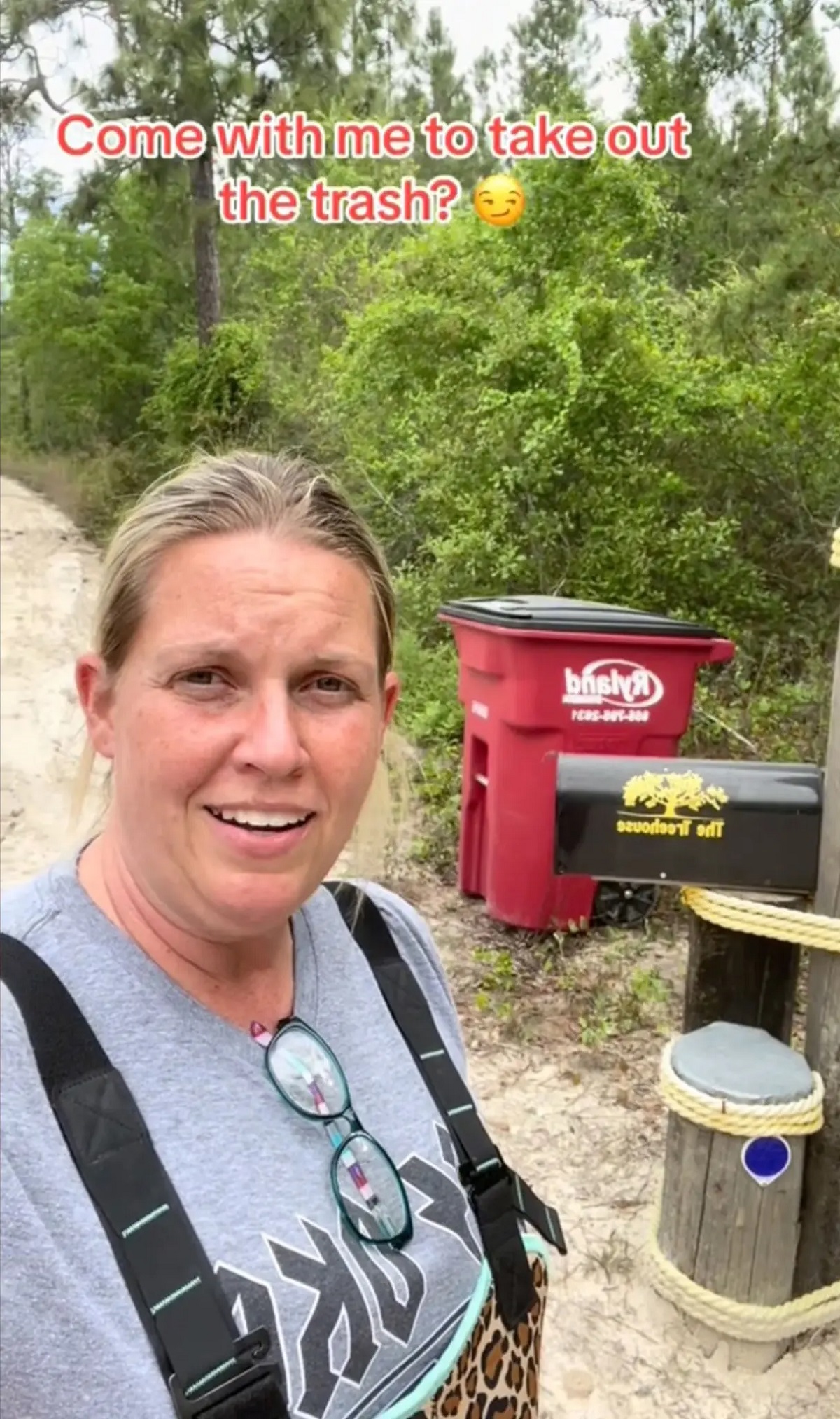
Isolation is the selling point and the invoice. There is no curb service because there is no curb. The mailbox, in the clips, lives out by the same roadside stop as the dumpster, which means mail and garbage are the same expedition. A locked gate turns the last stretch into a walk in waders, bags in hand, dog still riding along. Bugs are a constant on a blackwater porch in south Georgia. Snakes use the same banks the alligators use. None of that showed up in the comment section as often as the alligator did, because a mosquito does not thumbnail as well as a prehistoric reptile. The labor is ordinary rural labor with a worse commute. The spectacle was other people’s surprise.
Pierce County sits in the wiregrass and swamp country of southeast Georgia, upstream of where the Satilla widens toward the coast near Woodbine and the Atlantic. It is not a resort river. It floods, it drops, it stains everything it touches. Living on it means accepting that the public road is a privilege you paddle to, not a right that ends at your door. When the water is down, the chore shrinks. When Waycross is at 12 feet, the chore expands to fill a morning. She has kept posting from that house through the summers after the clip, including those June 2026 high-water and repair videos. The viral week did not move her to a subdivision. The river did not agree to stay down for the cameras.
There is a class story hiding in the jokes. Viewers with municipal trash service treated her week as content. She treated it as Tuesday. The people who said they would simply live in a pile of bags were describing a choice she does not have if she wants the health department, the mailman, and the animals to remain on speaking terms. Garbage in a floodplain is not a personality. It is a nuisance-wildlife attractant. Leaving bags on a porch above alligator water is its own kind of feeding. Hauling them out is the responsible version of the life, not the reckless one. The waders are the responsible part.
Her husband is in the picture the New York Post sketched, two people surrounded by water, but the checklist is hers on camera. She is the one dressing, loading, paddling, walking the locked gate, and turning around to do it again. That matters because the comments kept trying to make her a character in someone else’s domestic comedy, the wife with the extreme chore, the husband who would never. The footage does not support the bit. It supports a woman who knows the order of operations on her own river and is willing to show it without pretending the water is empty.
The AEGIS Alliance has covered other Southern houses that lost an argument with the animals next door, including the Charlotte family who found about 50,000 honeybees living in a toddler’s bedroom wall. More of this beat sits in Odd News and Environment. Katie’s clips remain at @southernadventurehunter. Georgia’s population figures are in the state wildlife fact sheet, and Newsweek’s interview is here.