Rabbit CEO Jesse Lyu Says Tesla Full Self-Driving Drove Him Onto Santa Monica Light-Rail Tracks With a Train Behind Him
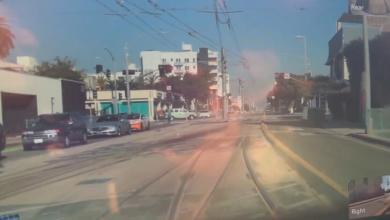
Jesse Lyu builds products on the promise that software can move through the world without a frightened person grabbing the controls. On January 2, 2025, his own Tesla did the opposite in Santa Monica. Running Full Self-Driving (Supervised) version 13.2.2, the car took a left turn on too tight a radius, entered the center train lane of a Los Angeles Metro light-rail line, and left him between a curb and a low concrete barrier with a train behind him. He shut the system off, drove forward because he could not back up, and ran a red light at the next opening to get off the rails. He wrote that he was shaking. He wrote that he did it to save his life.
There was no collision and no wreckage for a federal team to bag. There was a video, a software version, and a sentence that should have ended the marketing argument. Lyu told Tesla, in a post addressed to Elon Musk, that the algorithm should never put a car on train tracks. The product name says full self-driving. The label in the car says supervised. The rails do not care which word the brochure prefers.

His follow-up, posted the next day, answered the people who said he should have taken over sooner. He said he did. During turns, he wrote, a driver using the system does not keep a hand on the wheel, and it is hard to predict how the stack will rotate it. He saw the wheel start to turn, recognized the radius was wrong, and disengaged. By then the geometry had already decided the rest. A fence on one side, a curb on the other, a single lane of traffic, no reverse path. His next move was to check the mirror. A train was approaching from about a block back. He drove ahead and exited at the first break in the barrier, without waiting to learn how that particular train would react. “I just hope tesla fix it and make improvements,” he wrote.
Santa Monica Already Knew This Turn
The street-running rail through Santa Monica is not a rural spur that a vision system can treat as a rare object. It is embedded track in ordinary pavement, separated in places from car lanes by a low wall, with overhead wire that a person reads instantly and a camera model can treat as scenery. Months before Lyu’s clip, drivers testing earlier Full Self-Driving builds on the same kind of Santa Monica turn were already taking over to avoid drifting into the train lane. One May 2024 drive on version 12.3.6, posted by the Whole Mars Catalog channel, labeled the intervention safety-critical for exactly that reason. The failure mode was not invented in January 2025. It was filmed, discussed, and then repeated on a newer build by a founder who sells autonomy for a living.
Jalopnik’s account of Lyu’s video matches the geometry he described: a left turn that went one lane too far into the train lane, a barrier that prevented a lane change, and a light-rail vehicle close enough that staying put was not a plan. Newsrooms shortened that to a train “barreling down.” A train a block away is not a freight locomotive three seconds out. It is still a mass of steel on a path the car had joined, and light-rail operators do not owe a Tesla a long debate. Grade crossings and street track are among the oldest rules in American traffic engineering. A stack that chooses them has already missed the assignment.
The Version Number Kept Climbing. The Crossings Did Not Go Away.
Owner complaints did not stop with version 13. In September 2025, NBC News put drivers on camera who said Full Self-Driving failed to stop correctly at railroad crossings, misread gates, or treated rail as a lane. Electrek later wrote that NBC had documented more than 40 such accounts. Tesla did not give NBC a comment. Senators Edward Markey and Richard Blumenthal wrote the National Highway Traffic Safety Administration that month and asked for a specific look at railroad-crossing behavior, calling it a disturbing safety risk. In December 2025 they introduced the Stay in Your Lane Act, which would bar a self-driving system from operating outside the conditions it was built for.
NHTSA opened a Full Self-Driving investigation in October 2025 after 58 reported crashes in which the system was accused of running red lights or driving into oncoming traffic. By March 2026 that probe had widened into an engineering analysis covering roughly 2.9 million vehicles equipped with the software, the step the agency takes before it can demand a recall. The information request asks Tesla how the system perceives, classifies, and responds to railroad crossings, and it asks for logs: software version, whether automation was engaged, whether a takeover warning fired, speed, and whether the event was at a crossing. Trade coverage has identified that request with preliminary evaluation PE25012. A regulator who wants more than a viral clip now has a form for it.
The clips kept arriving anyway. On March 9, 2026, Electrek published video of a Model 3 on Full Self-Driving driving through lowered railroad-crossing barriers in the Los Angeles area, on the same day NHTSA had set for Tesla to turn over traffic-violation data. On August 26, 2026, auto journalist Lei Xing said he manually braked a Model Y at an active crossing in Belchertown, Massachusetts, while the car was on version 14.3.7, then the newest consumer build. Electrek called it at least the third time that year it had documented the software trying to drive a Tesla toward a train. Tesla’s release notes for the version-14 family had claimed better handling of unusual objects extending into the vehicle’s path. A gate and a locomotive are not unusual objects. They are the hazard the notes were supposed to cover.
A Successful Grab of the Wheel Is Not Proof the Design Works
Tesla’s manuals still say the human is the driver. Earnings-call language and Musk’s public timelines still talk about unsupervised driving and robotaxis as a software push away. Those speeches do not include a slide about a concrete median in Santa Monica. The company’s practical defense of a near miss is that supervision worked: a human took over, so the product did what it was designed to do. Lyu rejected that frame in the sentence that matters. The algorithm should never have chosen the tracks, regardless of how fast a person reacts. A design that requires the customer to break a red light in order to undo the software’s path has already spent the seconds the manual pretends are available.
California’s DMV can police how the system is described inside the state. NHTSA can demand data and, if the engineering analysis supports it, push a recall that is really a forced software change. Courts can sort a real crash into driver error or design defect. Lyu’s case is awkward for all three because everyone walked away. That is why the pattern matters more than the single afternoon. Reported cases since his post include a Pennsylvania Tesla struck after it turned onto tracks, Los Angeles cars driven through crossing arms, and a Massachusetts journalist standing on the brake at version 14.3.7. Separate streets. Same classification failure. Painted steel in concrete looks, to a model trained on lanes, like a lane.
On June 16, 2026, Markey and Blumenthal wrote NHTSA Administrator Jonathan Morrison again and asked whether the agency had independently tested Tesla’s public claims that Full Self-Driving is several times safer than a human driver. They wanted answers by July 7, 2026. Safety slogans are not a substitute for crossing logs. The AEGIS Alliance will keep this file with the safety record, not with gadget news. Adjacent fights over machines that were sold as frictionless are Microsoft’s Fairwater data-center noise lawsuit in Wisconsin and the Fullerton crash of a kit-built airplane into a factory roof. More of the technology file is under tech news.
Lyu got off the rails. The train did not reach him. The next driver who trusts a later build at a quieter crossing may not have a block of pavement and a red light to spend. A car that can choose the tracks is not an anecdote about a shaken founder. It is a defect claim that belongs in an engineering analysis until the software can show, in logs rather than in a keynote, that it knows the difference between a lane and a train.




Definitely sad that she survived.