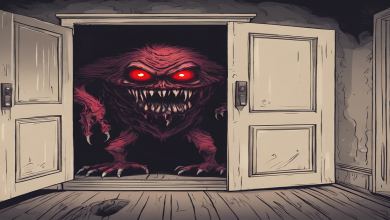
Charlotte Toddler’s Monster Spray Could Not Reach 50,000 Honeybees and 100 Pounds of Comb in Her Wall

Saylor was three, and she was specific. In a century-old farmhouse in Charlotte, North Carolina, she pointed at the wall by her closet and said the monsters were in there. The family had been watching Monsters, Inc. Her parents did what parents do with a Pixar plot that has crawled into a bedroom. They handed her a spray bottle of water and called it monster spray. Ashley Massis Class later told reporters the complaints ran about eight months. The spray did not work, because the noise was not a story. It was a colony.
@chaosinthecarolinas
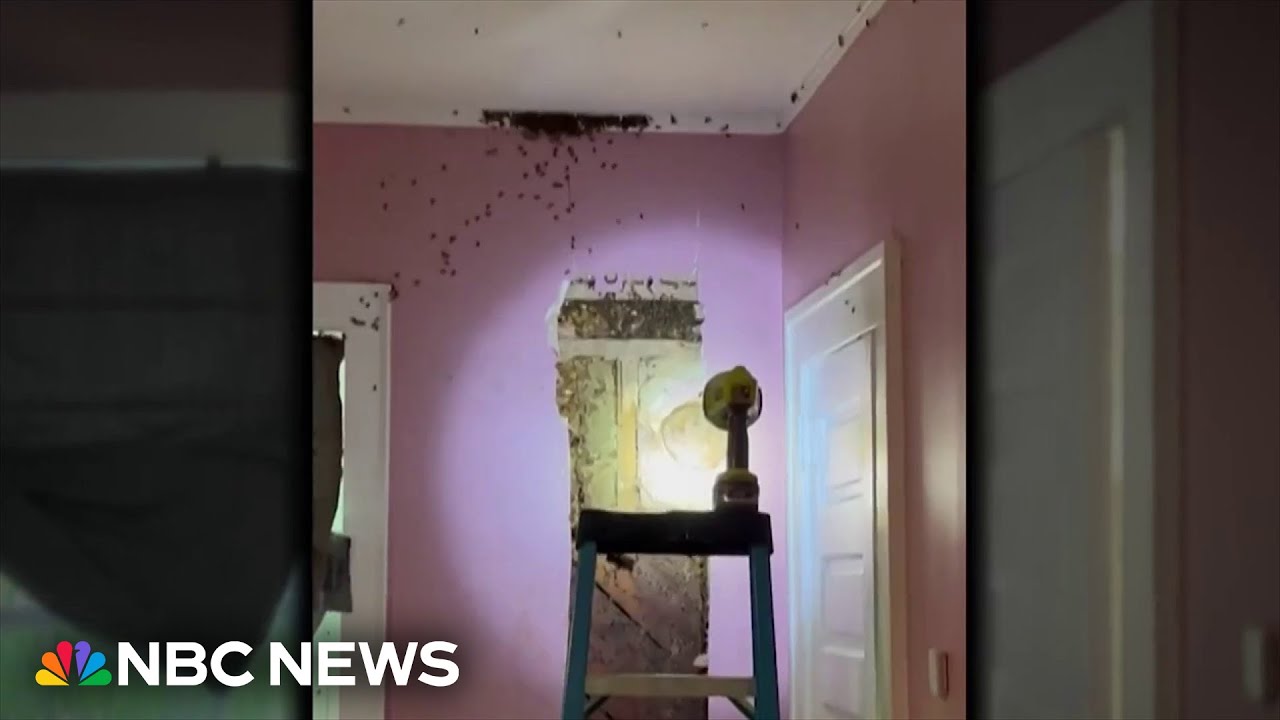
Bees had already been coming and going in the attic. That is an ordinary old-house problem, the kind a pest company is hired to glance at and shrug off. The Classes went through that stage. What they had not pictured was the path. A gap about the size of a dime, near a pipe by the chimney, was enough. Honeybees do not need a door. They need a draft and a dark cavity the width of a wall. From that dime they worked downward into the toddler’s room until the colony occupied the space from floor to ceiling. Ashley said the shape on the thermal camera looked almost like a man standing in the wall. Her husband, Chris Class, said it took up the entire wall space.
The thermal camera is what ended the argument between a child’s report and an adult’s explanation. Ashley Massis Class put it on the plaster. The wall lit up. Beekeeper Curtis Collins, who told Good Morning America he had been doing house removals for about six years, said he knew bees were in the building and that the only question was where they had decided to build. “I believe that may be actually the first one that I’ve done that was floor to ceiling,” he said. Other beekeepers had not found it. He did, by asking what room sat under an attic vent and then looking at the child’s bedroom instead of the roofline everyone had been staring at.
Opening the wall was the horror-movie part, and the family did not dress it up. Collins, by Ashley’s account to The Guardian, hit the plaster before he had all his gear on. Bees poured out. Honey followed, dark enough that it looked like blood running down Saylor’s pink walls. Ashley told People she first thought the thermal blob was a body. “At first, I thought it was a body,” she said. “I was like, ‘What is that?'” The relief that it was a hive lasted about as long as it took for the insects to fill the room. She and Chris did not have time to clear Saylor’s things. NBC’s report quoted her calling the moment an apocalypse. The quotes differ by interview. The picture does not. A child had been sleeping against that wall for months.
Three Visits, a Queen, and a Bill the Insurer Would Not Touch
They chose a beekeeper instead of a can of pesticide, which is the decision that kept the story from becoming a simpler kind of extermination clip. Poison in a wall full of comb does not just kill bees. It leaves a rotting, honey-soaked cavity inside a child’s bedroom, and it kills a colony that can be moved. Collins hunted the queen so the rest would follow. The work took three extractions. CBS, recounting Ashley’s updates, said the first day produced about 20,000 bees and 100 pounds of honeycomb, bagged so heavily that honey blew out the plastic. Later passes brought the total the family and the beekeeper described to about 50,000 bees. Some headlines, including posts that ricocheted online, rounded the colony to 60,000 or assigned the removal to a different name. The people who opened the wall were the Classes and Curtis Collins.
One widely shared post even quoted a beekeeper under another name, calling the hive the biggest he had pulled from a house. The mixup is what happens when a TikTok leaves the account that filmed it. @classashley and a repost under @chaosinthecarolinas carried Ashley’s own updates, including a clip that said it was day ten of the ordeal and another that said the beekeeper was going back for a third extraction. The queen was saved. The colony was relocated, in the account Ashley gave news outlets, toward a sanctuary rather than a dumpster. When the insects were gone, the floorboards were a sheet of honey. Wiring had been damaged. The room was not a bedroom anymore. It was a job site.
Saylor’s name for Collins was better than the job title. She called him a monster hunter. In at least one retelling he was “Mr. Monster Hunter.” The night terrors stopped once the wall was empty, which is the part of the story adults kept trying to make cute and which is actually the medical point. For eight months a toddler had been correct about a threat her parents could not see, and the adults had answered with a spray bottle. Believing her required a tool that sees heat. It should not have. Old plaster hides sound. A thermal camera does not. The delay was not her imagination. It was the gap between what a three-year-old can point at and what a homeowner is willing to cut open.
The bill is where the fairy tale ends. Ashley said homeowner’s insurance treated the colony as pest damage and declined coverage. She put the extractions, the wiring, the repairs, and the cleanup north of $20,000, paid out of pocket. That figure showed up across her TikTok updates and in interviews with CBS and Newsweek. Pest exclusions are standard in American home policies, and they are a blunt instrument when the “pest” has been building comb inside a structural wall for the better part of a year. Honey is heavy. A hundred pounds of it, plus the wax, plus the moisture, is a load a lath-and-plaster wall was not designed to carry. The insurer’s category and the engineer’s category are not the same category. The family got the insurer’s.
Newsweek quoted Ashley on the timeline: three weeks and several beekeepers before anyone fully understood the size of it, then the decision to open the bedroom wall, then a wait of about two weeks after the last extraction before the hole could be sealed, in case a remnant cluster was still inside. That waiting period is good practice and a miserable way to live. You do not close a wall on a queen you missed. You also do not sleep a child in the room while the studs are open and the floor is tacky. The house, more than a hundred years old, had given the bees exactly the architecture they wanted: a chimney gap, a void, and years of nobody looking.
Collins’s six years of removals are the right scale for understanding why this one traveled. House bees are common in the Carolinas. Floor-to-ceiling bees in a toddler’s room, discovered because she would not drop a Disney plot, are not. He told GMA he knew they were there and only had to find the hive. Finding it required believing the smallest witness. NPR, the Guardian, CBS, and Good Morning America all arrived after the TikTok, which means the public record of this colony starts as a mother’s camera, not as a city inspection. That is fine as a origin story and incomplete as a housing story. Charlotte is full of century houses with chimney gaps. Most of them will not get a thermal camera until something smells like wax or a child refuses the room.
There is a straight line from this wall to the way other Southern households negotiate with animals that were there first. The AEGIS Alliance reported the Pierce County case of Kayak Katie, who crosses the Satilla in gator waders because the dumpster is on the other bank. Different species, same lesson: the charming version is the video, and the invoice arrives after the views. More files in that spirit are in Odd News and Environment. The Guardian’s account of the pink wall and the dark honey is here, and CBS’s tally of the first-day haul is here.
Saylor got her room back without the noise. The adults got a lesson they could have skipped if they had cut a small hole sooner, and a bill they could not skip at all. Monster spray is a fine parenting trick for a movie. It does not reach a dime-sized gap in a chimney, and it does not move 100 pounds of comb. The monster hunter did. He was a beekeeper with a thermal camera, a hammer, and enough patience to come back until the queen was in a box instead of a wall.










How do bees equate to ‘horror’, exactly? Wasps, sure. Hornets, okay – but bees? C’mon…
Kevin Solomon Stevens 20,000 bees living in their walls though lol.