Sheriff Carmine Marceno’s Ethics Case Sits in Limbo While Amira Fox’s Alleged Court-Order Forgery Against Scott Huminski Stays Uncharged

LEE COUNTY, FLORIDA — Amira Fox will sit as state attorney for a third term without having to debate anyone. Carmine Marceno is still sheriff while a state ethics file about gifts and a consulting contract sits unresolved in Tallahassee. Neither of those facts erases the stack of court paper from June 2017 that activist Scott Huminski says was manufactured so a contempt case could change courthouses. No prosecutor has charged Fox, Clerk of Court Linda Doggett, or Marceno with forgery. They are presumed innocent of any crime that has not been filed. The papers, the docket, and the silence around them are still public.
Fox locked in that third term the easy way. She filed for reelection on January 5, 2026, and nobody else qualified by the April 20 deadline. The Fort Myers News-Press reported on May 29, 2026 that she would serve again unopposed, the same way she did in 2022. She was first elected in 2018, the first woman to hold the job in the 20th Judicial Circuit, which covers Lee, Collier, Charlotte, Hendry, and Glades counties. She started in that office as an assistant state attorney in 1990.
Marceno’s path was different, and the old description of him as an unelected sheriff is out of date. Then-Governor Rick Scott appointed him in 2018 after Mike Scott stepped aside. Voters have kept him since. What has not gone away is the question of what his office did, and did not do, when Huminski put a forgery complaint in front of it.
A gag order, then a contempt case
Huminski, who fronts the band Scott X and the Constitution Commandos, says he was getting death threats traced to Maricopa County, Arizona, from 2013 through 2017. He reported them to then-Sheriff Mike Scott. Instead of a threat investigation he could live with, he got a protective order that turned further contact with the sheriff or the sheriff’s staff into contempt. The motion is still online. Reporting a crime, Huminski has argued ever since, was itself treated as the crime.
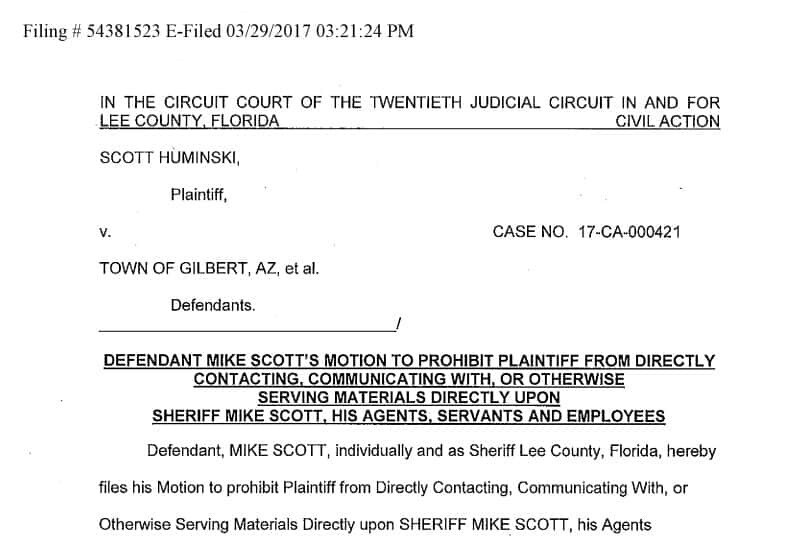
The contempt fight was opened in circuit court as case 17-CA-421. Fox’s office wanted it in front of Circuit Judge Elizabeth Krier. Krier recused herself over a conflict. Chief Circuit Judge Michael McHugh was next. Huminski’s account, laid out in filings that later reached the Florida Supreme Court, is that Fox did not want McHugh. She wanted a different building, a different judge, and a misdemeanor docket.
Two dates on one piece of paper
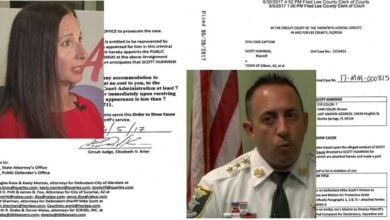
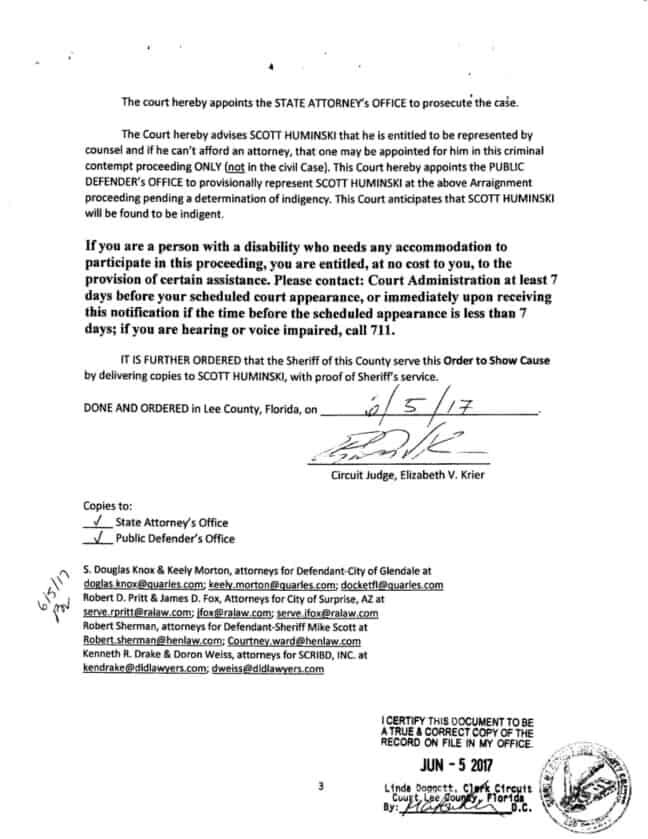
On June 30, 2017, according to the documents Huminski has circulated for years, a June 5 circuit order was printed, marked by hand with a new Lee County court number, 17-MM-815, and filed as if it were a fresh judicial order. The signature on it is Judge Krier’s from the earlier case. There is no new signature. The header carries the June 5 file stamp and a June 30 stamp. Court orders are not supposed to be recycled.
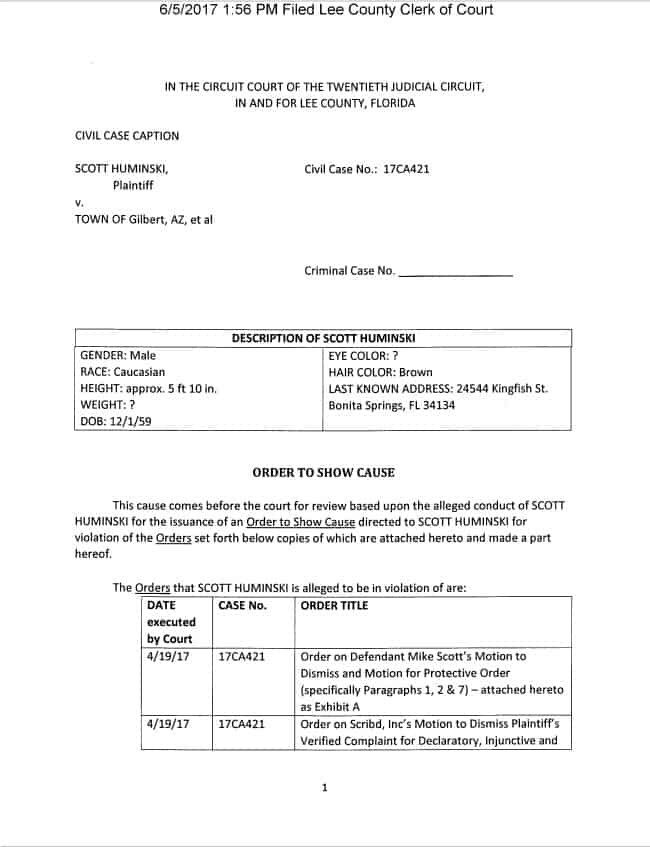
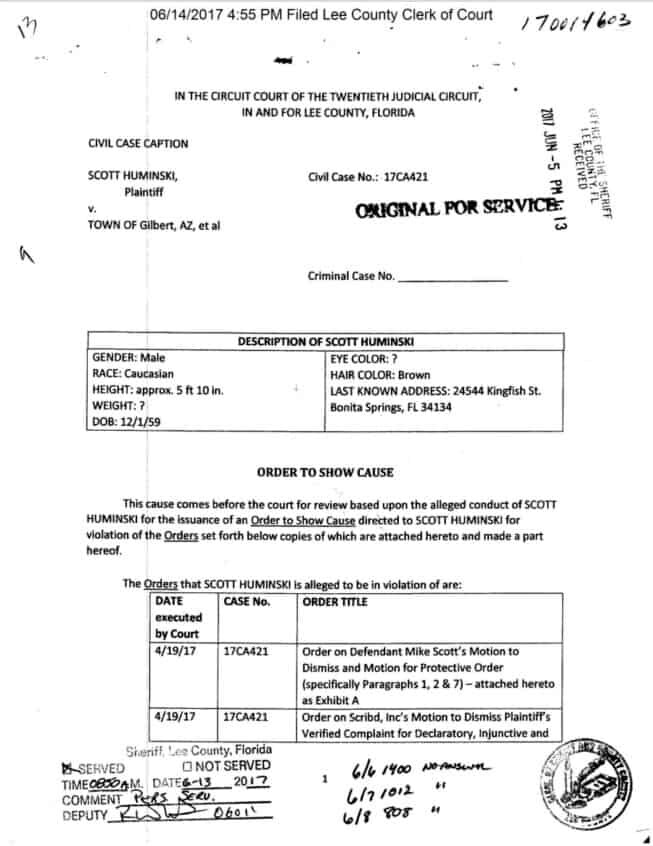
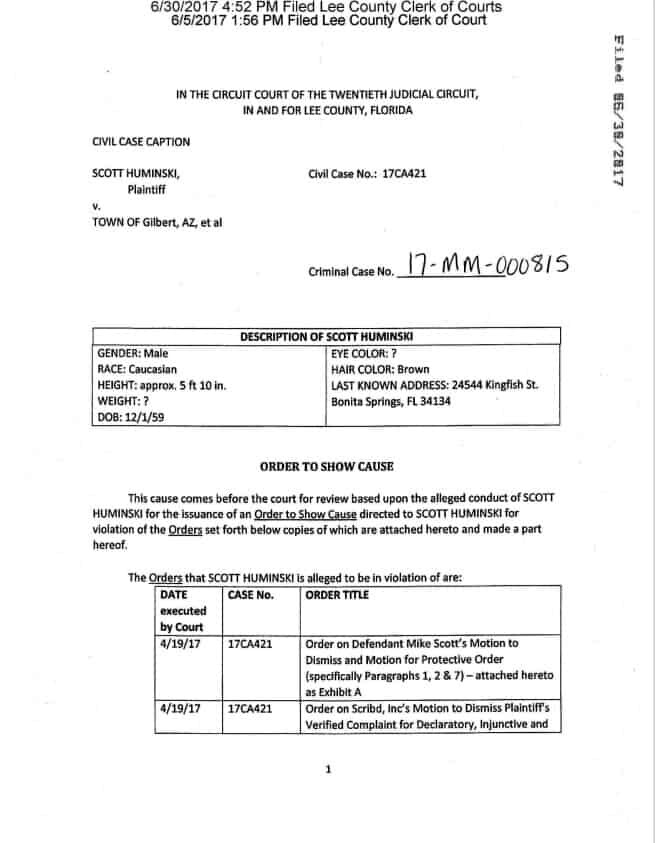

Page 3 of the disputed filing and page 3 of the June 5 order are the comparison Huminski wants a handwriting examiner, or a sheriff, to make. He says the electronic signature matches closely enough that it was lifted, not signed again, and that a real order in the case ran far longer than the three pages that landed on the county docket. The authentic show-cause order he points to is dated on or before April 26, 2017, not June 5, which is the offense date he says the clerk’s sheets later used. That April order and the county docket are posted with the story.
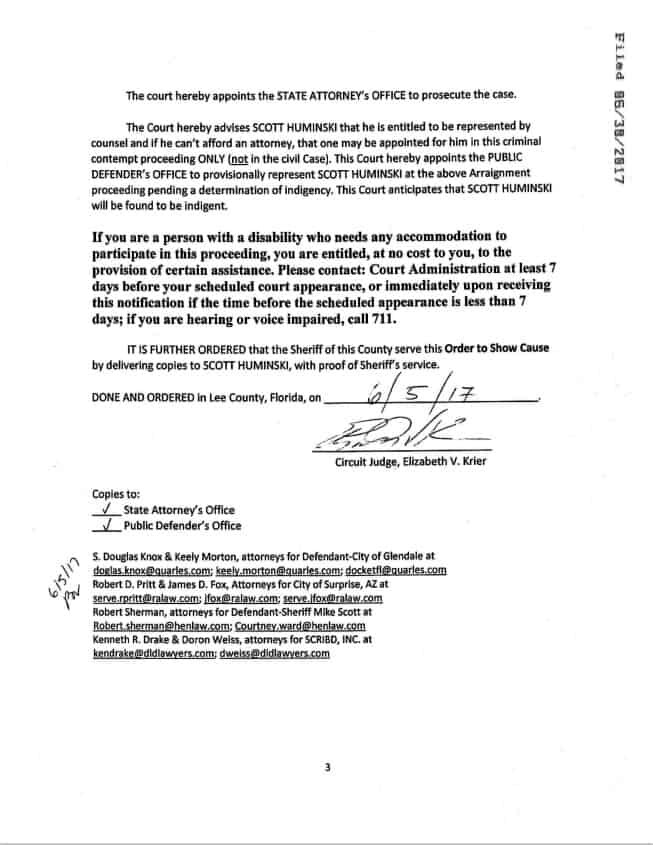
Florida’s forgery statute, section 831.01, and the official-misconduct statute, section 838.022, both describe third-degree felonies. Huminski also argues the county case never obtained personal jurisdiction because the disputed order was not served. The June 30, 2017 docket sheet is his exhibit for that point. A case without service, he says, is not a case. Trying him anyway, in a second court, is how he describes the double-jeopardy and due-process problems, along with the loss of counsel and a jury under Florida Rule of Criminal Procedure 3.840.
The judge who drew 17-MM-815 was James Adams. Adams had already been reprimanded by the Florida Supreme Court over a sexual relationship with a lawyer appearing before him, In re Adams, and the Second District Court of Appeal had criticized his handling of Pena v. State. Huminski’s theory is that Adams was chosen because he would not stop the transfer. That is an accusation about motive. The public record of the reprimand is not.
What the sheriff was told
Huminski did not keep the complaint in a drawer. He sent the comparison, the dockets, and a description of the statutes to the Lee County Sheriff’s Office through a MuckRock Sunshine Law request aimed at Marceno. An archived page of his own write-up is still on the Wayback Machine. The sheriff’s office did not open a forgery prosecution. Marceno inherited Mike Scott’s gag order and, Huminski says, kept treating contact with the office as contempt. The AEGIS Alliance has covered the broader record on Marceno and on earlier Lee County allegations for years. This file is the one that starts with a date stamp.
The fight left the Lee County courthouse. A jurisdictional brief in Huminski v. Florida, SC20-598, put the account in front of the Florida Supreme Court. A Second District ruling in the related appeal is posted here. On January 1, 2025, Huminski asked Fox’s office, again under the Sunshine Law, for the criminal information or any other charging document that actually opened State v. Huminski, 17-MM-815. MuckRock shows the request rejected. He wrote back that a petition was pending in the Sixth District Court of Appeal. The courthouse argument did not retire when the news cycle did.
A different investigation, the same sheriff
The forgery complaint and the ethics case are not the same case. They land on the same man. In 2022, former consultant Ken Romano alleges, Marceno steered him a public contract worth $5,700 a month and told him to send $1,700 of it each month to the sheriff’s father, Carmine Marceno Sr., for a Mercedes. Romano also says he gave the sheriff a $9,035 grand piano in 2020 and paid $2,377.03 for furniture at El Dorado Furniture in Fort Myers on January 20, 2022, and that those gifts were left off financial disclosures. The piano falls outside the limitations window the commission is using. The furniture, Romano says, does not. Marceno Sr. died in late 2024. On one recording the Florida Trident has described, the sheriff tells Romano, “Whatever you use your money on, you and my father’s relationship has nothing to do with me.”
Federal prosecutors notified Marceno’s lawyer, Donald Day, on November 17, 2025 that the FBI public-corruption investigation was closed and that the office would pursue no further action. The Florida Trident reported that the federal file had reached a grand jury and then stopped after the lead prosecutor, Assistant U.S. Attorney Mike Gordon, was removed in the post-election purge of January 6 prosecutors. The underlying allegations did not stop with the letter. Romano filed them with the Florida Commission on Ethics. On June 5, 2026, a state ethics investigator was given 60 days past the usual 150-day limit, with the inquiry focused on whether the father received the car payments. A separate complaint against Undersheriff John Holloway was dismissed in June 2026 as hearsay.
Then the witness blinked. The Trident reported on September 1, 2026 that Romano had asked to withdraw the complaint, sending the letter about 55 days after the June 5 extension, ahead of a closed-door probable-cause hearing at the end of August. A second ethics matter, brought by former commander James Bogliole, concerns a 2023 stop of an off-duty deputy accused of driving over 100 mph. Bogliole says supervisors pressed him to alter reports. As of September 3, 2026, the Florida Center for Government Accountability said no probable-cause decision had been announced. Marceno has not been charged in the ethics matters either. A closed federal case is not an acquittal on the papers, and a withdrawn complaint is not a finding that the Mercedes payments never happened.
Fox, meanwhile, has the job until the term voters did not even get to contest runs out. Marceno still controls the agency Huminski asked to investigate her filing. The June 5 order, the June 30 stamp, and the handwritten number 17-MM-815 have not been explained in a courtroom that was willing to call them what Huminski calls them. Until someone with a badge treats those two dates as evidence rather than noise, the cover-up claim is not a metaphor. It is a description of what has not been done.
Related from The AEGIS Alliance: the federal and ethics scrutiny of Marceno, the DeSantis-era silence around the same forgery file, Enzo Vincenzi’s false-arrest lawsuit, and the police accountability and U.S. news archives.