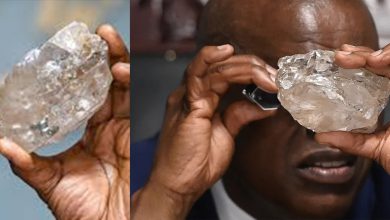
Lucara Sold Botswana’s 2,488-Carat Motswedi Diamond in Secret While President Duma Boko Was Shown a New 1,305-Carat Karowe Stone

Around August 19, 2024, Lucara Diamond Corp. recovered a rough crystal from the Karowe mine in Botswana’s Boteti District that first weighed 2,492 carats. Then-president Mokgweetsi Masisi held it up for cameras and called it a gift. Only the 3,106-carat Cullinan, pulled from South Africa’s Premier Mine in 1905, is a larger gem-quality rough in the historical record. The AEGIS Alliance wrote the discovery as a spectacle. Two years later the spectacle has a name, a laboratory file, a secret buyer, and a successor stone that a different president has already been asked to admire. The price of the famous one is still not public.
Karowe sits roughly 500 kilometers north of Gaborone in a kimberlite pipe that has turned giant-diamond recovery into an industrial process. Lucara, listed in Canada, installed a Mega Diamond Recovery X-ray transmission line in 2017 so large crystals would be spotted before conventional crushers smashed them into ordinary goods. Chief executive William Lamb and Botswana managing director Naseem Lahri credited that circuit when they showed the stone. Most mines are built on the assumption that the valuable diamonds will be small. Karowe is built on the opposite bet. The August 2024 recovery is what the bet looks like when it pays.
A Mine That Keeps Breaking Its Own Record Book
Karowe was already famous before this crystal. It produced Lesedi La Rona at 1,109 carats, Sewelô at 1,758 carats, and the 813-carat Constellation, which sold for about $63.1 million. Lesedi La Rona later went to Graff for a figure reported around $53 million, nearly two years after it was found. Those delays are not accidents. A stone this size is priced like a painting. Provenance, an intact recovery, and a presidential photograph add zeros that a tender of melee goods will never see. They also give the owner a reason to wait.
Weeks after the 2,492-carat recovery, Karowe produced another giant, later named Seriti, at 1,094 carats. National Jeweler later noted that Seriti sold in the second quarter of 2025. The pattern is the story of the mine. One season’s headline stone sits in inventory while the next season’s headline stone comes up the belt. On July 13, 2026, Lucara announced a 1,305.4-carat white gem-quality rough, the tenth Karowe diamond above 1,000 carats since production began in 2012. The company said further work was still needed to say whether that stone came from current open-pit ore or from stockpile. On July 30, 2026, Lahri presented it at the mine to President Duma Boko and members of cabinet. Masisi’s photo op and Boko’s are two governments and one deposit.
Motswedi, the Cleaned Weight, and What GIA Actually Saw
Lucara opened a national naming contest on November 22, 2024. More than 39,000 entries arrived. The winning word was Motswedi, Setswana for a spring or a source of water rising to the surface. The person who submitted it received 100,000 pula and a tour of the mine. After cleaning, a routine loss of surface and attached rock on a crystal this size, the official weight was 2,488.32 carats. The four-carat drop does not change the ranking. It is still the largest diamond ever recorded in Botswana and the second-largest gem-quality rough in the published record.
The Gemological Institute of America examined Motswedi in Gaborone and published its notes in 2025. GIA called it the largest single crystal the institute had tested. The dimensions were 106.3 by 71.6 by 53.8 millimeters, a little over a pound. Eleven small fragments totaling 1.50 carats had come off the main piece. Two of those weighed 0.75 and 0.47 carat and were essentially colorless. The main crystal was transparent and gem quality, with a light brown color that GIA said was likely emphasized by the size itself and by foreign material in fractures. On type, the early corporate language had reached for Type IIa, the nitrogen-poor class that is under 2 percent of world production and the usual Karowe headline. GIA’s more precise description of Karowe’s large goods was Type IaB, or a mix of IaB and IIa. Color, type, and what sits in the fractures decide whether a rough of this size becomes a suite of top-color polished diamonds, a brown collector piece with a famous name, or a museum loan. Lucara did not publish a cutting plan.
A Private Sale Inside a $41 Million Quarter
Motswedi stayed in inventory through the end of 2025. Lucara’s first-quarter 2026 report still listed it as unsold. The market for ordinary rough was soft. Lab-grown goods had taken the lower and middle jewelry case. Chinese bridal demand was not what it had been when Constellation sold. Sanctions and cautious manufacturers gave a company every reason to wait for one buyer who wanted a historic crystal rather than a parcel. On or about August 7, 2026, Lucara’s second-quarter results said the stone had sold during the quarter ended June 30. National Jeweler and subsequent trade coverage put that quarter’s diamond revenue at about $41 million. That figure is the quarter, not the stone. The buyer was not named. The price of Motswedi was not broken out.
The silence is a commercial choice and a political one. A public auction would have printed a number that every rival cutter could study. A private treaty lets a client avoid teaching the market what the bid was. It also leaves Botswana arguing in the dark about whether the country captured the value of the second-largest diamond ever mined. Diamonds remain a dominant share of Botswana’s export earnings and a large slice of public revenue. Debswana, the De Beers joint venture, is still the center of gravity. Karowe is the independent operation that keeps producing the stones people remember. Readers who follow resource politics on The AEGIS Alliance International News desk have seen the shape before. A naming contest is a pageant. The term sheet is the government.
Botswana has spent decades trying to keep more cutting and more marketing inside the country rather than shipping rough to Antwerp, Dubai, or Surat and importing the prestige later. A crystal the size of Motswedi is a test of that project. If it is cleaved somewhere else, the Setswana name is a brand on someone else’s bench. If it is kept whole, the public story stops at the GIA measurements and a line in a Canadian quarterly. Either way, the check has already cleared.
Why Machines, Not Myth, Found This One
The Cullinan was spotted in 1905 by a mine superintendent who thought he was looking at a piece of glass in a pit wall. A long list of historic roughs never became historic because crushers turned them into smaller goods before anyone knew they had been there. Motswedi was found by a machine built to prevent that. The unglamorous half of the romance is an X-ray transmission circuit commissioned in 2017. Without it, this article is about a pile of smaller brown diamonds and a recovery plant that did its ordinary job. The same circuit is why Lucara could stand in front of Boko in July 2026 with a tenth thousand-carat stone and call Karowe the only mine that has done that.
Lab-grown diamonds have repriced the mall case. They have not repriced this. A 2,488-carat natural crystal with a GIA file, a presidential photograph, and a Setswana name is not competing with a reactor. It is competing with the last handful of intact giants and with the patience of whoever can write a private check. That is why Lucara could sit on Motswedi for nearly two years. That is why the sale price is still a secret while the company talks, in the same earnings release, about resilient prices for large high-quality goods and a struggling market for small lower-quality ones. The split is the market. Exceptional natural rough has become its own asset class.
Three Questions the Quarterly Did Not Answer
Who bought Motswedi. Whether the rough will be cut or kept whole. Whether the 1,305.4-carat stone Boko was shown will be sold in public or will follow the same private path. Seriti already left the inventory in 2025 without becoming a household name. Karowe is still in ore. The next giant is a statistical expectation at this mine, not a miracle.
Related reporting sits on The AEGIS Alliance Science desk and the international wire. The AEGIS Alliance treats a president holding a rock as the start of a paper trail. The second-largest gem-quality diamond ever mined now has an owner. Botswana’s public still does not know what that owner paid, and the mine has already moved on to the next stone large enough to require a cabinet meeting.