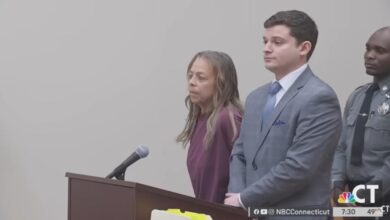
Waterbury Stepson Set His Room on Fire to Escape Two Decades of Alleged Captivity by Stepmother Kimberly Sullivan


On February 17, 2025, firefighters pushed into a second-floor room on Blake Street in Waterbury, Connecticut, and found a man who weighed 68 pounds. He told them he had lit the fire himself. Printer paper, hand sanitizer, and a lighter were the tools. Freedom was the reason.
The man, now in his thirties and identified in court papers only as “S,” said his stepmother had locked him in that room for roughly two decades. He said the captivity started when he was about 11. Kimberly Sullivan, now 57, has pleaded not guilty to kidnapping, assault, unlawful restraint, cruelty to persons, and reckless endangerment. Sixteen months after her arrest she rejected prison plea offers and told the court, through counsel, that she intends to take the case to a jury.
The AEGIS Alliance first reported this story when the fire was still the only public fact. The record since then is uglier, slower, and more bureaucratic than the first headlines allowed.
What first responders walked into
Waterbury police and fire units arrived after Sullivan called 911. Two people were inside. Sullivan got out. Crews pulled her stepson from the burning room. He was so thin that relatives later compared him to a concentration-camp survivor. He said he had been fed rice once or twice a day, denied water, forced to urinate in bottles, and left to drink from toilets when the bathroom was locked. Warrants described a man who scavenged from trash.
“I set the fire because I wanted my freedom,” he told investigators. Body-worn camera video released weeks later captured the rescue and the first statements on scene. Those clips, and the medical chart that followed, are now the spine of the state’s case.
Sullivan has said her stepson has developmental disabilities and that she was caring for him, not imprisoning him. Her lawyer, Ioannis Kaloidis, has repeated that there is no proof she locked a door from the outside. He has also pointed at the victim’s father, Sullivan’s husband, who died in 2024. Kaloidis says the father dictated how the boy was raised.
The school that tried to sound an alarm
The fire did not come out of nowhere. Tom Pannone, a former principal, has said staff flagged the child from about age 5. Classmates and teachers described a boy so hungry he ate from garbage and so thirsty he tried to drink from a urinal. “Everyone really was concerned with this child,” Pannone has said. “Not a damn thing was done.”
Those reports matter because they sit at the center of a separate fight. A conservator for S has filed a claim against Connecticut, arguing the Department of Children and Families failed to act on repeated warnings. Lawyers for the agency have moved to dismiss. If the boy’s family pulled him out of school after officials contacted authorities, as investigators have described, Connecticut’s loose homeschooling rules then hid him for the rest of his childhood. Education advocates have said that gap is how an 11-year-old disappears without a second look.
The pattern is familiar to readers of The AEGIS Alliance coverage of other hidden-in-plain-sight abuse cases, including the Tempe family that kept a disabled teen in a makeshift cage after years of contact with child-welfare workers, and the New Jersey caregivers accused of starving a child with cerebral palsy. In each file, the question is not whether someone eventually noticed. It is how many mandated reporters had already written the same sentence.
Family members who were pushed out
Kurt Sullivan, the victim’s uncle, has said Kimberly cut him off after he asked too many questions at Christmas gatherings. He remembered a skinny, quiet boy. After two decades of silence he looked for a death certificate. When he finally saw his nephew in a hospital room, the affidavit quotes him calling the man a Holocaust survivor.
Neighbors on Blake Street told local reporters they did not know another adult lived in the house. That is the detail that should haunt a city. Captivity on a residential street does not require a bunker. It requires a locked interior door, a story about disability, and a system that stops knocking.
The charges that grew instead of shrinking
Sullivan was arrested in March 2025, more than a month after the fire, and released on a $300,000 bond with a GPS monitor. She pleaded not guilty and asked for a jury. In March 2026 prosecutors replaced a second-degree kidnapping count with two counts of first-degree kidnapping. A judge later allowed her back into the Blake Street home and granted her lawyers access to the stepson’s medical records, a ruling the victim’s side fought because S has tried to keep a new name and address away from the defendant.
On July 29, 2026, the state put a number on the table: 30 years, suspended after 20, then probation. The judge signaled he might consider 30 years suspended after 10 if she took a deal. Kaloidis called both offers a “non starter.” “I don’t anticipate this case resolving with anything that involves incarceration,” he said. Formal rejection was set for a September 4, 2026, hearing, with a trial date expected then and a realistic start no earlier than 2027.
That calendar is the new angle. A man who weighed 68 pounds when he burned his way out is now waiting on motion practice while the woman accused of starving him argues she should serve no time at all.
What S has said for himself
The victim has released limited public statements through counsel and has asked to be called “S.” He has described being allowed out mainly to use the bathroom, then losing even that. He has described rice, restricted water, and years without school, friends, or a doctor who was allowed to see him as a free person. Recovery from that kind of starvation is not a montage. Refeeding has to be slow or it can kill. The psychological work of learning how to walk through a doorway that is not locked is longer than any bond condition.
A later report from The AEGIS Alliance followed the biological mother’s account and the body-camera tape. Those pieces belong next to this one. They do not replace the original fact pattern: a fire, a 68-pound adult, and a stepmother who says the state has the story wrong.
Why the state case is the smaller case
Even if a Waterbury jury convicts Sullivan, the DCF claim is the document that asks whether Connecticut had already been told. Pannone’s staff wrote concerns when the boy was in elementary school. Classmates saw him eat garbage. Someone at the school called authorities. Then the child left the building and did not come back.
That is the part of the story that does not fit on a booking sheet. Kidnapping charges test what happened inside one house. The civil claim tests why a child-welfare agency, a school district, and a set of homeschool rules could lose a boy for 20 years and only find him because he set the wallpaper on fire.
Kaloidis will tell a jury that Sullivan is a caretaker framed by a damaged young man and a dead husband who cannot testify. Prosecutors will put the medical chart, the room, the fire debris, and the uncle’s hospital-room reaction in front of the same twelve people. Between those closing arguments sits a city that walked past 2 Blake Street for two decades.
S got himself out with a lighter. The rest of Connecticut now has to explain why he had to.