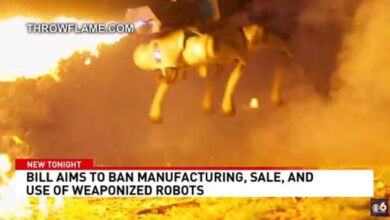


New York lawmakers want to make it a crime for a civilian to bolt a gun, a flamethrower, a laser, or an explosive onto a robot or a drone. The bill reads like a movie treatment until you remember that flame-throwing robot dogs are already for sale online and that police departments have already argued about putting rifles on tracked machines.
Assemblymember Clyde Vanel and Senator Jeremy Cooney filed the Responsible Robotics Act as S3133 in the Senate and A399 in the Assembly. The text would ban manufacturing, modifying, selling, transferring, equipping, using, or operating a robotic device or uncrewed aircraft mounted with a weapon. On January 7, 2026, the Senate version was referred again to the Committee on Consumer Protection. It has not cleared committee in either chamber. The AEGIS Alliance is covering the stall as the story, not the press conference.
What the bill would actually outlaw
The drafters listed the hardware they fear: firearms, machine guns, stun guns, chemical agents, kinetic impact projectiles, weaponized lasers, flamethrowers, and explosives, whether those sit on a four-legged robot or a drone. Knowingly mounting a weapon, using an armed machine to menace or harass someone, or sending one out to restrain a person would carry a civil penalty between $25,000 and $100,000. The attorney general could sue to stop a violation. A person harmed by an armed robot could go to court for liquidated damages, punitive damages, an injunction, and attorney’s fees.
The carve-outs are as important as the ban. Department of Defense contractors acting inside a federal contract would be shielded. So would developers testing tools designed to detect or defeat unauthorized weaponization. Government crews could still use robots to dispose of explosives or to destroy property when a human life faces an imminent deadly threat. Law enforcement would need a warrant before sending a robot onto private property or using one for surveillance. The state bill does not, by itself, stop police from arming robots. That gap is why a separate New York City Council measure has tried to bar the NYPD from putting weapons on its machines. The department says it does not arm its robots, even as it has deployed Boston Dynamics-style dogs to keep officers out of hazardous rooms.
Spot on the Million Dollar Staircase
Vanel did not argue the bill with a stack of paper alone. He brought Boston Dynamics’ Spot into the Capitol and had the robot climb the Million Dollar Staircase. The stunt was a thesis: a machine that can walk a marble staircase can also carry a payload, and the payload should not be a gun.
Boston Dynamics has not fought the legislation. The company lobbied for the New York bill and similar efforts in Massachusetts and California. Brendan Schulman, its vice president of policy, has said robots walking through neighborhoods “should not be weaponized.” That line tracks a 2022 open letter in which Boston Dynamics and several rivals asked the industry not to turn general-purpose robots into weapons.
Not every vendor agrees. Throwflame, an Ohio firm that sells a robot dog fitted with a flamethrower, has argued that its product is built for land management and agriculture, not for shooting people, and that New York has no documented case of a civilian-operated weaponized robot injuring anyone. Combat-robot hobbyists have asked for their own exemption. In that sport, machines fight inside cages with spinners, hammers, and flames aimed at other machines. They do not want an educational pastime written into a street-crime statute.
California vetoed a cousin. Massachusetts got further.
New York is late, not first. California passed a comparable ban with near-unanimous votes. Governor Gavin Newsom vetoed it. He said he supported limits on armed robots but feared the language would block what he called beneficial police uses, including less-lethal force against dangerous suspects. Massachusetts moved a restriction through its House; the Senate had not finished the job. Those outcomes explain why Vanel’s bill still sits in Consumer Protection. A ban that sounds obvious in a headline becomes a fight about SWAT robots, farm tools, and weekend builders.
The international backdrop is larger than Albany. In January 2024 the United Nations General Assembly approved its first resolution on autonomous killer robots, and Human Rights Watch used the vote to push for a treaty that would keep humans in the loop when machines select targets. New York’s bill is not that treaty. It is a state consumer statute aimed at civilians, written while Congress separately debates bills like the American Security Robotics Act, which is about keeping foreign-made unmanned ground vehicles out of federal fleets rather than about flamethrowers on Main Street.
Why a stalled bill still matters
Hobby drones are cheap. Quadruped robots are cheaper than they were when Spot was a research demo. The distance between a camera on a dog-shaped chassis and a rifle on the same chassis is a mount and a trigger circuit. San Francisco’s earlier fight over police robots with deadly force showed that the argument arrives before the first civilian casualty. Waiting for a body is a policy choice.
The Responsible Robotics Act tries to set the rule in advance: general-purpose machines that share sidewalks with children do not get weapons. The exemptions try to keep bomb squads and Pentagon vendors out of the dragnet. Whether that balance survives committee is the live question. A referral back to Consumer Protection is not a death certificate, but it is also not a law.
Readers who track technology power on this site, from hidden hardware in everyday access cards to shadow networks that quietly used phones as infrastructure, already know the pattern. Capabilities ship first. Rules arrive after someone notices the barrel.
Police robots and the hole in the state text
Vanel’s bill leaves a lane open that civil-liberties groups do not like. If a sheriff’s office decides a robot should carry a less-lethal launcher, Albany’s current draft does not slam that door. The City Council bill aimed at the NYPD is an attempt to close it locally. The ACLU and other groups have argued for years that an armed robot changes the threshold for force because the officer is no longer standing in the doorway. A warrant requirement for private property and surveillance is useful. It is not a substitute for a rule about whether the machine itself may fire.
Industry self-regulation will not finish the job either. An open letter from manufacturers binds the companies that signed it. It does not bind a garage shop in Ohio or a buyer who treats terms of service as optional. That is why a statute with penalties and a private right of action exists on paper. Paper that never leaves committee is still just paper.
The science-fiction excuse is expired
Vanel’s original pitch in 2024 was that flame-throwing drones and machine-gun dogs had left the movies. He was right. The 2025-2026 session was supposed to turn that observation into a statute. Instead New York passed and refined a different technology bill, the RAISE Act on frontier AI models, while the robot-weapons text idled.
That split is revealing. Lawmakers will regulate a language model that lives in a data center faster than they will regulate a dog-shaped robot that can climb the stairs of their own Capitol. The AEGIS Alliance will keep the Responsible Robotics Act on the desk until the committee either votes or admits it does not intend to. Until then, a civilian in New York can still buy a robot and, as a matter of state law, argue about what they are allowed to bolt onto it.











Isn’t there a federal law already in place that prohibits civilians from owning or possessing explosives at all without a federal permit? Also, airborne deadly weapons fall under terrorism laws, as well as lfedrral aws that ban the arming or militarization of civilian aircraft (which a drone actually is, as defined by the federal courts).
Think New York is simply adding more unnecessary laws. In other words, business as usual.