Stella Assange Warned Extradition Would Steal Their Sons’ Father. Julian Pleaded Guilty in Saipan, Came Home, and They Are Expecting Again

LONDON, THEN CANBERRA — Stella Morris stood outside Belmarsh Prison in 2020 and said the quiet part in a voice reporters could not soften. If the United States took Julian Assange, their sons would grow up without him. “It’s not Julian in the prison,” she said. “It’s the kids that are being deprived of their father. It’s me that’s being deprived.” She was Stella Assange by the time the case ended. The boys, Gabriel and Max, had been born while their father was living inside Ecuador’s embassy in London. The extradition she feared did not happen. A plea deal did. In September 2026 she and Assange announced they are expecting a third child together.
That announcement is not a happy ending stapled onto a press-freedom case. It is the measure of what the 2020 warning got right, and of what the plea left unfinished. Assange is home. He is also the first publisher convicted under the Espionage Act. The conviction traveled with him to Australia.
What Washington said it was charging
The indictment Assange was facing when this site first wrote about Stella’s warning ran to 18 U.S. counts, most of them under the Espionage Act, built on the cables and war logs Chelsea Manning gave WikiLeaks in 2010. Prosecutors said the publications endangered people who had talked to the United States. They never produced evidence that the releases got anyone killed. What the documents did show, in Iraq and Afghanistan, were civilian deaths, including the gunsight video WikiLeaks titled Collateral Murder. Publishing truthful information from a source is the ordinary work of a newsroom. The statute the Justice Department chose does not care. The Espionage Act has no public-interest defense a reporter can stand on, and no First Amendment exception written into it.
Barack Obama’s Justice Department debated charging Assange and backed off, in part because the same theory would have reached the New York Times and the Guardian. Donald Trump’s Justice Department filed. The prison at the end of a conviction on the full indictment was not a polite federal camp. Lawyers described ADX Florence in Colorado, the so-called Alcatraz of the Rockies, where cells run about seven by twelve feet and the day is 23 hours of isolation. Had he been convicted on everything Washington charged, the exposure was as high as 175 years. Stella called the case an attack on journalism. If a publisher in London can be extradited for inconvenient war reporting, the next defendant does not have to be Julian Assange.
 Julian Assange with his son Gabriel, born while Assange was inside Ecuador’s London embassy.
The family timeline is the part official statements skip. Assange walked into the embassy in 2012 seeking asylum and stayed until British police dragged him out in April 2019. Gabriel was born in 2017. Max was born in 2019. Stella, a lawyer who was part of his legal team before she was his wife, married him inside Belmarsh in March 2022. The visits were the childhood. She was not speaking in metaphor when she said the boys were the ones doing the sentence.
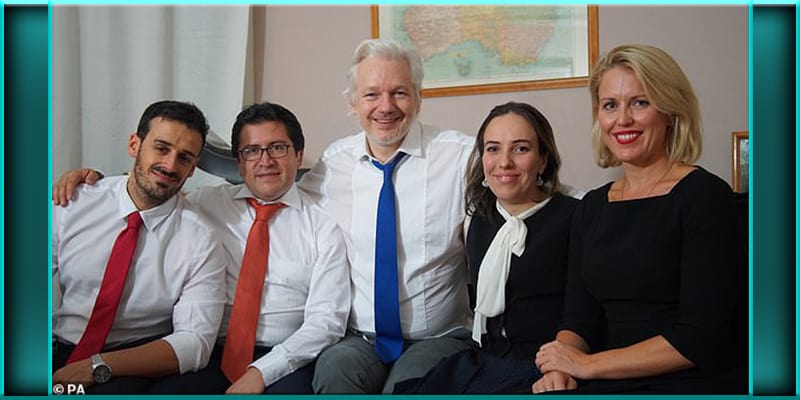 Spanish counsel Aitor Martinez, Ecuadorian counsel Carlos Poveda, Julian Assange, Stella Morris, and barrister Jennifer Robinson.
Saipan, time served, and a barred appeal
The extradition hearing at the Old Bailey never became a plane to Virginia. On June 24, 2024, Assange left Belmarsh after five years and two months. On June 26 he stood in a U.S. courtroom in Saipan, in the Northern Mariana Islands, and pleaded guilty to a single count of conspiring to obtain and disclose national-defense information. Judge Ramona V. Manglona sentenced him to time served, the 62 months already spent in the British prison, and told him he would walk out a free man. He flew to Canberra the same day. Stella met him on the tarmac. She told reporters he needed time to recuperate, to sleep in a real bed, to eat real food, to swim, to show his sons how to catch a crab. Prime Minister Anthony Albanese called the outcome the product of patient work and said it was what standing up for an Australian looked like.
Freedom, in the plea, was conditioned. Assange told the Parliamentary Assembly of the Council of Europe in Strasbourg on October 1, 2024, that he had chosen “freedom over unrealisable justice.” The United States had written into the agreement that he could not take the extradition fight to the European Court of Human Rights and could not file a Freedom of Information Act request about what was done to him. “I am not free today because the system worked,” he said. “I am free today after years of incarceration because I pled guilty to journalism. I pled guilty to seeking information from a source. I pled guilty to obtaining information from a source. And I pled guilty to informing the public what that information was. I did not plead guilty to anything else.”
He also said the criminalization of newsgathering “is a threat to investigative journalism everywhere,” and that journalists should not be prosecuted for doing their jobs. Reporters Without Borders called the release overdue. Amnesty International and the Committee to Protect Journalists warned that a guilty plea from a publisher, even to one count, is a weapon that can be pointed at the next reporter who handles a classified leak. A negotiated plea waives most appeals. A pardon could lift the conviction. It would not unwrite the precedent. Representatives James McGovern and Thomas Massie urged a pardon. Neither the Biden administration nor the Trump administration that followed it has signed one.
The account came back. The conviction did not leave.
On September 17, 2026, WikiLeaks posted that his handle was live again. Assange wrote, “I’m back.” Stella wrote that there would be more news the following week. On September 21 she posted a photograph and the line that closes the circle on her 2020 interviews: “HAPPY NEWS! This new life would not have been possible without all those who fought to bring Julian Assange home.” He quoted her with the hashtag OctoberSurprise and added, “this new life is thanks to everyone who fought for my freedom.” The child will be their third together and his fourth. He already had a son, Daniel, from before the relationship. The due window they pointed at is October 2026. Gabriel and Max will meet a sibling in a house, not a visiting room.
Stella’s warning holds up in both directions. She was right that the process was aimed at the family as much as at the publisher. She was also describing a threat that the plea did not dissolve. Assange did not win a ruling that publishing true information about a war is legal. He won a plane ticket by admitting a felony, with a written promise not to challenge the way he was held. The boys have their father. Every newsroom that receives a military leak now has his case citation.
The AEGIS Alliance has covered the publishing model he built, including WikiLeaks’ Spy Files Russia, and the risk that attaches to the work, including the Panama Papers reporter blown up in her car. The Strasbourg transcript is the document to read next to the Saipan plea. One is the government’s version of the ending. The other is his.