Tifton’s Scalded 12-Year-Old Still Lives Inside a Sealed Juvenile File While the Word Prank Does the Legal Work


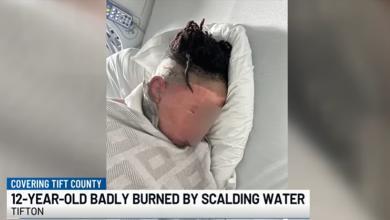
A twelve-year-old boy in Tifton, Georgia, went to a neighbor’s apartment for a sleepover and left in an ambulance. Three other children, ages twelve to fifteen, poured boiling water on him while he was asleep. Local television reached for the noun that American newsrooms keep on a hook for injuries between minors: prank. His mother, Tiffany West, did not. She told WALB she arrived to a scene that left her mad, hurt, and in shock, “seeing red,” and that the only thing she could do in that moment was get her son help. He was taken to the burn center in Augusta, underwent surgery for second-degree burns across most of his face, and went home with a healing window she put at twelve to fourteen days for the skin. The part of the injury that does not show in a photograph was never on that clock.
Police confirmed the outline to WALB. Three minors were charged and released to their families. The specific counts were not made public. A first juvenile hearing was expected about a month out, which, on the calendar reporters were using in the first week of January 2025, pointed at February. West kept her son’s name out of the coverage and kept the exact night off the record. That was the correct instinct. The internet did not share it. Photographs of a child in a burn unit moved anyway, because a scalded face is the kind of image a platform rewards and a family cannot get back.
Twenty Months and a Sealed File
The AEGIS Alliance went looking, in September 2026, for what a Tift County juvenile court did with those charges. There is no public adult-court successor. There is no published plea. There is no sentencing order a reporter can quote. That absence is not a reporting failure in the ordinary sense. Georgia juvenile files are built to stay shut. Secrecy is supposed to protect children, including the three who poured the water. It also protects the public from ever learning whether a system treated boiling water on a sleeping face as an assault or as a joke that got out of hand. The AEGIS Alliance will not invent a disposition to satisfy a comment thread. The silence is the fact.
West’s account, given to WALB and repeated by national outlets including the New York Post, is narrower than the prank frame. Her son was asleep. The other children had been playing video games. Someone heated water. Someone threw it. The boys later told police it was supposed to be a prank. That sentence is a motive claim. It is not a medical fact, and it is not an element that erases injury. Second-degree burns on a child’s face do not become shallower because the pourers say they were kidding. Planning, if investigators ever found it in texts or a video, would not require a written script. It requires a pot, a sleeping target, and a group that does not stop the person carrying the pot. If those messages exist, they sit inside a file the public cannot see.
What a Facial Scald Does After the Headlines Leave
Burn physicians describe hot-liquid injuries as a race against depth. Water near a boil can destroy the outer skin and part of the dermis in seconds. A face has little spare tissue. Eyelids, lips, and ears scar in ways that change how a child is seen in a hallway long after the first grafts, if grafts are needed, have taken. Augusta’s unit exists because south Georgia does not keep a spare burn center for this kind of night. Surgery in the first days is about cleaning dead tissue and protecting what can still heal. The twelve-to-fourteen-day window West described is the early close of wounds. Pigment changes, tightness, and the possibility of later revision are ordinary in facial scalds. So is the flat affect her aunt, Nachelle, described when she asked the boy whether he was mad or sad and heard, in the reporting of that conversation, that he was numb.
West asked for the medical bills to be taken seriously and for her son’s privacy to be respected. That is the floor. Crowdfunding posts circulated because American burn care is expensive and because a family in Tifton should not have to hold a fundraiser to treat an injury inflicted in a neighbor’s apartment. The AEGIS Alliance will not turn those posts into a second spectacle. Readers who want to help should use channels the family controls. Readers who want a close-up of a burned child should sit with the fact that the photograph already exists and that the boy has had to live beside it. More than a year and a half has passed. Skin that “healed” on a two-week clock can still tighten, darken, and need another trip to Augusta. None of that appears in a juvenile docket the public is not allowed to read.
Adults Were in the Apartment Whether or Not They Held the Pot
A kettle does not boil itself in a room full of minors without someone older failing a duty. The AEGIS Alliance is not declaring the adults in that apartment guilty of a crime they have not been charged with. It is saying that a sleepover in which children can produce boiling water and use it on a sleeping peer is a supervision failure before it is a meme. Parents who send a child to a neighbor’s place assume the neighbor will keep the stove from becoming a weapon. That assumption is how sleepovers work. It is also how they fail. A house with minors and a working kettle needs a rule that sounds childish until a face is burned: no boiling water in a room where children are unsupervised. Video games do not replace a grown person who can see a pot coming off a burner.
Juvenile prosecutors have a narrow path, and the public will probably never see them walk it. They have to protect the burned child, decide whether the other children should be treated as delinquents under assault statutes, and resist the language the internet will try to force onto the file. “Prank” does work for the pourers and for any adult who was in the house. It suggests mischief that overshot. It suggests the burned child was a participant in a joke. It is a word that belongs in a yearbook, not in a charging document. If the hearing happened in February 2025, the result stayed in the juvenile system, which is where Georgia put it. If it was continued, delayed, or diverted, the public record looks identical. That is a design, not an accident.
The Hallway Is the Rest of the Case
Schools in Tift County had to decide what to do when a boy with a healing face went back, and what to do if the other three walked the same halls. Administrators like to call that a safety plan. A family is allowed to call it a test of whether a district treats a scald as a medical absence or as a problem to be managed until the news cycle moves. The news cycle moved in days. The face did not. Small-town coverage often implies that children are safer because everyone knows everyone. Tifton is the counterexample sitting in a burn unit: the people who did this were close enough to be invited to sleep over.
Harm dressed up as a joke shows up in other files on this desk, including the show-goat poisoning case, where a classmate’s animal was the target, and in Georgia crime coverage such as the Climax mayor case, which is a different crime and the same reminder that a small town is not a sanctuary. Readers who want the wider pattern of child-injury reporting can start in the crime news section. None of those links is a substitute for a Tift County order the court has chosen not to publish.
The AEGIS Alliance is not treating this as entertainment. Investigators should have kept the adults in the apartment on the list. Prosecutors should have kept the word prank out of whatever language they used, even if that language is sealed. The family should have been left to dressing changes and counseling appointments. A twelve-year-old who went to sleep at a neighbor’s house and woke up in a burn unit is the only person in this file who did not need a lesson. Everyone else did, and most of them got to take it in private. That privacy is the law. It is also why, twenty months later, the public still knows more about a mother’s shock than about a consequence.







Wtf are wrong with kids these days
Poor lad
With friends like that God forbid they were his enemies