The Virgin Islands Took More Than $105 Million for Little St. James, Then Fired the Lawyer Who Sued Epstein’s Bank

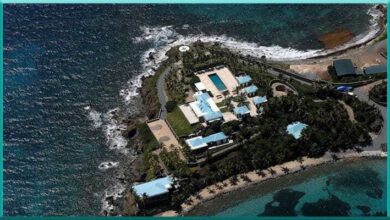
U.S. VIRGIN ISLANDS — Little St. James was never a rumor with a helipad. It was a parcel inside a territory that had given Jeffrey Epstein tax benefits, and in January 2020 the territory’s attorney general, Denise George, sued his estate for using that parcel to traffic girls. The complaint, filed after his death in a Manhattan jail and after the Miami Herald had already forced the Florida deal back into public view, alleged a pipeline that was still delivering victims to the island as recently as 2018. Girls, some described in contemporaneous accounts of the filing as young as 11, were recruited with money, jobs, schooling, and the kind of career talk that sounds like a future until the boat leaves the dock. George asked the court to treat the network of companies and the people around it as a criminal enterprise under territorial law, and to take the islands. She said the case was not meant to elbow aside the women who were already suing. A criminal lien followed the same year.
The estate’s answer, when it finally came, was a check rather than a trial. In December 2022 the government announced a settlement of more than $105 million in cash, plus half the proceeds of any sale of Little St. James, the return of more than $80 million in tax benefits, and $450,000 to repair environmental damage on neighboring Great St. James. Co-executors Darren Indyke and Richard Kahn were on the paper. CNN, reconstructing the money years later, noted that a large share of what the property sales produced went into settlements, this one included. Nobody in that December announcement admitted a crime. They admitted a price.
George did not stay to collect the next one. About four weeks after the estate deal, and days after she sued JPMorgan Chase for moving Epstein’s money, Governor Albert Bryan Jr.’s office removed her. It was New Year’s Eve 2022. American Banker later found her in the off-season quiet of St. Croix, a scales-of-justice pendant on a chain her husband had given her, and reported that the firing landed while she was cooking at her father’s house. The bank case, the billionaire case, and the public record of who inside the territory had looked the other way were suddenly somebody else’s to finish or to fold. She had priced the estate. She was not allowed to price the bank in the same job.
The checks, the buyer, and the lawyer who was fired
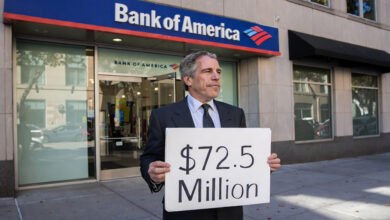
The money arrived in a stack, and the stack is the only map that does not depend on a flight log. Leon Black, the Apollo co-founder, paid the territory $62.5 million. In September 2023 JPMorgan agreed to pay the Virgin Islands $75 million to end the suit that accused the bank of servicing the trafficking pipeline, and it settled a separate victims’ class for $290 million. Deutsche Bank paid victims $75 million the same year. Bank of America’s $72.5 million agreement with survivors surfaced in March 2026, a figure The AEGIS Alliance reported when the number became public. None of those institutions admitted enabling a crime. All of them paid as if a jury might.
The islands themselves left the estate in May 2023. Stephen Deckoff, founder of Black Diamond Capital Management, bought Little St. James and Great St. James together through SD Investments for about $60 million. The listing had been $125 million. The discount is the market’s verdict on a crime scene that is also a view. Under the settlement, half of what Little St. James brought was owed to the territory. Reports into 2026 described almost no building. An early permit tied to a warehouse was incomplete for lack of an environmental review, and territorial officials were described as having no real development application in hand. The buyer owns the shoreline. He has not, on the public record, turned it into anything that would let a passing boat forget the previous owner. That stasis is not justice. It is a holding pattern with a private-equity signature.
The victims’ fund was designed by Kenneth Feinberg and Camille Biros, the same administrators whose names sit on the September 11 fund and on payments after the BP spill, with input from victims’ lawyers, the attorney general’s office, and the co-executors. CNN reported in September 2026, citing lawyers for Indyke and Kahn, that the program paid $121 million to 136 people, and that the estate separately resolved claims by 58 more women for about $48 million, not counting a newer class settlement. Those numbers are large. They are also a ceiling negotiated by the estate that caused the harm, which is the structural fact every Epstein fund shares. A woman who was 15 on that island does not become whole because a special master approved a grid. She becomes a line in a distribution that lets the executors say the books are closing.
Who gets to close the books
Closing them is now the fight, and it runs through the same two names that signed the 2022 deal. In September 2026, St. Croix attorney Russell Pate objected to a proposed class settlement that would sweep in sexual-assault and trafficking claims from January 1, 1995, through Epstein’s death on August 10, 2019, and would release the estate and its managers, Indyke and Kahn, from suits still to come. Pate’s point, as described in accounts of the objection, was due process. Unknown survivors who never got real notice could lose claims that Virgin Islands law, including punitive damages, lets survive a defendant’s death. A New York release, he argued, should not be allowed to silence a woman who would have sued in the territory where the estate is actually administered and where the island sits. He also argued the deal could preserve tens of millions for the will instead of for people who have not yet been able to come forward. The same month, CNN reported that newer lawsuits may keep Indyke and Kahn from money the will contemplated for them, because the estate is smaller than the bequests and the legal bills are still the estate’s to pay.
That is a different story from the one George filed in 2020, and it is the sequel the firing made inevitable. The first case asked whether the territory would admit what the island was. The territory answered with nine figures and then changed lawyers. The later cases ask whether the men who administered the fortune get to be both the people who settle the claims and the people who inherit what the claims do not reach. A reader does not have to decide Pate’s motion to see the shape. Every release that names Indyke and Kahn is a document that treats the staff of the enterprise as the people you must protect in order to pay the victims. Sometimes that is the cost of a settlement. Sometimes it is the settlement.
Ghislaine Maxwell remains the criminal case the civil checks cannot substitute for. She is serving 20 years. The Supreme Court denied review of her appeal on October 6, 2025. On August 24, 2026, Judge Paul Engelmayer denied her petition to vacate the conviction in a 67-page order made public the next day. Politico reported that he called the bid meritless, built on speculation and falsehoods, and wrote that the records released under the Epstein Files Transparency Act incriminated her rather than cleared her. Congress sent that law to the president on November 19, 2025. The Justice Department’s January 30, 2026 publication ran, in contemporaneous descriptions, past three million files, including hours of video. Andrew Mountbatten-Windsor lost his titles on November 3, 2025, and was arrested on February 19, 2026, on suspicion of misconduct in public office. None of that returns a girl to the year she was taken to the island. It does make the “we may never know” pose harder to hold.
The AEGIS Alliance has followed this record in pieces: the criminal-enterprise questions around the death, the autopsy photographs a pathologist said did not match a simple hanging, the court filings, and the compensation fund itself. The Virgin Islands chapter is the one where a government both enabled a fortune and then billed it. George’s suit is the billing. Her firing is the limit the government put on its own curiosity once the banks, and not just the dead man’s estate, were in the caption. Little St. James has a new owner, a lower price, and no public evidence that the buildings have been made to mean something else. The co-executors are still in the captions of the deals that were supposed to end the story. A territory that took more than $105 million has not, by doing so, answered the women the money was priced from. It has answered its own treasury. Those are not the same ledger, and the objection sitting in front of a judge in 2026 is the argument that the second ledger is trying to close the first one for good.