The Felony That Stuck Was the Report: Jonesboro Officer Joseph Harris Pleaded Guilty After Video Showed Him Beating Billy Lee Coram

JONESBORO, Arkansas — The punches were on camera. The felony that survived in court was the sentence Joseph Tucker Harris wrote afterward. On November 18, 2025, the former Jonesboro officer stood in Craighead County Circuit Court and pleaded guilty to filing a false report with a law enforcement agency and to misdemeanor third-degree battery. Prosecutors dropped aggravated assault. Circuit Judge Scott Ellington imposed 120 days of confinement — 30 days in the Craighead County Detention Center and 90 days of monitored home confinement — followed by 48 months of probation. Harris, then 29 and listing a home in Hickman, Kentucky, permanently surrendered his Arkansas law-enforcement certification. He can wear a badge in this state again only if that surrender is somehow undone, and the plea deal was written so that it would not be.
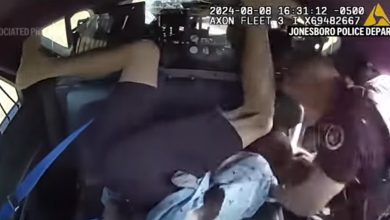
The recording that made the bargain possible is short and ugly. On August 8, 2024, Harris, a five-year veteran, was moving Billy Lee Coram, then 42, from a hospital back toward the Craighead County jail. Coram was in a hospital gown. In the moving car he looped a seatbelt around his neck. When the vehicle stopped, Harris opened the rear door, struck Coram with his fist and elbow, and shut the door against Coram’s head. A later stretch of the same tape shows an expandable baton pressed into Coram’s chest. Craighead County Sheriff’s Deputy Chris Ditto later opened the same door and asked whether the man inside was all right. The department’s own camera is the witness. Nobody has to take a press release’s word for the sequence.
Jonesboro Police Chief Rick Elliott fired Harris the next day, August 9, after the sheriff’s office complained and administrators watched the file. Elliott told The Associated Press he was “shocked and appalled” and that he was “not going to have it.” The department posted the recording on its YouTube channel the same day, an unusual choice in American policing, where agencies more often wait for a leak, a lawsuit, or a television station. Elliott also told local reporters the conduct looked criminal and that he had been in touch with the FBI’s Little Rock office. On August 15, 2nd Judicial District Prosecuting Attorney Sonia Hagood asked the Arkansas State Police Criminal Investigation Division to take the case.
Coram’s own condition that night does not erase the strikes, and The AEGIS Alliance is not going to pretend it does. According to the civil complaint he later filed, he had been taken to the hospital after swallowing a baggie of fentanyl, fled in a panic, and then tried to force the packet back up by gagging himself with the belt. Booking records show he had been jailed the evening before on an escape hold for another agency. A person in a hospital gown who is trying to choke himself is a medical emergency sitting in a police car. He is also a person the Constitution still covers. Harris was not wrestling an armed stranger in a dark alley. He was standing in an open doorway, on a camera he knew was running, hitting a handcuffed man.
What the report said, and what the plea kept
Hagood’s office has been explicit about the paper half of the case. After the car reached the jail, and after control of Coram had passed to detention staff, Harris tried to strike him again. None of that appeared in the officer’s report. The narrative instead said Coram “was transported with no further incident.” That sentence is why a felony remained after the aggravated-assault count was traded away. A false official story travels. It lands in a booking sheet, a use-of-force log, a prosecutor’s first look, and, later, in civil discovery. Punching a restrained man can be argued as a split-second judgment under the Graham v. Connor “objective reasonableness” test. Writing that nothing else happened, when a camera shows otherwise, is a document a jury can read without a use-of-force expert.
Criminal Investigation Division agents arrested Harris on January 21, 2025, after he turned himself in at the Craighead County Sheriff’s Office. The charging sheet listed aggravated assault, the false-report felony, and third-degree battery. Bond was $15,000. He posted it and left the same morning, then appeared before Judge Ellington that afternoon. The case never reached a jury. At the November plea, prosecutors described the conduct as unacceptable and also noted that Harris was a first-time offender with no prior criminal history, a factor Arkansas courts are required to weigh. Craighead County NAACP chapter president Shamal Carter said the charges showed that no officer is above the law. Local television added a detail the plea hearing did not erase: Harris had been suspended in 2022 over excessive force during an arrest at a nightclub. A suspension is not a conviction. It is a record that the department already knew force was a problem with this officer before August 2024.
Some local write-ups described the probation term as 36 months, with jail and house arrest treated as conditions of that shorter period. The Arkansas State Police account, carried by the Northwest Arkansas Democrat-Gazette and by KATV, described four years of probation on top of the 120 days of confinement. The AEGIS Alliance is using that figure. Thirty days in a county jail is a short stay next to a twelve-minute video.
A civil file, and a death that is not this beating
The criminal case is not the only docket with Harris’s name on it. Coram sued Harris, the City of Jonesboro, and Chief Elliott in federal court, alleging Fourth and Fourteenth Amendment violations. Public reporting around the January 2025 arrest placed a trial setting in May 2026 in Little Rock. The AEGIS Alliance has not found a published verdict, a posted settlement figure, or a dismissal order that closes those claims. Municipal liability is a different question from a state plea. A city is not automatically on the hook because one officer pleaded guilty. Plaintiffs have to show a policy, a training failure, or a pattern supervisors had reason to expect. Elliott’s same-day firing and the public video will be exhibits for both sides: evidence that the chief rejected the conduct, and evidence that the conduct happened on his watch.
A separate lawsuit sits beside this one and should not be collapsed into it. Brock Austin Tyner died on May 4, 2024, after an arrest involving Harris and Officer Payton Perkins. The family sued the city, both officers, and Turn Key Health Clinics, the jail’s medical contractor. In May 2025 the estate and Turn Key described a $900,000 agreement, then withdrew the petition to approve it while a written deal was unfinished. That figure did not include the city or Harris. A December 2025 order set a trial date on the remaining claims. The AEGIS Alliance has not found a later public judgment that resolves the claims against Harris in the Tyner file. The two cases share an officer. They do not share a victim or a video.
Coram, through his lawyers in 2024, put the back-seat moment in a sentence that does not need decoration: “In the moment, I thought he was going to kill me. I’ve dealt with a lot of cops, but never one as vicious as Officer Harris. He was stone cold; he didn’t say nothing and was just hell-bent on punishing me.” A defendant’s statement in a civil case is not a verdict. It is the reason the video still circulates. People who have watched other hidden-camera files, including the teenager who wired her own room because adults would not believe her, already know what a recording does to a denial. Jonesboro did not wait for a stranger to upload this one. The department published it.
Why a certification surrender is not the end of the story
American use-of-force prosecutions now have a familiar shape. Video arrives. A chief speaks. An officer is fired within a day. The violence count is bargained down, and a paper crime — the false report — is the felony that remains, because it is easier to prove than a jury instruction about “reasonable” punches. Readers who follow police accountability coverage at The AEGIS Alliance have seen the shape elsewhere, including cases in which a civil jury, not a plea, set the price of a bad arrest. Jonesboro’s version is sharper than most because the agency posted the evidence against its own employee before a prosecutor had charged him.
That speed is also why the sentence feels small to people who watched the tape. A department that calls conduct criminal on a Friday cannot later ask the public to treat 30 days in jail as a full answer. A first-time-offender discount, a dropped felony, and a permanent loss of certification are what the bargaining produced. Those are facts. They are not a moral equal to the video. The duty to intervene, the medical duty to a man choking himself with a seatbelt, and the duty not to invent a quiet transport are three different obligations. Deputy Ditto’s question at the door touches the first. The hospital gown touches the second. The phrase “no further incident” breaks the third.
Harris is done as an Arkansas officer. Coram is still the man who was in the gown. The federal complaint is still the place where any dollar figure would have to be explained. For the wider pattern, The AEGIS Alliance keeps related reporting on U.S. news and crime. The lasting exhibit is not the bond receipt. It is a door, a baton, and a report that said the ride was uneventful.