She Mailed Herself an Apple AirTag: How a Los Alamos Mailbox Owner Led Deputies to Two Santa Maria Theft Suspects

LOS ALAMOS, California — The woman who caught the thieves never published her name, and she never knocked on their door. She kept a box at the Los Alamos Post Office. The box had already been hit. On a morning when she expected it to be hit again, the mail inside included a package she had sent to herself with an Apple AirTag in it. On August 19, 2024, at about 7:17 a.m., Santa Barbara County sheriff’s deputies were called to the post office. The bait package was gone with the rest of her mail. She handed them the map instead of a confrontation. The pin sat about 16 miles away, in the 600 block of East Sunrise Drive in Santa Maria. There deputies found her mail, the package with the tracker still in it, and items they believed had been stolen from more than a dozen other people.
The Santa Barbara County Sheriff’s Office identified the two people at that address as Virginia Franchessca Lara, 27, of Santa Maria, and Donald Ashton Terry, 37, of Riverside. Both were booked into the Northern Branch Jail. Lara faced felony counts including possession of checks with intent to commit fraud, fictitious checks, identity theft, credit card theft, and conspiracy, and was held on $50,000 bail. Terry faced felonies including burglary, possession of checks with intent to commit fraud, credit card theft, identity theft, and conspiracy, plus theft-related warrants out of Riverside County, and was held on $460,000 bail. Detectives said they were still calling other victims. The sheriff’s press release is the primary account. The Associated Press, the Los Angeles Times, and CNN matched the names, the block, and the bails. The AEGIS Alliance has not found a widely posted 2025 or 2026 verdict that revises those bookings into a published judgment.
A $29 disc that did not prevent anything
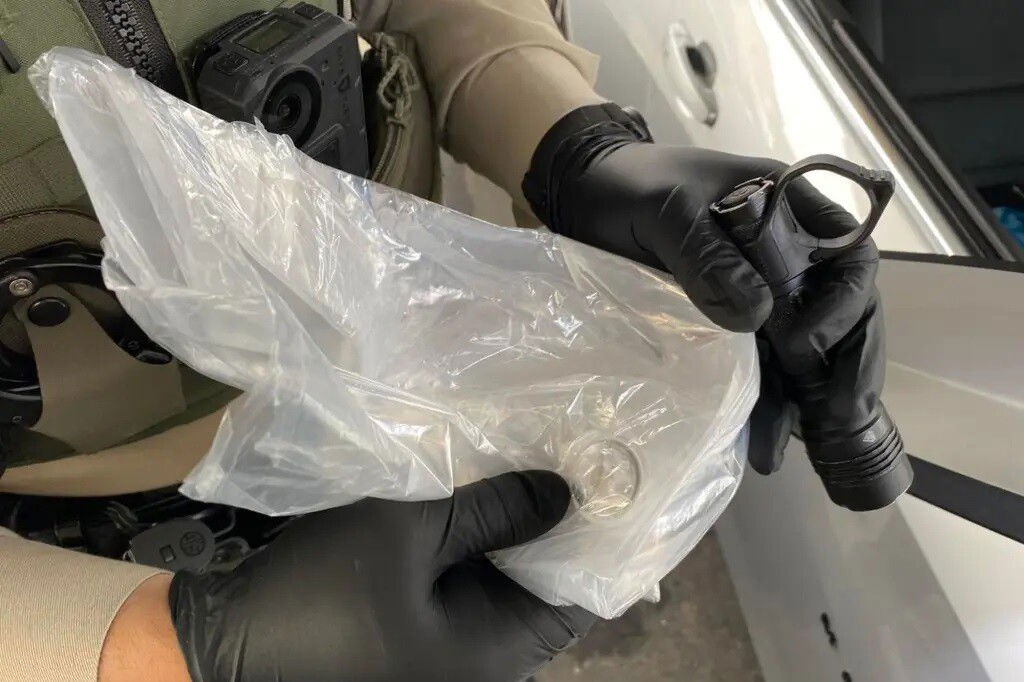
AirTags have sold since 2021 for about $29. They ping Apple’s Find My network, which is really everyone else’s nearby Apple device quietly reporting a Bluetooth beacon. The disc is a consumer gadget for keys and luggage. In this file it did police work only because the owner used it as bait in her own mail and then stopped. The sheriff’s office commended her “proactive solution” and, in the same breath, noted that she did not try to contact the suspects herself. That second sentence is the whole legal theory. A bait package you mailed to yourself is your property. Following a stranger to a driveway is a different crime scene, and it is how a theft case becomes an assault case with the original victim as the defendant.
The gadget also has a built-in warning that makes this arrest slightly lucky. Apple designed AirTags so an unknown tag traveling with an iPhone triggers an alert, and so the tag can be made to play a sound. Android phones can scan for the same beacon. A thief who uses an iPhone and who bothers to look can find the disc before a deputy does. Santa Maria’s suspects did not, or did not in time. The AEGIS Alliance is not going to invent a reason. The map simply still worked at 7:17 a.m. and for the drive that followed. The same feature is why AirTags fill stalking dockets in other counties: a tool that finds a package also finds a person who did not agree to be found. A bait envelope is legal. Clipping a tag to someone else’s car is, in states such as Florida, its own felony. The Los Alamos case stayed on the legal side of that line because the tag was inside the victim’s own parcel and the next hands on it belonged to deputies.
Local reporter John Palminteri asked the question the viral posts skipped. How did the mail leave a United States post office in the first place? The sheriff’s release does not say whether the thieves had a stolen or copied cluster-box key, a pry bar, or help from someone with legitimate access. Los Alamos is a small community in northern Santa Barbara County, not a city block with a camera on every pole. Cluster-box units at rural and semi-rural post offices are a known target precisely because they hold many households’ paper in one metal cabinet and because dawn staffing is thin. A key or a bar can empty dozens of boxes in minutes. Checks, replacement cards, and government letters come out in one handful. The AirTag did not harden that cabinet. It made the next theft visible after the cabinet had already failed.
The business model was the checks, not the package
Mail theft is not a quirky California gadget story, which is why the booking sheets matter more than the AirTag. Lara’s and Terry’s counts put fictitious checks and credit-card theft next to conspiracy. That is a pipeline, not a porch pirate grabbing a sweater. Stolen checks are often washed — the ink stripped with chemicals — or rewritten and cashed before the account holder notices a missing envelope. A cluster-box raid in Los Alamos is one node. A washed check deposited in another county is the next. The U.S. Postal Inspection Service and the Postal Service launched Project Safe Delivery in May 2023 after attacks on letter carriers and a surge in stolen financial mail. By March 31, 2026, that effort had produced 3,654 mail-theft arrests and 545 robbery arrests nationwide. Complaints of mail theft from fiscal 2023 through fiscal 2025 topped 800,000. High-security blue boxes and electronic arrow locks have replaced tens of thousands of older pieces of equipment. The thefts did not stop because the locks improved.
The Postal Service’s inspector general has described the same economy in blunter numbers. In the six months ending March 31, 2026, OIG investigations returned more than $91 million in fines, recoveries, and restitution, and the office has said its mail-theft work closed more than 730 investigations in the first half of fiscal 2026, with more than $10 million tied to those cases. Between April and September 2025 the same office closed 778 mail-theft investigations. One Alabama ring the inspectors described stole more than $17 million by recruiting a postal employee to pull business checks from post-office boxes and sell them. A Bethesda case attributed about $2.8 million in damage to more than 1,600 victims. Los Alamos is not those cases. It is the same market at the scale of one morning and one residential block. Deputies said the pile on East Sunrise Drive looked like other people’s mail, not a single angry neighbor’s package. A stolen sweater is a theft. A stolen checkbook is a business model.
Authorities still tell residents to collect mail promptly, to use Hold Mail when they travel, and to leave the arrest to law enforcement. Those tips are older than AirTags, and they are still the advice that does not depend on a $29 disc. What changed in Santa Maria is that a complaint became coordinates. Informed Delivery, a locking residential box, and signature confirmation on anything that proves an identity are the boring tools that work before a theft. A tracker is the tool that works after one. The AEGIS Alliance has covered the overlap of cheap sensors and financial crime on the crime desk, including the FBI’s warning on phantom-hacker scams that empty bank accounts and the IRS-impostor phishing wave Microsoft traced to tens of thousands of inboxes. A mailbox and an inbox are different doors into the same checking account.
The lesson from East Sunrise Drive is narrower than the posts that called the woman a vigilante hero. She treated the next envelope as evidence. She called the sheriff when the pin moved. She did not go to the door the pin pointed at. That is why this file ends in a jail intake, with one suspect held on $50,000 and another on $460,000, and not in a confrontation on a driveway. The larger check-fraud problem did not recede when two people were booked. Project Safe Delivery’s arrest totals show a national campaign still running two years later. Los Alamos lost one morning’s take. The cabinet at the post office, and the question of how it was opened, remain the part of the story a Bluetooth beacon cannot answer. For related reporting, see The AEGIS Alliance U.S. news coverage. A disc the size of a coin did not fix the mail. It told deputies which block to drive to.