Kelvin Ellis Jr. Spent His Last Dollar on a Millionaire He Mistook for Homeless, Then Kept Showing Up to Help Baton Rouge

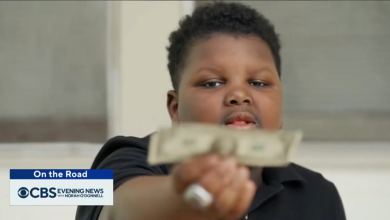
Kelvin Ellis Jr. was nine, a third-grader in Baton Rouge, and the bill in his fist was the last of a twenty-dollar reward for good grades. He had already spent nineteen dollars. Outside CC’s Coffee House he saw a man in mismatched clothes, eyes closed, standing on the patio, and he decided the man was homeless. He walked over. “Excuse me sir, are you homeless?” he asked. “‘Cuz if you are, here’s a dollar.”
The man was Matt Busbice, then 42, who had built and sold outdoor companies worth hundreds of millions of dollars with his partners. He co-founded Wildgame Innovations and runs BuckFeather, a sporting-goods store in Baton Rouge. A fire alarm had emptied his condo that morning. He pulled on whatever was nearest, found no fire, and crossed the street for coffee. On the patio he stopped to say a morning prayer he had skipped. A security camera caught the rest. Busbice opened his eyes, saw a child about his height coming at him with a clenched fist, and braced for a fight. The fist opened into a dollar.
CBS News recorded both of them. Kelvin said he had always wanted to help a homeless person and finally had the chance. His father, Kelvin Ellis Sr., was next door in an eyeglass shop. Busbice bought the boy a snack, found the father, and asked to stay in touch. He later gave Kelvin forty seconds inside BuckFeather. The boy left with clothes and a bike that The Advocate later priced around $2,000. Kelvin told Steve Hartman the spree was not the point. “Joy, because I helped someone,” he said. Give something away, he added, and you feel like you’ve got a lot of things from it.
A Year Later, the Dollar Was Still the Story
National television froze the morning as a shopping montage. The Advocate’s April 14, 2025, check-in, built around a visit to the Ellis porch on April 2, showed a slower plot. Kelvin, by then ten, and Busbice had kept texting and meeting. Over Christmas break they went to a Winn-Dixie hoping to pay for strangers’ groceries without being noticed. People recognized them, which ruined the anonymity and made the memory anyway. For Kelvin’s birthday, Busbice took him to Barnes & Noble and told him he could pick anything in the store. The boy walked the aisles, weighed the options, and chose a King Kong figure that fits in a hand. Busbice, thinking of the bike, asked about a bigger prize. The small monster was the choice.
Busbice has said the first thought, when a child mistook him for someone with nowhere to sleep, was how bad he must have looked. “It hits you, and it humbles you.” He also said that when the dollar came out he thought there was hope in the world. In Baton Rouge he is still stopped by people who know the clip. Some of them hand him a dollar as a joke that is also a thank-you. He launched Accubow, a company built around virtual-reality archery training, and he has had Kelvin in the Perkins Rowe shop learning how to talk to a customer about a bow. As of that April interview, the plan for summer 2025 was a camp at Tara Wildlife in Mississippi, a hunter-safety certificate, and, if the family agreed, a hunt on a family ranch. The AEGIS Alliance has not seen a later public confirmation that the camp happened. The plan itself is the evidence that the relationship did not end at the register.
Both families had, by April 2025, sat separately with Brian Sleeth, executive director of the Christian Outreach Center of Baton Rouge, about helping people who are actually without housing. Sleeth said he looked forward to plugging them into work the center already does, and that it mattered that someone Kelvin’s age wanted to contribute. Sleeth also described the reverse experience: losing friends because people do not know what to say when hardship is real. Kelvin’s error on the patio was visual. Busbice was not homeless. He was a rich man in the wrong shirt, praying with his eyes shut. The wrong facts did not cancel the impulse. If the man had been hungry, the dollar would have been a meal. Because the man was not, the dollar became a test nobody had scheduled before coffee.
What the Patio Camera Did and Did Not Solve
A patio camera is why the country saw it. The AEGIS Alliance has written about cameras that catch what adults would rather hide, including a 14-year-old who wired her own house to prove abuse. This tape showed a boy who did not wait for proof of need. He spent the only bill left in his pocket. Kelvin Ellis Sr. later put a theology on it. “God used my son to send a message,” he said. “If a 9-year-old kid’s willing to give his last dollar, then why can’t we as adults — as people — be more courteous to each other and love each other the way He loves us all?” The boy has stayed plainer than the sermon. His favorite memory, he told The Advocate, was the bookstore, not the parable.
Baton Rouge is not short on people who are actually outside. A forty-second run through a sporting-goods aisle does not build housing, raise wages, or staff an outreach van. Busbice asked Kelvin, in so many words, whether his heart was still aimed at a homeless man now that the man on the patio had turned out not to be one. The meetings with Sleeth are the adult attempt to answer yes. They are also unfinished. Separate conversations are not a program. They are a door that, as of spring 2025, had not yet been walked through together.
The clip keeps circulating years later because it is short and the line is complete. “If you’re homeless, here’s a dollar” does not need a foundation or a brand deck. It needs a bill and a person who looks like he might need it. Most adults walk past that possibility because they do not want to be wrong, scammed, or late. A third-grader who had already spent nineteen dollars of a twenty-dollar grade reward did not have those excuses yet. He was wrong about the biography and right about the gesture. Busbice flinched, then listened, then asked a father for a phone number instead of posting the video himself. WBRZ and CBS did the broadcasting. The adults in the original scene did the slower thing. They sat down.
The Grade, the Bike, and the Figure in His Hand
Feel-good packages usually expire. This one has a paper trail past the montage: a porch interview, a grocery store, a bookstore, a shop floor, and a nonprofit director who said he would take the help if they showed up. The AEGIS Alliance files that kind of American story on the U.S. News desk and in Activism, next to other moments when a private gesture outran the institutions around it, including a centenarian pilot who waited decades for a diploma he had already earned and a grandmother who stopped a purse snatcher herself. Kelvin’s tape does not cancel the abuse files on the Crime News desk. It shows what a child does before anyone teaches him to look away.
Readers who want a policy on a yard sign will not find one here. The run through BuckFeather solved one morning’s question: whether a child would keep the last dollar he had earned. He did not. A millionaire noticed. A camera happened to be on. A year later the boy picked a palm-sized King Kong over another spectacle, and the two of them were still talking about people who do sleep outside. The country can keep the bike. Kelvin can keep the sentence he gave Hartman. Give something away, and you feel like you’ve got a lot of things from it. That is not economics. It is a third-grader describing the only transaction that made sense to him, and then, a year on, still acting like he meant it.