Belmar Officer Ryan Braswell Put Surfer Liam Mahoney in the Sand, and a $1,410 Diversion Left the Force Question Unanswered

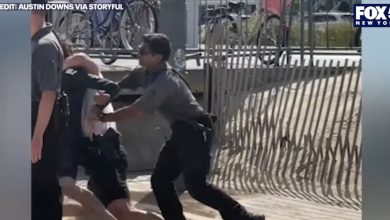
On the afternoon of August 20, 2024, a beach-badge check at 19th Avenue in Belmar, New Jersey, ended with Class II Special Officer Ryan E. Braswell and a second officer driving surfer Liam Mahoney into the sand. Bystander video, posted by Austin Downs, shows Mahoney in a wetsuit, a woman off camera insisting his badge is on his bag, and a forearm across his neck before the takedown. A voice yells, “Get off of him.” The AEGIS Alliance kept the clip on the Police Accountability desk because a summons for an unpinned tag is ordinary summer work on the Shore. A chokehold is not.
Mahoney was 28 that week, a Belmar native then living in Junction City, California. Belmar requires a badge from Memorial Day through Labor Day under N.J.S.A. 40:61-22.20, a statute that lets oceanfront towns charge for access and spend the money on lifeguards and the seasonal officers who walk the sand. Daily tags that summer were widely described as about $12. Surfers have argued for years that a metal pin tears a wetsuit, so they clip the badge to a bag. Downs wrote that Mahoney’s tag was on his gear. On the phone video a woman says, “His badge is right here.”
Two Videos, Two Stories, One Takedown
Chief Tina Scott released about six minutes of Braswell’s body-worn camera on August 22, 2024, after the bystander clip had already traveled. The department’s line was that Mahoney was not arrested for a missing pin. He was arrested, Scott said, because he obstructed an investigation by refusing to give his name after being told he was not free to leave. On the recording Braswell explains the badge rule, says he will write a summons, and asks for identification. Scott said Mahoney answered that he did not need a badge to cross the sand to the water, declined to identify himself nine or ten times, and walked off. Officers then took the board, told him to put his hands behind his back, and took him down when he did not. A strike lands on his back during the struggle. Children nearby are crying in the bystander cut.
The Asbury Park Press, ABC7 New York, and NBC New York ran both versions. The police cut makes a wet man look argumentative. The phone cut makes the force look wildly out of scale for a recreation ordinance. Both can be true. Municipal officers in New Jersey write badge tickets all summer. They do not usually put a surfer on his face to do it. The department said it would review the arrest under the state attorney general’s use-of-force guidelines. No public internal-affairs finding that names Braswell has been posted.
The charges filed in Belmar Municipal Court were disorderly conduct, obstruction, resisting arrest, and the borough badge ordinance. The first three are disorderly persons offenses in New Jersey, not indictable crimes. Braswell’s title matters. A Class II special officer is a seasonal appointment. The badge and the authority to make arrests on the sand are real. The job is not the same as a full-time municipal career with the same training hours. Locals told surf outlets he had drawn complaints earlier that summer. The borough did not publish a discipline record that confirmed or killed that talk.
The Motion That Lost Before the Plea
Lawyer Cathleen Christie spent the fall and winter trying to get the case thrown out. Her theory was the Public Trust Doctrine: the wet sand and the ocean are held for the public, and a surfer walking to the water is not a customer of a recreation department. In the spring of 2025 she filed a motion that Mahoney did not need a badge at all. Belmar Municipal Court Judge Dennis Lavender did not grant it. NJ.com reported in May 2025 that Mahoney, by then 29, intended to try the case. A trial date of May 13 was on the calendar and had already slipped because he lives in California. Christie said she would press on even after the motion died. That posture lasted about three weeks.
The legal loss is the part of this story that outranks the viral still. New Jersey courts have upheld beach fees for decades. Belmar sells daily and seasonal tags and staffs special officers to check them. A doctrine argument that surfers are exempt because they are only crossing the sand was the cleanest way to turn a use-of-force video into a rule change. Lavender’s court, in the same town that collects the fee, said no. After that, Mahoney was choosing between a municipal trial in the town that employs the officer and a deal. People who have watched other low-level force cases on The AEGIS Alliance US News desk will recognize the math.
What $1,410 Actually Bought
On June 3, 2025, Mahoney stood in front of Lavender and took a deal. The reporting split is real and should stay visible. NJ.com wrote that he pleaded guilty to the badge ordinance and entered a one-year diversion under which disorderly conduct, obstruction, and resisting arrest would be dismissed if he stayed clean. During the allocution, the same story said, he told the judge he had not been displaying a badge, that he had believed he did not need one, and that walking away and keeping his hands in front amounted to obstruction and resisting. Lavender accepted the plea. NJ.com put a combined $1,410 fine on the three disorderly-persons counts and a separate $57 badge fine.
The Asbury Park Press, quoting court administrator Patty White two days later, described a broader plea: guilty to disorderly conduct, obstruction, resisting arrest, and the ordinance, with fines and costs for the whole package totaling $1,410, and with the disorderly-persons counts dismissed if he finished a year of probation. Patch published the same total from White. The operational result the court administrator described is the one that matters for the file. He paid. The more serious counts were parked on a one-year diversion. The badge violation was admitted. Braswell was in the courtroom. Nobody announced a suspension.
A year of diversion that began in early June 2025 would have run into June 2026. No news report and no public docket note of a violation, a revocation, or a civil complaint against the borough had surfaced by late September 2026. That silence is not a certified dismissal order. It is the absence of a second chapter. The video did not close. It is still the thing people find when they search the town’s name.
A Revenue Ordinance With a Neck Restraint Attached
Belmar is a badge town on purpose. The borough’s recreation budget depends on people paying to sit on sand the ocean already reaches. Courts have said the scheme is legal. Legality is not a use-of-force policy. New Jersey’s attorney general has rewritten force rules for years after deaths and after the 2020 protest wave. Seasonal special officers sit in a thin slice of that policy. They are armed enough to arrest. They are assigned to quality-of-life rules that elected officials also treat as income. When the subject is a surfer who will not hand over a name, the collision is built in. Identify yourself or we take you down. The body camera then becomes the press release.
A Change.org petition to decriminalize beach access cleared roughly 1,400 signatures in days. The Jersey Shore chapter of the Surfrider Foundation called the video disturbing and said badge rules should not be enforced with neck restraints. That is how a local ordinance becomes a national force story. The internet does not watch the summons. It watches the sand. Mahoney’s words in court narrowed the badge dispute: he was not displaying one when Braswell walked up, and he thought the law did not require one for the walk to the water. A summons ends that argument. A forearm does not.
The AEGIS Alliance has watched the same shape on other tapes that are not this case. An Inglewood driver who punched a firefighter in Gardena is a different set of facts. So is the handcuffing of an 8-year-old in Florida and the Ohio woman tasered at a football game over a mask. The through line is a low-level rule, a camera, a takedown, and an agency that asks the public to call the force reasonable.
The Record Without the Rally
Belmar never released a named internal-affairs disposition. Monmouth County prosecutors did not announce an independent review that produced public discipline. Braswell’s name remains on the original complaint. The borough still sells badges. The 19th Avenue break is still a surf spot. Summers of 2025 and 2026 passed without a second viral clip of the same officer in the same town. That is not a finding. It is a quiet season.
People who want a civil-rights lawsuit out of every viral arrest will not like this file. People who want every officer defended because a civilian talked back will not like it either. The record is small. A special officer put a surfer on the sand after a badge argument. The department said the offense was walking away. A judge rejected the theory that surfers do not need tags. The surfer paid on the order of $1,410 and took a year of diversion. The officer was not publicly fired. That is the case. The AEGIS Alliance is leaving the Belmar tape in the accountability stack because beach-town special officers still carry cuffs, and the next argument over a pin will be filmed again.