Syrian Women Burned Their Burqas and Men Shaved Their Beards as Raqqa Celebrated the Fall of ISIS

Footage of women burning their burqas and men shaving off their beards as Syrians celebrated being liberated from the Islamic State of Iraq and Syria (ISIS) near Raqqa spread rapidly across social media. The scenes, captured in displaced-persons camps and newly freed districts, became some of the most striking images of the campaign to dismantle the group’s self-declared capital.
Under the four-year reign of terror imposed by Daesh, women were forced to wear burqas and men were ordered to grow beards. The terror group seized the city in 2014 and declared it the “capital” of its so-called caliphate, a claim that drew years of airstrikes from a U.S.-led coalition, Syria, and Russia, leaving large parts of Raqqa in ruins long before the final battle.
By the summer of 2017, U.S.-backed fighters had breached the militants’ defenses, seizing the last road leading into Raqqa before pushing toward the center to cut off the terror group’s Syrian stronghold. An estimated 100,000 civilians were trapped inside the city, used as human shields by the roughly 2,000 to 3,000 Daesh fighters who remained, while the Syrian Democratic Forces (SDF) worked to move civilians to safety.
In a video released by the People’s Protection Units (YPG), women were filmed pulling off the black robes and burqas the militants forced them to wear and setting them alight while cursing the group that had ruled them. Many had wrenching stories: one woman said ISIS had killed her son for refusing to pray; another said the militants had burned her father. “Burn these,” one shouted through tears as she stamped on a pile of discarded coverings. Nearby, men lined up for a barber. “Cut it all off, just to spite them,” one told the barber as years of forced growth fell away.
The dress code Daesh enforced was severe. Women were required to cover their faces and bodies in loose-fitting black gowns and could be punished for something as minor as carrying a brightly colored bag, while men were pushed toward an “Afghan-style” appearance that helped the group’s fighters blend into the civilian population. A year earlier, residents of Manbij had staged near-identical scenes, burning veils and shaving beards after the SDF drove the militants out of that city.

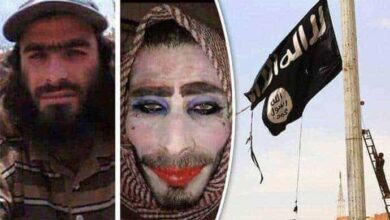
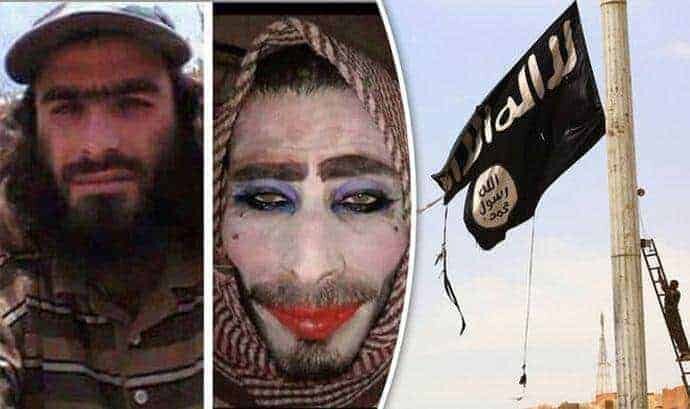
As civilians celebrated, retreating ISIS militants resorted to female disguises in a desperate effort to hide their faces and escape the frontline. Some simply pulled on a burqa; others applied makeup. As the group’s territory collapsed, many were caught while attempting to flee. The Sunday Express reported on one such case:
“The Jihadi had powdered his face, applied obscene amounts of purple eye shadow with thick black eyeliner, plucked and heavily filled in his bushy eyebrows, drawn on some beauty spots and finished the look with painted on red lips.”
“He was also wearing a headscarf to try and make his outfit look more authentic. But the fanatic had overlooked one crucial part of his look – he had forgotten to shave off his beard and moustache – an immediate giveaway that he was not a real woman.”
The celebrations marked the beginning of the end for ISIS in Raqqa rather than the finish. On October 17, 2017, after the militants’ last holdouts were cornered in the city’s sports stadium — a site they had turned into a notorious prison — the SDF declared that it had taken full control of the city. Three days later, on October 20, U.S. Secretary of State Rex Tillerson hailed the liberation as a milestone for the 73-member global coalition fighting the group, even as a coalition spokesman acknowledged that pockets of fighters and an estimated 100 holdouts likely remained.
Victory came at a devastating cost to the civilians the campaign was meant to free. The monitoring group Airwars estimated that during August alone, coalition munitions struck the city roughly once every eight minutes, with the bombardment intensifying through September and October. By the time the fighting ended, the UK-based Syrian Observatory for Human Rights estimated that around 80 percent of Raqqa lay in ruins. Airwars put the civilian death toll from coalition strikes at more than 1,300, while local monitors counted over 1,800 dead. Human Rights Watch’s terrorism and counterterrorism director Nadim Houry described the scale of destruction in the city center as astounding, and pressed an uncomfortable question that the coalition has largely avoided: what moral and political responsibility does it bear for a city it had to destroy in order to retake it?
In the aftermath, the SDF handed administration to the Raqqa Civil Council, a body of local residents tasked with clearing unexploded ordnance, recovering bodies, and beginning a reconstruction effort that officials warned could take years. Civilians were barred from returning to the city center for months as crews worked through booby traps left behind by the militants, and basic services — electricity, water, hospitals — remained scarce as no single party stepped forward to fund the rebuilding. For the residents who burned their burqas and shaved their beards in defiance, freedom from Daesh was real, but it arrived amid the rubble of the place they once called home.
What Became of the City They Freed
The women who burned those burqas did not get a quiet peace. On December 8, 2024, Bashar al-Assad’s government collapsed and Ahmed al-Sharaa took power in Damascus. The SDF, the force that had taken Raqqa from ISIS, held the city until January 18, 2026, when Syrian government troops and allied tribal fighters entered central Raqqa at al-Naeem roundabout. A U.S.-mediated ceasefire on January 30, 2026 set terms for integrating SDF units into the national army and transferring administration of Raqqa and Deir ez-Zor to Damascus. Residents reported 24 hours of electricity for the first time in more than a decade. ISIS remnants remain a threat in the camps and deserts around the city.
For more of our coverage of the war against ISIS, including a first-person account from the #OpISIS years, see our International News section.