A Red Oak Valve Left Open Over a Weekend Killed 749,242 Fish, and Iowa Settled for Less Than the DNR’s Own Price

The Iowa Department of Natural Resources priced the dead at $225,992.82. The state settled for $100,000. Half of that settlement was not even a penalty. That arithmetic, more than the photographs of fish on a bank, is why a grassroots group sued the cooperative that left a valve open.
The release started in Red Oak, in Montgomery County, over the weekend of March 8, 2024. NEW Cooperative, a farmer-owned grain, feed, and energy business based in Fort Dodge, kept a roughly 500,000-gallon tank of urea ammonium nitrate at its Red Oak site. The product is sold as UAN-32, a 32 percent nitrogen solution. In cold weather it can crystallize. Employees had spent days trying to clear a blocked distribution line that runs from the tank to the truck-loading area. When they left on Friday, March 8, the line was still clogged and a valve on it was open. The co-op has said it does not usually staff that site on weekends at that point in the year, with planting still more than a month off.
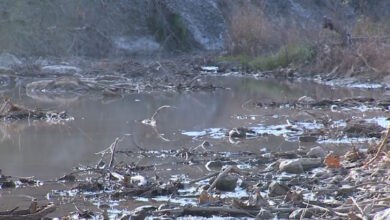
A warm weekend did the rest. The plug thawed. Fertilizer poured out of a tank that was itself ringed by a containment barrier and onto a gravel lot, through a storm drain, into a ditch, and through a pipe in the levee. Nobody was there to shut it. NEW employees found the release at about 5:30 a.m. on Monday, March 11, and used soil to block the ditch. By then the company and the DNR were talking about roughly 1,500 tons, about 265,000 gallons. A lawsuit filed later put the figure at a minimum of 266,929 gallons. The chemical had already entered the East Nishnabotna River.
A ledger with species on it
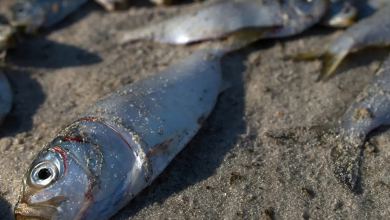
DNR fish-kill event 1045 is the cleanest public count. Investigators estimated 749,242 fish dead along 49.80 miles of the East Nishnabotna and Nishnabotna, with the damage continuing into Missouri and ending near the Missouri River. A federal pre-assessment by the U.S. Fish and Wildlife Service measured the contaminated reach at 60.39 miles. The DNR called it the largest Iowa fish kill in at least a decade and the fifth-largest on record. Cold water and low flows had already thinned populations. Officials said the toll could have been worse in a warmer, fuller river.
The species table is more honest than a round number. Minnows, shiners, dace, and chubs accounted for 707,871 of the dead. There were also 14,500 carpsuckers, 9,255 common carp, 7,681 channel catfish, 6,654 diploid grass carp, 1,542 suckers, 935 green sunfish, 264 flathead catfish, 201 goldeye, 199 sauger, 69 largemouth bass, 67 silver carp, and 4 buffalo. Conservation officers found dead frogs, snakes, mussels, and earthworms on the same stretch. The DNR valued the fish at $225,992.82 and logged $3,510.29 in investigation expenses. Channel catfish, the fish people actually drive to a river to catch, made up a large share of the dollar figure even though they were a small share of the bodies.
UAN-32 does not poison a river as fertilizer sitting in a tank. In water it breaks down into un-ionized ammonia and carbon dioxide. Un-ionized ammonia is on the order of 100 times more toxic to fish than the ionized form. Concentrations around 1 milligram per liter can kill. The Environmental Protection Agency’s acute criterion for total ammonia nitrogen sits at 17 milligrams per liter. Field crews told the public to stay off the affected reach and not to eat the dead fish. Ammonia readings fell in the following weeks. A heavy rain in May washed more residue off the site anyway. At Riverton, where the two branches of the Nishnabotna meet, residents were told the smell was strong enough to keep people indoors.
A fine cap that has not moved since 1992
Discharging this material into a waterway without a permit violates Iowa law. The DNR’s own administrative penalty is capped at $10,000, a ceiling that has sat there since 1992. The Environmental Protection Commission referred the case to the attorney general because $10,000 against a quarter-million-gallon release would have been a rounding error. On July 24, 2025, Attorney General Brenna Bird announced a consent decree in Montgomery County. NEW Cooperative agreed to a $50,000 civil penalty and another $50,000 for a supplemental project with the Montgomery County Conservation Board, money aimed at habitat work, controlled-burn equipment, and native trees. The company accepted a three-year statewide injunction against further water-quality violations. It admitted the violations in two paragraphs of the state’s petition, and only for purposes of that settlement. The decree did not order new containment on the truck-loading line, remote shutoff valves, or weekend staffing. After three years the company can ask the court to lift the injunction.
The cooperative said the weekend was the first time in its 50-year history that it had to trigger its emergency environmental plan, and that it remains “dedicated to being good environmental stewards.” It also said it had cooperated with state and federal regulators and that remediation and a natural-resource restoration plan were still underway. Neighbors did not hear stewardship. They heard a number that did not reach the DNR’s own fish valuation, let alone the frogs, the mussels, the downstream smell, or the catfish that were smaller than they used to be when biologists sampled the river again in September 2024.
The lawsuit the settlement did not prevent
Nishnabotna Water Defenders formed in the aftermath. The group put up a billboard near Avoca in September 2025, dead fish staring out above the line “know what you drink,” and started asking people to test their own water for nitrate. In March 2026 it sued. The petition, e-filed March 10 in Iowa District Court for Montgomery County, names nuisance, negligence, and trespass, and it demands a jury. It asks for the value of the lost natural resources, containment barriers and remote shutoffs at the cooperative’s chemical sites, and a permitting regime that would keep watching. Attorneys James C. Larew of Iowa City and Carrie La Seur represent the group. La Seur has called the case about more than one spill. Larew has said citizens are doing the work agencies “should be doing, but too often are failing to do.”
When reporters called that week, NEW Cooperative said it had not yet been served and would not comment on a suit it had not read. It repeated that it took the 2024 release seriously. At the defenders’ first annual meeting in Atlantic in early April 2026, board member Kevin Eicher said the group was still waiting for the state and the company to change how these tanks are run. The organization said it had raised about $14,000 in its first year, for the lawsuit, more billboards, and water testing. A separate federal Natural Resource Damage Assessment, with Iowa, Missouri, Nebraska, and the Interior Department signed onto a memorandum, is the other open file. It is described by the Fish and Wildlife Service.
The river did not become a museum. In mid-September 2026 the National Weather Service posted flood warnings for the East Nishnabotna at Red Oak and near Riverton after heavy rain, a weather event, not a new chemical release. The gauges people watch are the same ones that carried ammonia in March 2024. Recovery and flooding are different facts. Both are reasons the water is not an abstraction in Montgomery, Page, and Fremont counties.
Iowa’s administrative fine cap is the policy detail that made the consent decree look small before any judge signed it. A $10,000 ceiling from 1992 cannot price a kill the state’s own biologists valued at more than $225,000, and a settlement that spends half its cash on a county project rather than on the pipe that failed does not install a shutoff. The DNR’s public ledger is fish-kill event 1045. The citizens’ case is summarized by the Iowa Capital Dispatch. For a different American river hit by a pipe failure, see The AEGIS Alliance’s report on 100,000 gallons of sewage in the San Gabriel, and for another spill that outlived the first headlines, the Red Hill jet-fuel litigation in Hawaii. More of this reporting lives in the Environment section.