A Fort Collins Thief Returned a Stolen Baby Jesus to a Safe-Haven Firehouse With an Apology Note, Chipped Fingers, and No Charges Filed

The infant figure left Old Town Square in Fort Collins, Colorado, in the early hours of Sunday, December 15, 2024, and came back four days later through a door built for a different kind of surrender. Fort Collins Police Services posted a surveillance still, called the thief a Grinch, and asked a college town to put a name on the person in the frame. On Thursday, December 19, firefighters at Poudre Fire Authority Station 1 on East Mulberry found the statue with a handwritten note. The wording that traveled with the police photo reads, “I’m really sorry. I made a dumb mistake in the moment. It won’t happen again.” Some national copy added or dropped a word. The promise did not change. Neither did the missing name.
The operator of the downtown nativity told police a prosecution was not wanted. No arrest report, charging document, or named suspect has been posted on the case. Some fingers on the figure looked broken when it returned. Officers said they could not tell whether the damage was old or new. That small uncertainty is the part holiday coverage skipped. A returned object is not automatically an intact object, and a declined prosecution is not the same thing as a detective closing a file. The AEGIS Alliance is treating the note as evidence of a choice, not as a pardon the city was required to grant.
Station 1 is a Colorado Safe Haven site. State law lets a parent hand an unharmed newborn, 30 days old or younger, to a hospital, a standalone emergency clinic, or a staffed fire station, without an appointment, without identification, and without a child-abandonment charge. The hotline is 888-510-2229. The person who took the nativity figure used the civic muscle memory of that door: if you need to give something back without a conversation, take it to the firehouse. Firefighters said motion cameras did not catch the drop. The note did the talking. A plaster infant is not a newborn. Using the safe-haven porch for stolen church property borrows the anonymity the statute created for a parent in crisis. It does not inherit the statute’s immunity.
A postcard square and a date that drifted
Old Town Square is the grid Fort Collins puts on postcards, about 65 miles north of Denver, packed in December with Colorado State students and with visitors who treat the lights as an appointment. A nativity there is a civic object. Taking the infant out of it is closer to lifting a piece of a park than to walking off with a neighbor’s inflatable snowman. The “dumb mistake in the moment” line blurs that on purpose. Moments end. A figure missing from a public square for four days is a plan that had time to reverse itself.
The date is the other blur. Police described the theft as the early hours of December 15. Some national rewrites, including a New York Post item, later said the figure had been missing since December 17, which is when the department’s public appeal was moving. A two-day slip does not change the crime. It shows how a seasonal story gets sanded until the calendar matches the headline. Colorado Public Radio and CBS Colorado stayed closer to the police timeline: a still, a young-looking person in winter clothes, a firehouse return, an owner who wanted the figure more than a defendant. KKTV’s package, embedded above, walks through the same sequence without turning the note into theology.
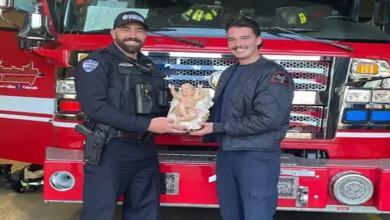
The person in the surveillance still moved like someone who wanted the object and wanted to be gone. Teen or young adult, winter coat, no sermon attached. Then the figure came back and the owner declined charges. That combination is why the case died as news and lived as a parable. Parables are not police work. A department that publishes a suspect image and then receives a statue in a box still has a theft unless a supervisor writes it off. Fort Collins did not stage a press conference with a named defendant. It staged a photograph of an officer and a firefighter holding the returned infant under station lights. That picture is the featured image on this report. It is also the entire accountability product the city chose to show.
Why these figures keep leaving American lawns
Every December a baby Jesus disappears from a church lawn, a courthouse step, or a downtown tableau. Some thefts are dares. Some are statements. Some are walks home with a souvenir. Other cities have put a named defendant on camera and taken a nativity theft to a conviction. Fort Collins never got a second chapter. The Northern Colorado version ended at lined paper and a firehouse porch. Two Christmases have come and gone since, and no court caption matching this statue has surfaced in the public record The AEGIS Alliance reviewed.
The owner’s decision not to press charges is a real right. It is also a data point about how American institutions treat holiday property crime when the property comes back and the victim would rather model mercy on the local news. Insurance is not the point. The point is whether a surveillance still plus a returned object equals a suspect interview. In this file it did not, at least not in any document released afterward. If the person in the still is a minor, a declined case may be the least harmful off-ramp. If the person is an adult who bet that a cute sentence would outrun a theft charge, the off-ramp is a gift. The public cannot tell which version is true because the department stopped talking after the photo.
“I made a dumb mistake in the moment” is a sentence built for television. It confesses without naming. It promises without a date. It converts a theft into a lesson about grace before anyone has to knock on a dorm-room door. Newsrooms accepted the conversion because Christmas copy prefers redemption to a booking photo. Preference is not a finding. The broken fingers, if they were broken in transit, are the physical remainder of a theft that the note describes as weightless.
Grace on camera, a blotter that stayed blank
Holiday crime on this desk has a range. A Santa-suited motorcyclist in Citrus County used a costume to outrun Florida troopers and never came back with an apology. A person who returns what he stole is not that rider. He is also not a hero. He committed a property crime, got his image on a police page, and chose the one building in town trained to accept anonymous drop-offs. The square got its figure in time for the last lights. Firefighters got a story for the next open house. The department got national pickup without a trial. The writer of the note stayed a silhouette.
That is a complete civic transaction if the only goal was the plaster infant. It is an incomplete police transaction if the goal was to know whether the same hands would come back for the next display. The nativity goes up again. So do the cameras. The question is whether the next note arrives before a name or after one. Readers who want the wider Christmas blotter can stack this file with other property-and-spectacle reports on Odd News, Crime News, US News, and the running News board at The AEGIS Alliance.
The infant is in storage or in a box waiting for another December. The note is in a folder or in a reporter’s photo set. The person who wrote it is still, officially, nobody. Grace is a theological category. A police blotter is not. Fort Collins chose a photograph and a victim’s mercy. Both are part of the record. So is the gap between them, including a chipped hand the redemption headline did not have room to mention.