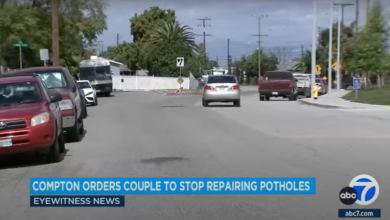

Alex and Daisy De La Rosa were not running a construction company. They were a courier team in Compton, California, Daisy at the wheel and Alex hopping out with the packages, and the streets they used for work were eating the car that made the work possible. Flat tires. A blown suspension. Arguments in the front seat about money that had just gone into rubber. Daisy later put a number on it that was worse than one bad week. “It’s not just been once or twice, it’s been a toll on our cars for five years now,” she told KABC. The hole that ended their patience was the one by their own driveway.
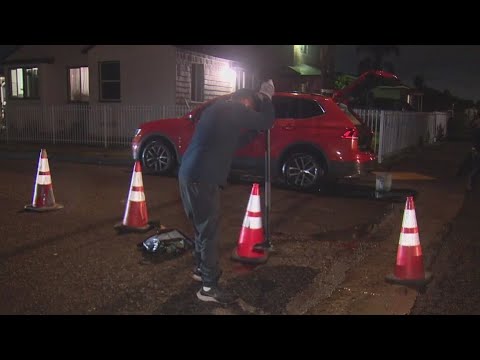
While a shop dealt with yet another tire, Alex watched asphalt-patch videos and drove to Home Depot. The first load of cold patch, tools, and the rest of the kit came to about $400. He filled the driveway hole and four more on the same street. Daisy, looking at the receipt, was the cautious one. Alex’s answer, which she repeated for cameras, was that the budget was not the point. One pothole at a time. Each bag of blacktop, neighbors later heard them say, ran about $17. The method was not a secret recipe. It was a YouTube education and a couple who could not spare another alignment.

The street started making requests
They posted the work. Compton answered. People who had been driving the same craters asked the De La Rosas to come to their block. A neighbor, Gabriel, told ABC7 he had seen the location on Facebook and showed up to help. Daisy wrote on the GoFundMe she opened once the bags started adding up: “Our entire city is riddled with massive potholes. These constant impacts are damaging our vehicles, causing flats, and ruining suspensions. We’ve pleaded with the city, but they seem overwhelmed. Many of us can’t afford these repairs.”
The campaign’s first goal was $1,000. By March 29, 2024, the Los Angeles Times counted $1,255. LAist, reporting a few days earlier, said the couple had filled 38 holes, spent about $700 of their own money, and figured the whole effort had cost around $2,000 once donated patch was included. Road Soup and American Road Patch offered material. TikTok clips showed their young children at the edge of the work. In roughly three weeks a courier couple had done more visible patching on their streets than many residents could remember the city doing on those same blocks. That visibility is what made the city pick up a pen.
A letter dated March 14
Compton’s Community Improvement Services Department sent a cease-and-desist dated March 14, 2024. The phrase that mattered was “unauthorized repairs to public roadways.” The letter said the patches raised “serious concerns” as a threat to public safety and to “the integrity of our city’s infrastructure,” and that maintenance of public streets has to follow “established regulations and procedures.” It warned of fines, penalties, and “potential liability for damages incurred as a result of” the work. The city later said it had chosen the letter over an immediate fine. The point, officials said, was to stop a repair the city might have to own if it failed.
City Manager Willie Hopkins did not pretend the roads were fine. At a council meeting he said he spends a tremendous amount of time driving Compton, “so I understand there’s potholes,” and then the sentence every public-works director keeps in a drawer: “It didn’t get that way overnight, and obviously we’re not going to fix it overnight.” He called it embarrassing that residents were doing the city’s work. He also said what they were doing was illegal. If a cold patch heaved, lipped, or hid a deeper failure, and a driver or a cyclist was hurt, both the couple and the city could be in the lawsuit. A statement from the city said it “understands the frustration felt by our residents and share their concerns regarding the state of our roads,” and told people to leave repairs to trained crews. The reporting tool it offered was the City of Compton app, a pin on a map instead of a shovel.
Hopkins’s explanation for the backlog was weather plus headcount. Heavy rain had opened more holes than the street division could close, and the public-works department was still short after the pandemic, with recruiting underway for jobs that had sat empty. Crews were still patching on a monthly cycle. None of that is exotic. Cold-laid asphalt dumped into a wet hole by an amateur can look black and firm on a TikTok and then shove out in the next storm, leaving a sharper edge than the original crater. Cities insure against that edge. They do not insure against a resident’s good intentions. The letter is the insurance department talking, even when the politics feel like a scolding.
Thank you was not the sentence they got
“We were expecting more of a thank you,” Daisy said. Alex’s version was shorter: “I feel sad. I feel frustrated.” Daisy had a theory about the timing. “Now they’re trying to stop us. Why? Because they feel embarrassed. Because they feel that we have put them on blast.” She also offered a deal the city never wrote down. If Compton could not pay a crew, it could have said so and invited people to a fill-in day the way it already invites them to beautification days. “There’s beautification days — why not a fill-in-potholes day?”
The reporting in those first two weeks does not line up into a single ending, and it should not be sanded flat. LAist quoted the couple saying they would keep going despite the letter. The Los Angeles Times, updated April 9, 2024, quoted Daisy saying they were still filling holes between deliveries and after work. In the same stretch, the couple also told reporters they were stopping, thanked donors, and pointed at a community petition. More than 150 people had signed on to the idea that citizens should not have had to buy the asphalt at all. Residents at city meetings called it a crying shame. Both things can be true in sequence: a few defiant weekends, then a halt once the liability language sank in. What has not appeared since is a second viral season. No 2025 or 2026 campaign shows the De La Rosas back out with a new GoFundMe and a fresh count of holes. The internet left. The legal theory that stopped them did not.
The famous man with a shovel
California had already watched a celebrity do a version of the same thing. In April 2023, former governor Arnold Schwarzenegger filled a wide pothole in his Los Angeles neighborhood after, he wrote, the block had been “upset about this giant pothole that’s been screwing up cars and bicycles for weeks.” His line was the one Daisy was reaching for and did not get: “I always say, let’s not complain, let’s do something about it.” Nobody sent the Terminator a cease-and-desist that stuck to the public memory of that afternoon. The De La Rosas are couriers. He is Arnold Schwarzenegger. The municipal code does not contain that distinction. The enforcement pattern does. A city can tolerate a famous patch on a camera and still decide that a working couple with a TikTok and a donation link is an unlicensed contractor on a public street.
That is the argument worth keeping after the clips fade. Compton did not claim the holes were imaginary. Hopkins admitted the embarrassment. The city’s case was that a public road is not a front yard, that a bad patch can injure the next driver, and that liability lands on the treasury whether or not the patcher meant well. The couple’s case was that five years of blown tires is its own kind of tax, paid at the tire shop, and that a $17 bag was faster than a ticket in an app. Both descriptions fit the March 2024 record. The handbook for what happens next is still the letter: report the hole, do not fill it, and wait for a crew the city says is hiring.
The De La Rosas’ three weeks sit with other moments when residents stop waiting, collected in The AEGIS Alliance’s Activism coverage and in U.S. News.