Women Burned the Burqas ISIS Forced on Them Outside Raqqa, and the City They Freed Is Still Hunting Cells That Started There

The clip did not look like a military communique. Women pulled black cloth off their bodies and threw it on a fire. Men sat down in a line and told a barber to take everything. The footage, shot in the summer of 2017 in camps and districts the Syrian Democratic Forces had just opened outside Raqqa, moved faster than any official claim that the so-called caliphate was finished. People who had lived under the Islamic State were doing, in public, the two things the group had forbidden on pain of a beating or worse: a woman uncovered, a man without the beard the hisba police had treated as a uniform.
The Independent carried the scenes as liberation footage. They were that. They were also the first honest inventory of what four years of rule had been. ISIS took Raqqa in 2014 and called it the capital of a state that ran from the Iraqi border through a belt of Syrian towns. Airstrikes from a U.S.-led coalition, and from the Syrian government and from Russia, had already broken large parts of the city before the street fighting of 2017. The dress code was not a side ritual. Women had to cover face and body in loose black. A bright bag could be an offense. Men were pushed toward an “Afghan” look that also let fighters disappear into a crowd. When the crowd got the chance, it reversed both orders at once.
By that summer, U.S.-backed fighters had cut the last road into the city. Roughly 2,000 to 3,000 ISIS fighters were still inside, and an estimated 100,000 civilians were still with them, held as shields while the Syrian Democratic Forces tried to walk people out. A video released by the People’s Protection Units, the YPG, showed women stamping on piles of coverings. One said ISIS had killed her son for refusing to pray. Another said the militants had burned her father. “Burn these,” a woman shouted. A man in the barber’s chair told the barber, “Cut it all off, just to spite them.” A year earlier, in Manbij, residents had staged almost the same scene after the SDF pushed ISIS out of that city. The Daily Beast noted the Manbij fires in August 2016, filmed by Hawar News, and pointed out why the town mattered: it sat on the road between the Turkish border and Raqqa. The Raqqa fires were the same gesture, one city closer to the capital ISIS had invented.

The Men Who Stole the Uniform on the Way Out
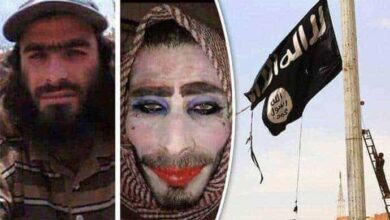
As the front moved, some fighters tried to leave inside the clothing they had forced on everyone else. A few put on a robe. At least one, caught and photographed, had gone further: powder, purple eyeshadow, heavy liner, filled eyebrows, beauty marks, red lipstick, a headscarf. The Sunday Express described the makeup in the tone of a tabloid, then landed the only detail that mattered. He had not shaved. The beard the group had made compulsory was the thing that gave him away. The photograph of that arrest became one of the most circulated images of the battle. It is also easy to misread. The joke was on a man fleeing a regime he had helped police. The women burning the same garments were not a joke. They were disposing of a rule.
The fires were the beginning of the end inside Raqqa, not the end. On October 17, 2017, the SDF said it held the city after the last ISIS pocket was pinned in the sports stadium, a building the group had used as a prison. On October 20, Secretary of State Rex Tillerson called the capture a milestone for a 73-member coalition. A coalition spokesman added the footnote the milestone buried: pockets of fighters were still in the area, on the order of 100 men. The stadium photo and the burqa fire were three months apart. Both were real. Neither was the whole city.
What the Coalition Spent to Take the Capital Back
The civilians who burned those clothes did not get a standing city in exchange. Airwars, which logs allegations of civilian harm from airstrikes, estimated that in August 2017 coalition munitions hit Raqqa about once every eight minutes, with the pace rising through September and October. The Syrian Observatory for Human Rights later estimated that about 80 percent of the city was ruined. Airwars put deaths from coalition strikes above 1,300. Local counts went above 1,800. Nadim Houry, then Human Rights Watch’s director for terrorism and counterterrorism, called the destruction in the center astounding and asked the question official language still slides past: what does a coalition owe a city it had to smash in order to retake?
The SDF handed day-to-day administration to the Raqqa Civil Council, local people tasked with pulling bodies out, marking mines, and starting a rebuild nobody would fund at the speed the ruins required. Civilians were kept out of the center for months because of booby traps. Electricity, water, and hospitals did not return because a flag had changed. Freedom from the hisba was real. It arrived in a place where the pipes were gone. That is the part of the 2017 footage a celebration crop always cuts off.
The Flag Over al-Naeem Changed Again
The women in that video did not get a quiet decade either. Bashar al-Assad’s government collapsed on December 8, 2024. Ahmed al-Sharaa took power in Damascus. The SDF, the same force that had taken Raqqa from ISIS, held the city until January 18, 2026, when Syrian government troops and allied tribal fighters entered the center at al-Naeem roundabout. A U.S.-mediated ceasefire on January 30, 2026 set terms for folding SDF units into a national army and for moving the administration of Raqqa and Deir ez-Zor to Damascus. Residents reported a full day of electricity for the first time in more than ten years. That report needs the national number next to it. United Nations data has put Syria’s generating capacity near 1.6 gigawatts, down from about 9.5 before 2011, with many districts still living on two to four hours. A full day in Raqqa was news because it was an exception, not because the grid had been rebuilt.
On January 20, 2026, Energy Minister Mohammad al-Bashir walked the al-Thawra oil field in the Raqqa countryside after government forces took it from the SDF. The visit was an inspection of wells, pipes, and a light crude that is cheaper to refine than the heavy grades, and it was a political sentence: the fields that had sat outside Damascus’s reach were being counted again as state assets. Output nationwide was still a fraction of the pre-war 400,000 barrels a day. Counting a field is not the same as pumping it.
The military map kept moving after the roundabout. In late August 2026, SDF commander Mazloum Abdi said the force would dissolve as an independent army and end its mission in that form. An Etana Syria brief dated September 30, 2026 described government security forces deploying beside former SDF patrols in the largely Arab neighborhoods of Ghuweiran and Al-Aziziyeh, with those districts moving toward full government control under the integration deal. Hasakah’s deputy governor said 4,500 SDF personnel had been absorbed into the Syrian army. Etana’s own estimate was less than half that. Damascus has talked about 20,000 to 25,000 people it wants integrated. The gap between those figures is the actual argument in the northeast: a press statement of unity, and a headcount that does not match. Agricultural banks reopened under government administration in Hasakah, Qamishli, Amouda, Al-Darbasiyeh, and Al-Qahtaniyeh, and began paying farmers for wheat. Post offices started exchanging old currency. Administration is a bank window and a wheat invoice, not only a checkpoint.
The Cell That Started Where the Capital Was
ISIS did not leave with the beard clippings. On September 28, 2026, Syria’s Interior Ministry said the General Intelligence Service and the Internal Security Forces had broken a cell that began in Raqqa and then spread into Aleppo, Idlib, and Homs. Four alleged leaders were arrested in Raqqa. Five more suspected members were picked up in the other three provinces. Explosive material prepared for attacks was seized. Initial questioning, the ministry said, tied the group to five kidnappings, to assassinations, and to planted bombs. SANA carried the announcement. The New Arab and Anadolu reported it the same day. In July, the Interior Ministry had said that over three months its forces had detained 235 people it called terrorists and had foiled seven planned ISIS attacks, including the arrest of a senior figure, Firas al-Dagher, in the south.
Raqqa was the capital of a project that no longer holds a city, and it is still a place where a cell can recruit, kidnap, and try to build a bomb. The women who burned the burqas won a specific fight against a specific dress code. They did not win a guarantee about who would fly a flag at al-Naeem, who would switch the power on, or who would still be planting charges in the same streets nine years later. Calling the 2017 fires the end of ISIS was how the coalition preferred to remember the battle. The September arrests are how the city actually continued.
The AEGIS Alliance’s file on the wider war includes a first-person account from the #OpISIS years. More of the record is in International News and Politics.