Rodrigo Duterte’s Lawyers Ask Hague Judges to Shrink a 62,000-Item Evidence Pile Before His November Crimes Against Humanity Trial

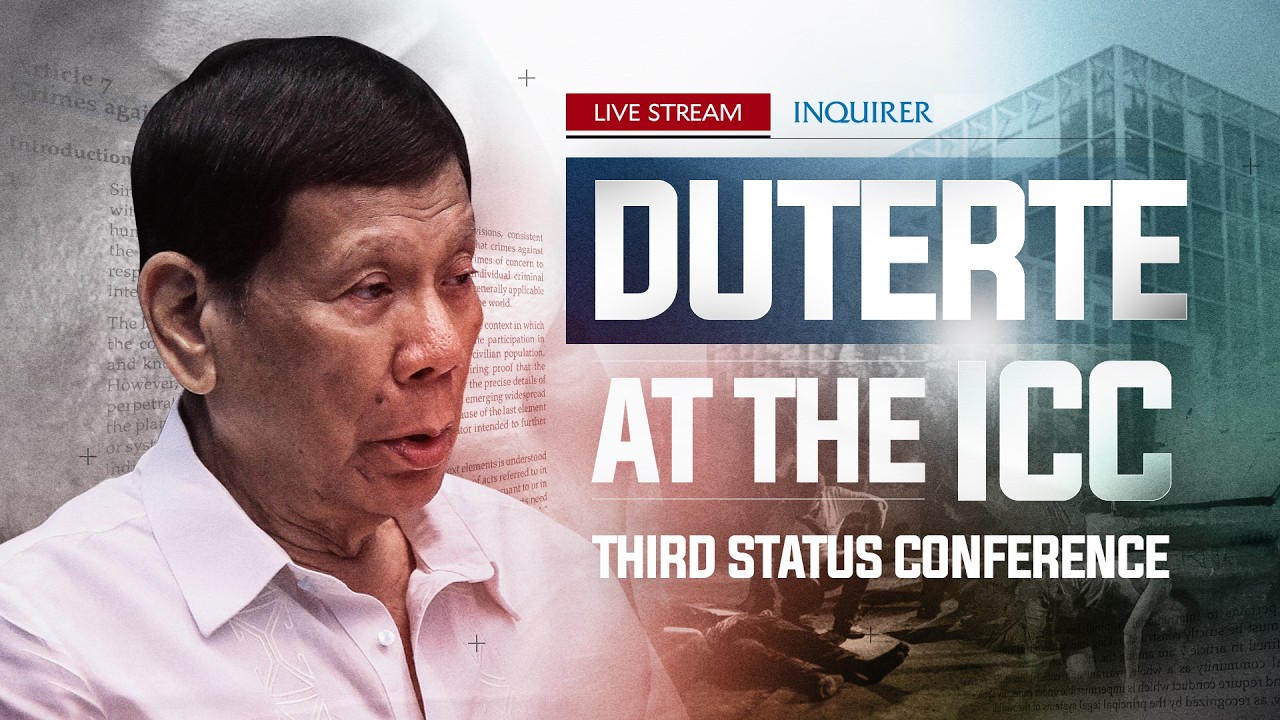
Rodrigo Duterte spent years daring the International Criminal Court to come get him. On March 11, 2025, Philippine authorities did it for the court. Police took the former president into custody in Manila on an ICC warrant tied to murders in his so-called war on drugs. The next day he was on a plane to The Hague. He has been in the ICC detention center at Scheveningen ever since. His first appearance, on March 14, 2025, was by video. He did not walk into the courtroom until September 16, 2026. Presiding Judge Joanna Korner marked the moment in a sentence that sounded almost administrative. “This is the first time that Mr. Duterte has been in this court.” By then the case was no longer a warrant. It was a trial with a date.
Pre-Trial Chamber I confirmed three counts of crimes against humanity on April 23, 2026, and committed him for trial. The counts are murder and attempted murder under article 7(1)(a) of the Rome Statute, alleged between at least November 1, 2011, and March 16, 2019. That window covers his years as mayor of Davao City and his presidency. The modes of liability the judges found substantial grounds to believe are indirect co-perpetration, ordering or inducing, and aiding and abetting, under articles 25(3)(a), (b), and (c). Trial Chamber III, constituted the next day, is Korner, Judge Keebong Paek, and Judge Nicolas Guillou. The opening is set for November 30, 2026.
Seventy-Eight Names on Paper, Thousands in the Record Around It
The charging document is built on 49 incidents and 78 victims: 76 murders and two attempted murders. Deputy prosecutors and the court’s own papers have been explicit that the list is not the death toll. It is a non-exhaustive sample meant to show a course of conduct. The same record refers to at least hundreds of other murders in the mayoral period and thousands more in the presidential period. The three counts are thematic. One covers killings in and around Davao attributed to the Davao Death Squad. One covers murders of people described as high-value targets during the presidency, blamed on a national network of police, assets, and hitmen. One covers murders and attempted murders during barangay clearance operations.
Official counts and rights-group counts have never matched, and both sit in the court file. The Philippine Drug Enforcement Agency acknowledged 5,281 people it called drug personalities killed in anti-drug operations between July 1, 2016, and February 28, 2019. A 2017 government year-end report, mixing operational deaths with homicide cases under investigation, produced a combined figure above 20,000 through late that year. When Pre-Trial Chamber I authorized the investigation in September 2021, it recorded the prosecutor’s estimate of 12,000 to 30,000 civilians killed in connection with the campaign between July 2016 and March 2019. In December 2015, while he was still mayor, Duterte told a crowd that about 1,700 people had been killed in Davao. Rights groups treated the line as a boast. Allies later tried to sand it down. Former ICC judge Raul Pangalangan has said the choice to try 78 named victims is prosecutorial strategy, not a finding that the rest did not die. Deputy prosecutor Mame Mandiaye Niang called the 49 incidents “merely a fraction” of the criminality.
A social-media claim that the court “only counted 78 dead” is false on the face of the document that invented the number. The 78 are the people the prosecution believes it can prove inside a courtroom with witnesses, not the people the night left in the street. The AEGIS Alliance has watched that trick in other files: shrink the count until the policy looks like a handful of bad nights. The drug war was a policy. Police operations and vigilante-style killings ran together, and families spent years being told their dead relatives had fought back.
Withdrawal Did Not Erase the Years He Was Inside the Statute
Duterte pulled the Philippines out of the Rome Statute. The withdrawal took effect in March 2019. His lawyers have argued ever since that the court lost the case when the country left. On April 22, 2026, the Appeals Chamber rejected that appeal and upheld an October 2025 ruling: the court keeps jurisdiction over crimes alleged while the Philippines was still a state party. The door at Scheveningen is not a kidnapping by a foreign bench. It is a treaty the country joined in 2011 and a withdrawal that does not reach backward. That is the entire jurisdictional fight in one paragraph, and the defense lost it the day before the charges were confirmed.
The confirmation hearing itself ran February 23 to 27, 2026. Duterte waived his right to attend. Judges had already, on January 26, 2026, found him fit for the pre-trial phase after three independent doctors examined him, and they refused the defense request for an indefinite delay. Fitness for a full trial is a separate question. Medical reports described limits on how long he can sit through hearings. Korner has said written rulings on further exams are coming. At the September 16 status conference, that trial-fitness decision still had not been issued. It is an argument about accommodations and capacity, not an acquittal.
A Mountain of Paper, and a Cell That Stayed Shut
The September 16, 2026 hearing was a logistics fight dressed as a rights fight. Prosecutors asked for 193 hours to question witnesses and walked in with a case file the defense called unreadable at that scale. Counsel Peter Haynes told the judges, “I hate to make this confession, but we haven’t got a prayer of reading 20,000 items of evidence by a trial date that starts at the end of November.” He described disconnected pages, missing material, and documents the team could not use. The same day, the chamber ordered Duterte kept in custody. Judges said the approaching trial raised the risks of flight and of interference with witnesses, and that the medical reports did not justify release.
Nine days later the defense put a number on the complaint. In a filing dated September 25, 2026, Haynes asked Trial Chamber III to cap the prosecution’s usable evidence at 10,000 items. The defense said the disclosed pile had reached 62,130 items, up from 5,275 at the confirmation stage, while the prosecution’s active list stood at 19,238. The filing described more than 320,000 pages and about 1,000 audio-visual items. Haynes wrote that the defense “has no ability to read this volume” and that even a skim showed much of it had “extremely limited or no relevance.” At three minutes a page, he said, one pass would take 16,000 person-hours. He argued that volume, disclosed about three months before trial, violates the right to adequate time to prepare under article 67(1)(b) and the right to a trial without undue delay. The proposed fix is a triage: a new record, including exculpatory material, by October 7, so the November 30 date and an October 30 pre-trial brief can survive.
Korner gave the defense a week to write the complaints down and the prosecution a week to answer. That calendar is the case now. Not a speech in Davao. Not a tarmac photograph in Manila. A fight over whether 62,000 items is a case or a flood, while the man accused of building a killing campaign stays in a Dutch cell. Practical details for the public, including whether the November opening will be webstreamed, were promised closer to the date. The court’s own case page still lists him at Scheveningen.
President Ferdinand Marcos Jr.’s government carried out the arrest, a rupture with the Duterte family. Vice President Sara Duterte’s threats against Marcos, covered when a Quezon City court issued a warrant over her remarks, belong to that split. They are not a defense to a crimes-against-humanity charge.
What November Has to Be For
Victims’ lawyers are in the case as common legal representatives. Their clients are not a backdrop for a fitness motion or an evidence-cap brief. If the trial opens on November 30, the prosecution will have to prove specific murders, a widespread or systematic attack on civilians, and Duterte’s role in ordering, inducing, aiding, or co-perpetrating that attack. If the defense wins a drastic cut in the file, some of those incidents may never be read aloud. If judges later find he cannot follow a full hearing day, the court will have to build a schedule around a defendant who spent years saying the court had no right to schedule anything.
The AEGIS Alliance’s view of this file is not complicated. A drug war that counted corpses as accomplishments is not law enforcement. It is a policy of killing, dressed in the language of public safety, and the court’s job is to test that policy against evidence rather than against applause. The 78 named victims are the narrow door the prosecution chose. The thousands around them are why the door was built. Readers following the hearings can stay with international news, crime news, and politics. A cap on exhibits would be a procedural ruling. It would not be a smaller graveyard.






Too bad that $hit don work for the Jews