

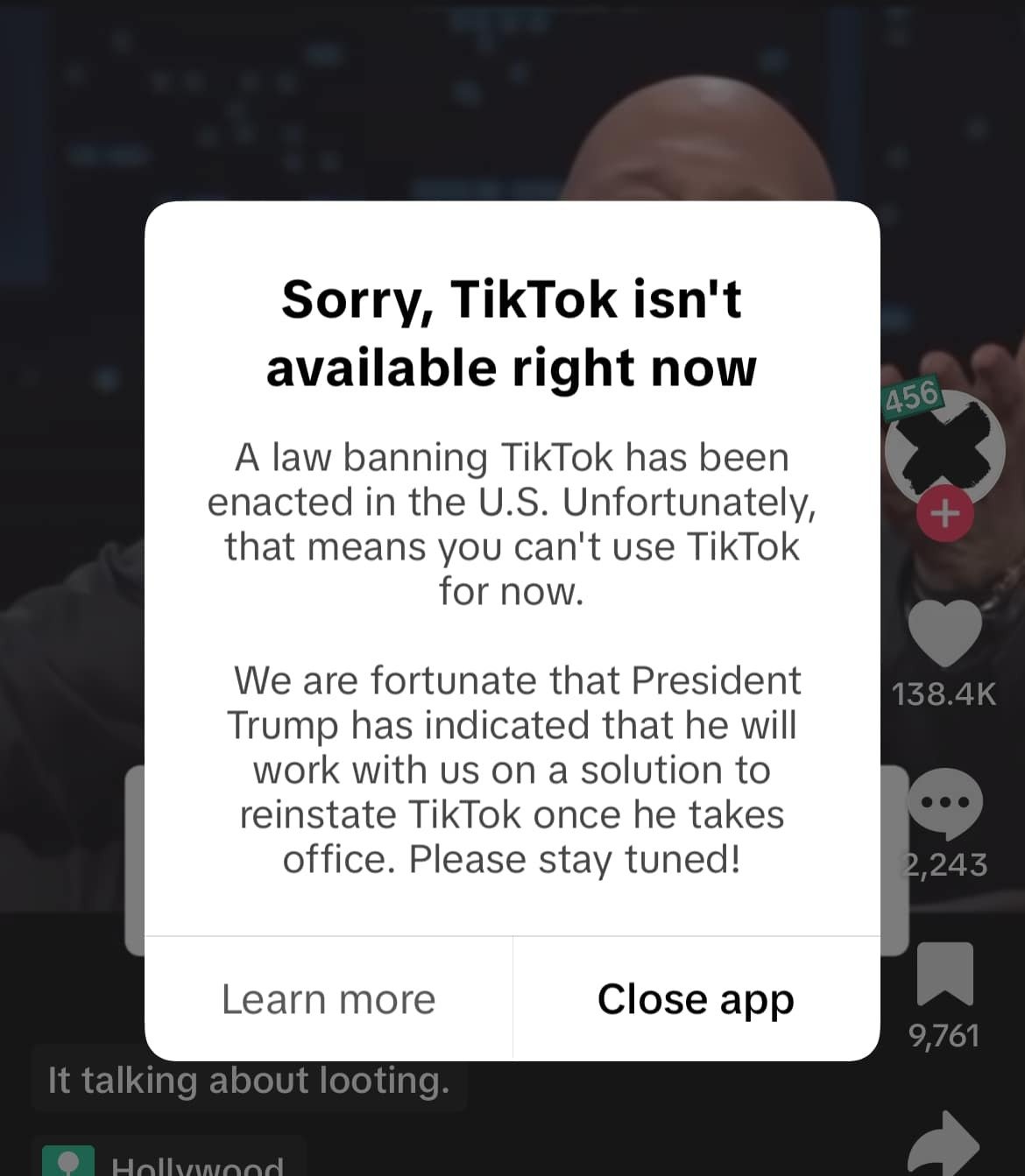
For roughly fourteen hours in January 2025, the most downloaded entertainment app in America was a dead icon. Users who opened TikTok found a notice that the service was unavailable. Apple and Google pulled it from their stores. Creators who had built storefronts on fifteen-second clips watched the till go dark. The outage was not a routing error. It was the first time a federal sale-or-ban law the Supreme Court had already declined to block became a thing a teenager could hold in a hand.
The AEGIS Alliance covered that weekend as a legal event wearing an app icon. The years that followed turned the blackout into a corporate org chart. The chart still does not settle the argument that produced the statute.
The Night the Feed Went Blank
On January 18, 2025, ByteDance took the U.S. app offline ahead of the statutory deadline in the Protecting Americans from Foreign Adversary Controlled Applications Act. The company framed the move as compliance. The political class framed it as proof that industrial policy could reach a phone. Reporting later put the blackout at about 12 to 14 hours — long enough to scare users, short enough to become a bargaining chip.
Then-President-elect Donald Trump told critical infrastructure firms his Justice Department would not treat the overnight outage as the start of a permanent ban. By January 19 the app was loading again, this time with a thank-you message aimed at the incoming White House. What Congress wrote as a hard stop became, in practice, a pause the executive branch kept signing. The companion piece on this desk, the reconstruction of the restart, covers the branding. This piece covers the law that made the restart necessary.
Five Extensions and a $14 Billion Bargain
After the inauguration, Trump signed a series of orders directing the Justice Department not to enforce the statute while a sale was negotiated. Critics on the Senate Intelligence Committee, including Sen. Mark Warner, argued those extensions had no clean basis in the text Congress passed. The statute did not say a president could keep rewriting the calendar. The White House did it anyway.
In September 2025 the administration announced a framework valuing TikTok’s U.S. assets at about $14 billion. On December 18, CEO Shou Zi Chew told staff that ByteDance had signed with Oracle, Silver Lake, and Abu Dhabi’s MGX to form TikTok USDS Joint Venture LLC. Each of those three managing investors would hold about 15 percent. Existing ByteDance-affiliated investors would hold just over 30 percent. ByteDance itself would keep 19.9 percent — a sliver under the 20 percent “foreign adversary” cap.
That cap is the entire legal trick. Congress defined the problem as foreign-adversary control. The deal answers with a percentage. Percentages are not source code. They are not access logs. They are a line in a press release that can be true and still leave the recommendation engine on a leash held somewhere else.
What Closed on January 22, 2026
The transaction closed on January 22, 2026, one day before the last enforcement deadline. The new company is headquartered in Culver City. Adam Presser, previously TikTok’s operations and trust-and-safety lead, became chief executive of the venture. Oracle was named the trusted security partner, with U.S. user data stored in domestic cloud centers. Reuters described the close as the end of a yearslong fight to keep the app in American stores. TikTok’s own announcement used the language of compliance with Trump’s September 2025 executive order.
The recommendation algorithm — the product feature every hearing treated as the actual prize — is supposed to be retrained on American user data under U.S. jurisdiction. ByteDance still owns the core intellectual property and licenses it to the joint venture. That licensing line is why the Center for American Progress and members of Congress keep asking for the full transaction documents. A press release is not a statute.
In May 2026 Sen. Ed Markey pressed the same point in letters to Presser and to Oracle’s chief executives. Four months after the spin-off, the public still could not see whether the deal severs an operational relationship with ByteDance or merely relabels it. Oracle, Markey wrote, had refused staff briefings on the actual scope of its source-code review. Advertising, e-commerce, and “global interoperability” remaining with TikTok’s global entities is not a footnote. That is how the app makes money.
The Argument That Did Not End With the Closing Memo
Supporters of the original law said the issue was never dance videos. It was a foreign parent with a legal duty to cooperate with Chinese intelligence services sitting on the behavioral graph of roughly 170 million Americans. Opponents said Washington was willing to break a communications platform it would never treat the same way if the parent company were headquartered in Menlo Park. Both statements can be true in the same week. That is why the fight survived the closing.
By February 2026, early talk of a mass user exodus looked overstated. CNBC reported that U.S. usership steadied after a turbulent rollout. Stability is not the same as independence. A feed can feel American and still be ranked by an engine whose intellectual property lives on the other side of a licensing agreement. Forrester’s read after the close was blunt: the U.S. algorithm will be trained on U.S. data, so the trends will feel domestic, and no one yet knows whether that makes the product more addictive or less culturally relevant.
The same political season produced a different platform decision that belongs in the same file. Meta dropped third-party fact-checking and reached for an X-style Community Notes model while Washington was busy deciding who may own a For You page. The through line is not China. The through line is who gets to sit between a user and the next video, post, or ad.
Creators who lived through the fourteen-hour outage learned a lesson no terms-of-service update can sand off. An app store icon is a political object. A joint venture with a Culver City address is a political object. Oracle cloud regions in the United States are a political object. The statute Congress passed is still on the books. The executive branch decided not to use it while the org chart was rewritten. That is not the same as the national-security question being answered.
The AEGIS Alliance will treat the January 2026 close as a change in letterhead until the transaction documents, the source-code review, and the advertising split are public. The blackout made the law concrete. The joint venture made the ownership chart look American. Whether the algorithm is actually out of Beijing’s reach is the question the closing statement did not answer. For the technology desk around this fight, see tech news and how other platforms have handled hidden software on the same devices.









Tiktok. An app for kids and nonces. Who gives a shit really
Now we’re unburdened from TikTok not a happy Trump supporter here. Tom Cotton and Marjorie Green need to go. Even if TikTok comes back and I’m sure President Trump can make it happen. We need to vote those two out and all the other others that supported the ban no matter how much they support President Trump and everything else they can be replaced with somebody else that will stand behind him. God bless President Trump and the USA. 🇺🇸
Plot twist…Elon wants TikTok….never saw that coming much.